
ART & CULTURE · MIAMI
Reading time: 10 minFor its fifteenth edition, Design Miami/ set exhibitors a single word to answer: water. Curatorial director Aric Chen wanted the fair to think about a resource running short, but under Friedman Benda’s mint green glass and TAKT Project’s dripping resin, the strongest booths reached for water’s slower relative instead, the erosion, crystallisation and growth that only shows itself given time. What follows is that argument, gallery by gallery, from a sisal coffee table grown in Yucatán fields to a lamp built as a private joke about an Italian painter obsessed with decay.
Design Miami/ opened its fifteenth edition on 3 December 2019 with an invitation only preview, followed by five public days, Wednesday 4 December to Sunday 8 December, in the fair’s tent beside the Miami Beach Convention Center on South Beach. Around seventy galleries from thirteen countries filled it, alongside the smaller Curio platform reserved for emerging practices, all showing under Art Basel Miami Beach’s own December dates during the city’s design week.
The fair’s theme that year was Elements: Water, set by Aric Chen in his first year as curatorial director. Chen had run the fair’s June edition in Basel before taking on Miami, and arrived with a curatorial CV built at Hong Kong’s M+ museum, where he had spent five years developing the collection that would define the institution’s design and architecture holdings. Water followed the previous year’s theme, Elements: Earth, continuing a series built around materials fundamental enough that every exhibitor could answer them from a different angle. Chen also used the week to put the theme into practice beyond the booths, partnering with the advocacy group A Plastic Planet to remove single use plastic from the fair’s own food and beverage service.

Read literally, water suggests liquidity, reflection, flow. Almost nobody at the fair took it that literally. Instead, gallery after gallery answered with the processes water actually performs on matter over long periods, wearing surfaces down, growing crystal structures, dissolving one form into another. That reading turned the fair’s fifteenth edition into something more interesting than a fair about water would usually be: a fair about time, staged through objects that looked caught mid transformation, unfinished on purpose.

Friedman Benda: Daniel Arsham’s booth as a private museum
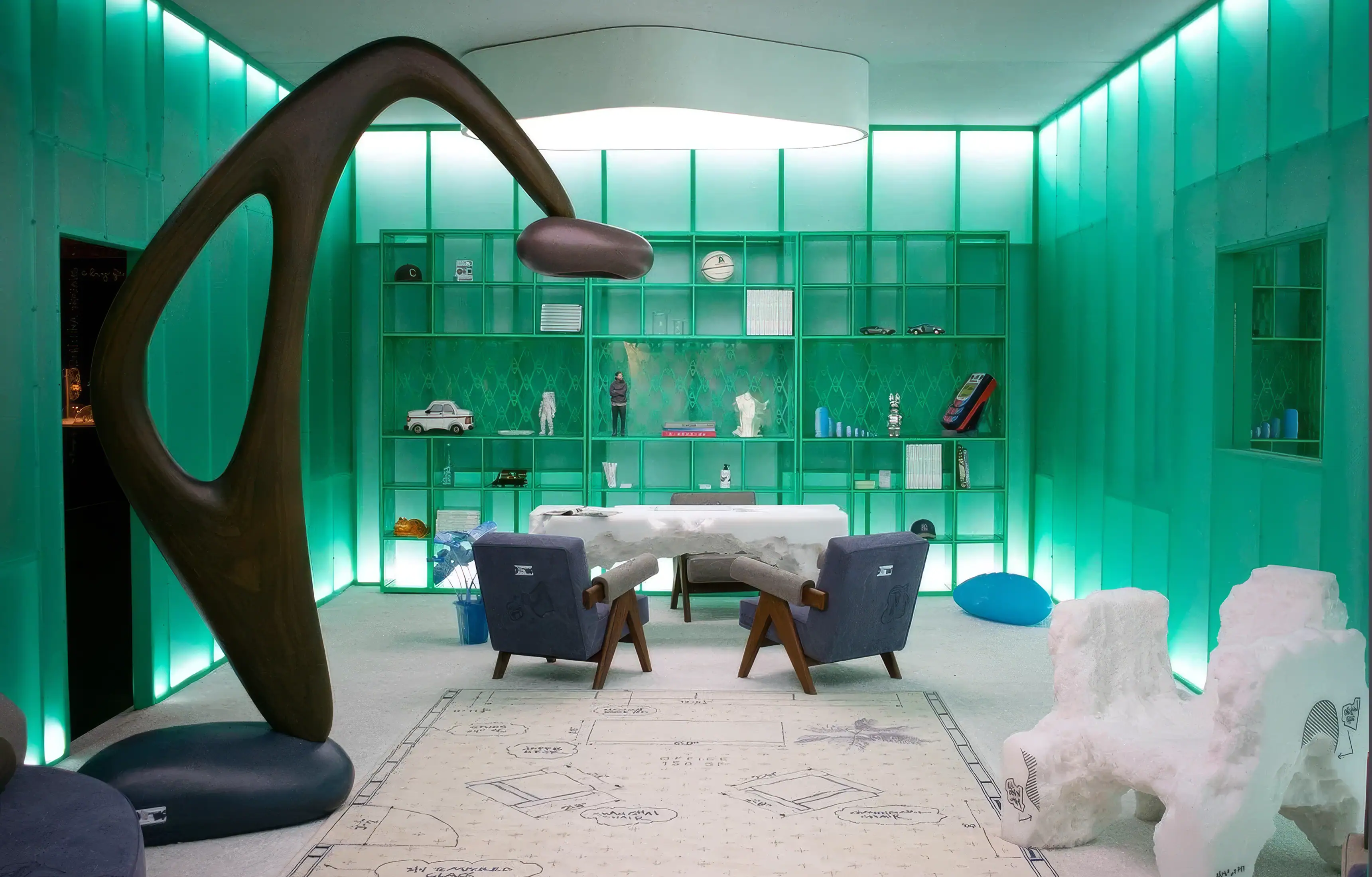
Friedman Benda gave its entire booth over to Daniel Arsham, wrapping it in panels of mint green frosted glass so that the space read as a single enclosed room rather than a conventional stand. Inside, a hand made rug reproduced the floor plan of Arsham’s own Long Island house, and the furniture arranged on it, a Cleveland Chair, a Paris Chaise Lounge, the Shanghai Chair, a Philly Lamp arcing overhead, was cast to look partway dissolved, its resin surfaces broken open with irregular missing sections rather than finished edges. A glass fronted cabinet held smaller objects and keepsakes, turning the whole booth into a kunstkammer, the cabinet of curiosities that gives a private collection the structure of a museum.

The work belongs to the wider practice Arsham calls his future relics, objects made to look as though excavated long after their own era rather than built new. What the Design Miami booth added to that practice was domestic specificity: rather than a gallery plinth, Arsham built an entire living room, complete with the chair he actually sits in and the shelving that holds his own books, and asked the fair’s visitors to walk through a home rendered as though it had already passed into archaeology. Every piece in the room sold within the first day.

AGO Projects: Fernando Laposse and a coffee table grown, not built
AGO Projects, the Mexico City and New York gallery, gave a central position in its booth to Fernando Laposse, showing a glass topped coffee table and a matching bench built from dyed, hand stitched sisal fibre pulled taut over a frame, its surface finished with the kind of dense, textured pile that reads closer to hide than to plant matter. Laposse trained as a product designer at Central Saint Martins and has spent the years since building what he calls endemic design, work in which a material’s history in a specific place, and the people who grow and process it, matters as much as the object it becomes. Sisal, an agave fibre traditionally used across the Yucatán for rope, twine and coarse textiles, is one of several agricultural byproducts he has built a practice around; the corn husk marquetry he calls Totomoxtle, developed with growers preserving heirloom Mexican corn varieties, is the material that has since carried his name furthest, into the collections of MoMA and the V&A. The sisal pieces at Design Miami 2019 belong to the same method: take a fibre most industries treat as waste or filler, and give it the attention a rarer material would usually receive.

The booth also carried ceramic work in looser, more improvisational forms, pieces whose glazes pooled and ran rather than sitting flat, continuing the same instinct that runs through Laposse’s fibre work: let the material’s own behaviour set the final shape, rather than forcing it into a predetermined one.

Galerie Scene Ouverte: porcelain spires against indigo
The Paris gallery Galerie Scene Ouverte set its booth against a deep indigo backdrop, a colour choice that did real work rather than decorative window dressing, since it let the pale, mineral surfaces of the pieces shown against it read as though lit from within. Nadège Mouyssinat’s Pseudosphère console, built from porcelain and steel, rose from its base in clustered vertical forms, somewhere between stalactites and the spires of an imagined castle, exactly the sort of geological ambiguity that fitted a fair asking exhibitors to think in terms of water’s long, slow effects on stone. William Coggin’s ceramic coffee table sat nearby, its surface built up in a way several visitors described as coralian, ridged and porous rather than smooth, another material pushed toward a state that looked grown rather than thrown.

TAKT Project: resin that hardens like ice, grown in public
TAKT Project, the Tokyo studio founded in 2013 by Satoshi Yoshiizumi after his years at Nendo, brought its installation Glow ⇄ Grow to the fair’s Curio section, having first shown the piece a few months earlier during Milan’s Fuorisalone. The work is built from clear resin dripped continuously onto a base fitted with programmed LEDs; the light itself hardens the resin as it falls, so the sculpture accumulates in real time, the way an icicle or a stalactite grows, except that here the growth is set by code rather than by gravity and mineral content alone. Yoshiizumi has described the piece as less a finished object than a design of a process, a system built to keep generating form after the studio’s own involvement ends. At Design Miami, visitors could watch the resin drip and set in front of them, which made the fair’s theme of water suddenly literal in the one booth where almost nobody expected it: not water as subject matter, but water’s own logic of freezing and accretion, reproduced in synthetic material.

Todd Merrill Studio: a lamp named for an artist obsessed with ruin
Todd Merrill Studio filled its booth with newer names working in heavily worked, hand finished surfaces, and the strongest of them was Brecht Wright Gander, showing his Yo! Burri Lamp alongside a shimmering console piece, Kismet, built from fiberglass and a colour shifting resin that reads differently depending on the angle of the light hitting it. The lamp, built from pigmented paper mache, epoxy clay, steel and plaster wrap around a hidden LED core, stands on a spindly tripod base and carries a domed, gold lined interior that glows from within its crude, deliberately unsmoothed surface.

Gander has said the piece pays homage to Alberto Burri, and the reference is worth pausing on, because it is not a passing gesture. Burri was the Italian painter who spent the decades after the Second World War building work directly from the language of decay: burlap sacks stitched and torn, plastic sheeting burned until it blistered and cracked, and, in his largest late works, a landscape of concrete deliberately cast with fissures running through it, so that the cracking itself became the composition rather than a flaw in one. Gander’s own titling for the piece, Decay and Flourish, reads as a compressed version of exactly that idea, that a surface allowed to show its own damage can end up more alive than one polished smooth. Placed inside a fair asking every gallery to answer the theme of water, a material force defined by slow erosion, a lamp built as a direct homage to an artist who made erosion his entire subject was one of the more exact answers on the floor, even though almost nobody at the fair seems to have drawn the connection explicitly.

The connection: three booths, one idea about unfinished material
That is the thread worth pulling all the way through, because it runs under booths that otherwise look unrelated. Arsham’s resin furniture is cast to look as though it has already lost material, its missing sections read as time having already acted on the object. TAKT Project’s resin gains material in exactly the opposite direction, in front of the viewer, but by the same logic of a form caught mid process rather than completed. Gander’s lamp names its own decay explicitly, borrowing the vocabulary of an artist who treated a cracked surface as the finished work rather than damage to one. None of the three galleries appears to have coordinated with the others, and none of the fair’s own framing draws this line between them. But set side by side, Friedman Benda’s dissolving resin, TAKT Project’s accreting resin and Todd Merrill’s decayed papier mache surface make the same argument in three different materials: that an object mid transformation can be more interesting, and more honest about how material actually behaves, than one that arrives at the booth looking finished.

What the fifteenth edition gave the fair
Elements: Water asked seventy galleries a genuinely difficult question, since water is not a material most collectible design actually uses. The interesting result was how rarely anyone answered it literally. Instead, the theme pushed exhibitors toward the processes associated with water rather than the substance itself, and that turned out to be the more productive brief. A coffee table grown from sisal fibre, a console built to look like a cave formation, a lamp modelled on a painter’s cracked concrete, and a sculpture that genuinely grew in front of visitors over the run of the fair, all answered the same prompt without a drop of actual water appearing anywhere in the tent.

Final thoughts
It would be easy to file Design Miami/ 2019 away as another year of the same fair, distinguished mainly by whichever word the curatorial director chose for the tent that December. That undersells what actually happened across the booths. Aric Chen set exhibitors an abstract, faintly awkward brief, water, a material almost nobody in collectible design actually works in directly, and the galleries that answered it best did so by translating the brief rather than illustrating it, reaching for erosion, crystallisation and growth instead of anything literally wet.
That is why the connection between Friedman Benda, TAKT Project and Todd Merrill Studio matters more than any single booth on its own. Three galleries, working in resin, papier mache and cast furniture, arrived at the same underlying idea without apparently coordinating: that a material shown mid transformation tells a more honest story than one presented as finished. Brecht Wright Gander’s quiet homage to Alberto Burri gave that idea its clearest single expression, a lamp named for a painter who spent his career arguing that a cracked surface was the artwork, not a flaw in one.
Design Miami/ has kept returning to Miami Beach every December since, each edition built around its own curatorial theme and its own set of galleries. The fair’s eighteenth edition, in 2022, took The Golden Age as its brief and found a different answer again, this time in natural fibre, hand tooled wood and Guadalajara ceramics. The fifteenth edition belongs earlier in that sequence, a year when a fair asked about water and heard back, from three galleries in particular, an argument about time instead.

What was Design Miami/ 2019?
Design Miami/ 2019 was the fifteenth edition of the international collectible design fair, held in a tent beside the Miami Beach Convention Center on South Beach, running alongside Art Basel Miami Beach.
When did Design Miami/ 2019 take place?
The fair held an invitation only preview on 3 December 2019, with public days from Wednesday 4 December to Sunday 8 December 2019.
Who curated Design Miami/ 2019?
Aric Chen, previously lead curator at Hong Kong’s M+ museum, directed the fair’s 2019 programme in his first year as curatorial director, having led the Basel edition earlier the same year.
What was the 2019 curatorial theme?
The theme was Elements: Water, following the previous year’s Elements: Earth, asking exhibiting galleries to build presentations that engaged with water as both a material and a diminishing resource.
What did Daniel Arsham show at Design Miami/ 2019?
Friedman Benda gave Daniel Arsham its full booth for an installation recreating his Long Island living room, with furniture cast in resin to look partway dissolved, part of his ongoing future relics practice.
What is Fernando Laposse known for?
Fernando Laposse is a Mexico City based designer trained at Central Saint Martins, known for building furniture and objects from Mexican agricultural byproducts, including sisal fibre and the heirloom corn husk marquetry he calls Totomoxtle.
What was TAKT Project’s Glow ⇄ Grow?
Glow ⇄ Grow is an installation by the Tokyo studio TAKT Project in which clear resin drips continuously onto a base of programmed LEDs, hardening on contact with the light so the sculpture visibly grows over time.
Has Design Miami/ continued since its fifteenth edition?
Yes. The fair has returned to Miami Beach every December since, including its eighteenth edition in 2022, built around the curatorial theme The Golden Age.


Leave a Reply