
Miami Art Week · Miami Beach
Reading time: 6 minFor two decades, Design Miami has been the fair where collectible design proves it can hold its own beside fine art. Its 20th edition, staged on Miami Beach in December 2024 under Glenn Adamson’s optimistic “Blue Sky” theme, felt like both a birthday and a manifesto: a reminder that the best design begins with an imaginative leap toward a boundless horizon. From a French designer’s cloud of ceramic flowers to fashion houses turning their craft to furniture, here is what made this anniversary edition sing, and why it mattered.
There is a moment, at the start of every Design Miami, when the pace of Art Basel week settles and the eye adjusts to a different register. Alongside the art fairs and their images and ideas, Design Miami deals in objects you could, in principle, live with, a chair, a cabinet, a light, elevated to the status of art and valued accordingly. For its 20th edition, the fair leaned into exactly that distinction, gathering more than forty-five of the world’s leading galleries under a theme designed to celebrate design’s peculiar optimism.


Mathieu Lehanneur
What began in 2005 as a modest satellite to Art Basel Miami Beach has become a genuinely global institution, now staging annual editions in Miami, Basel and Paris, and, for the first time in 2024, Los Angeles. Two decades on, the fair remains the essential meeting point for collectors, curators and the merely curious — and this anniversary outing, set against the light of South Beach, offered as rich a survey of contemporary craftsmanship as any in its history. Below, the pieces, presentations and ideas that lingered longest.
“Blue Sky”: The Idea Behind the Edition
Every recent Design Miami has been shaped by a curatorial director, and for the 20th edition that role fell to Glenn Adamson — the design historian, curator and writer whose fingerprints are on some of the most thoughtful design exhibitions of the past fifteen years. His chosen theme, “Blue Sky”, did a surprising amount of work for two small words.


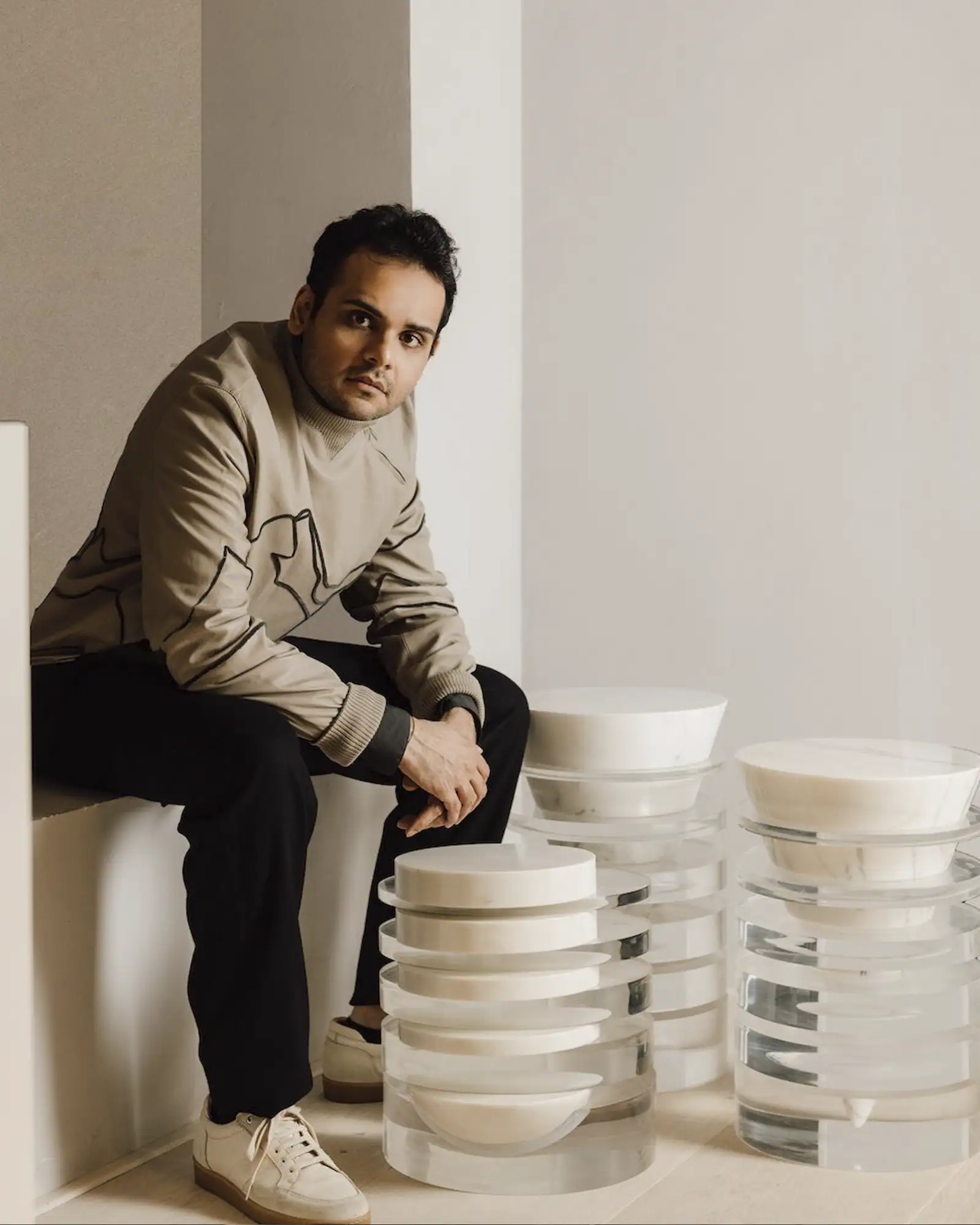
Nader Gammas
On one level, it evoked “blue-sky thinking”, the imaginative, unconstrained leaps that sit at the heart of design practice. On the other hand, it reached for something more universal. As Adamson framed it, the sky is the one thing we all share: the same expanse hangs above every one of us, regardless of who or where we are. It was a quietly hopeful proposition, design as a collective, optimistic endeavour, tilting the horizon upward. The theme rippled through the fair, from the palette of its signage to the works galleries chose to show, lending a remarkably coherent mood across the whole event.
“Design, at its best, is a form of optimism made tangible.”


Carpenters Workshop Gallery
A Centrepiece in the Clouds
Nowhere was the theme more literally realised than at the entrance, where the French designer Mathieu Lehanneur staged the fair’s Curatorial Project. His installation, Flowers Season, suspended a cascade of handmade ceramic flowers in mid-air — a frozen, weightless bloom that set the tone for everything beyond it. Around it, Lehanneur showed a range of functional collectibles, among them a dresser, a floor lamp and a cabinet, each pairing solid, sculptural mass with an impression of liquid movement. It was a fitting overture: nature, beauty and reverie translated into the vocabulary of design, and a clear expression of the show’s aspiration to lift the eye skyward.


Sarah Myerscough Gallery
Craft, Material and the Persistence of the Hand
If one thread ran through the galleries this year, it was an unashamed devotion to material and making, the sense that the evidence of the human hand has never been more valuable, or more keenly sought by collectors.
London’s Gallery FUMI, founded in 2008 by Sam Pratt and Valerio Capo, offered a case in point. Its presentation read as a tribute to artisanal craft, drawing on visual motifs steeped in ancestral tradition and cultural heritage, and rendering them in striking pattern and lively colour. The gallery’s designers work largely by hand in small workshops, employing carving, glassblowing, cabinetry and lacquering — techniques that gave the booth its depth and its warmth.


Gallery FUMI
Nearby, Charles Burnand Gallery, based in London’s Fitzrovia Design District and founded by Simon Stewart, mounted Haptic Horizons, an exhibition that took the artist’s touch as its subject. Investigating the future of materials and the enduring significance of tactility, it brought together the work of makers including DEGLAN, Kyeok Kim, Dawn Bendick and Studio Furthermore, and asked how our physical relationship with objects might evolve.


Charles Burnand
The material theme continued with Sarah Myerscough Gallery, founded in 1998 and long a champion of wood and natural materials. Its presentation, Dreamscape, turned to the intimacy of the bedroom, gathering pieces such as Marc Fish’s Ethereal Bed, a suspended chair by Christopher Kurtz and Dana Barnes, and a rococo-inflected mirror by Tadeas Podracky. And from Stoke-on-Trent, the ceramics house 1882 Ltd — run by the fourth and fifth generations of the Johnson Brothers family — unveiled Imaginarium, a collection of one-off and limited-edition works by an unlikely roll-call of British talent, from the Oscar-winning set designer Shona Heath and furniture designer Max Lamb to the musician Robbie Williams, each piece playful in form, pattern and texture.


1882 Ltd.
When Fashion Houses Turn to Furniture
One of the most telling stories of the 20th edition was the deepening presence of the great fashion houses, drawn to collectible design as a natural extension of their craft. FENDI made a richly considered contribution, commissioning the London-based designer Lewis Kemmenoe to create ænigma, a name that plays on the Latin for “puzzle” and the English word for something hard to explain.


Anna Karlin
The collection was the product of genuine research: Kemmenoe visited Rome’s museums and botanical gardens, FENDI’s Palazzo della Civiltà Italiana headquarters and its Tuscan factory before conceiving a suite that included chairs, a cabinet, wall panels, lamps, a coffee table and a reimagined Peekaboo bag. The details rewarded close attention. Box joints doubled as a way of working in the FF motif; a jacket pattern from FENDI’s workshop was translated into timber patchwork; the bark of Rome’s umbrella pines was cast into brass and aluminium. It was a masterclass in how a house’s heritage can be reinterpreted in a wholly new material language.


FENDI Presents ænigma
FENDI was not alone. Bottega Veneta arrived with The Ark, a limited-edition run of lounge chairs riffing on the classic Zanotta Sacco beanbag, reimagined as a menagerie of playful animal forms — a reminder that even the most serious design fair has room for wit.
Narrative, Identity and the Personal
Beyond material experiment, the fair’s most affecting presentations were those with a story to tell. The Dubai-based designer Roham Shamekh unveiled Pharrell’s Echoes, a deeply personal collection meditating on manifestation and the quiet ways we shape one another’s lives. Named for Pharrell Williams — who, Shamekh explained, unwittingly redirected his path at a pivotal moment — the work made a case for design as autobiography, carrying themes of hope and intention meant to be passed to a younger generation.


Roham Shamekh: Pharells Echoes
Friedman Benda, the New York and Los Angeles gallery that would go on to be named Best Gallery of the edition, looked to the Mexican architect Javier Senosiain and his philosophy of organic architecture. It presented Senosiain’s first collection of limited-edition furniture — sinuous, organic forms set deliberately against the rigid geometry of modern building — complemented by works from Formafantasma, nendo, Fernando Laposse and Carmen D’Apollonio, among others. It was a characteristically expansive statement from a gallery committed to widening design’s canon.


Nick Thomm
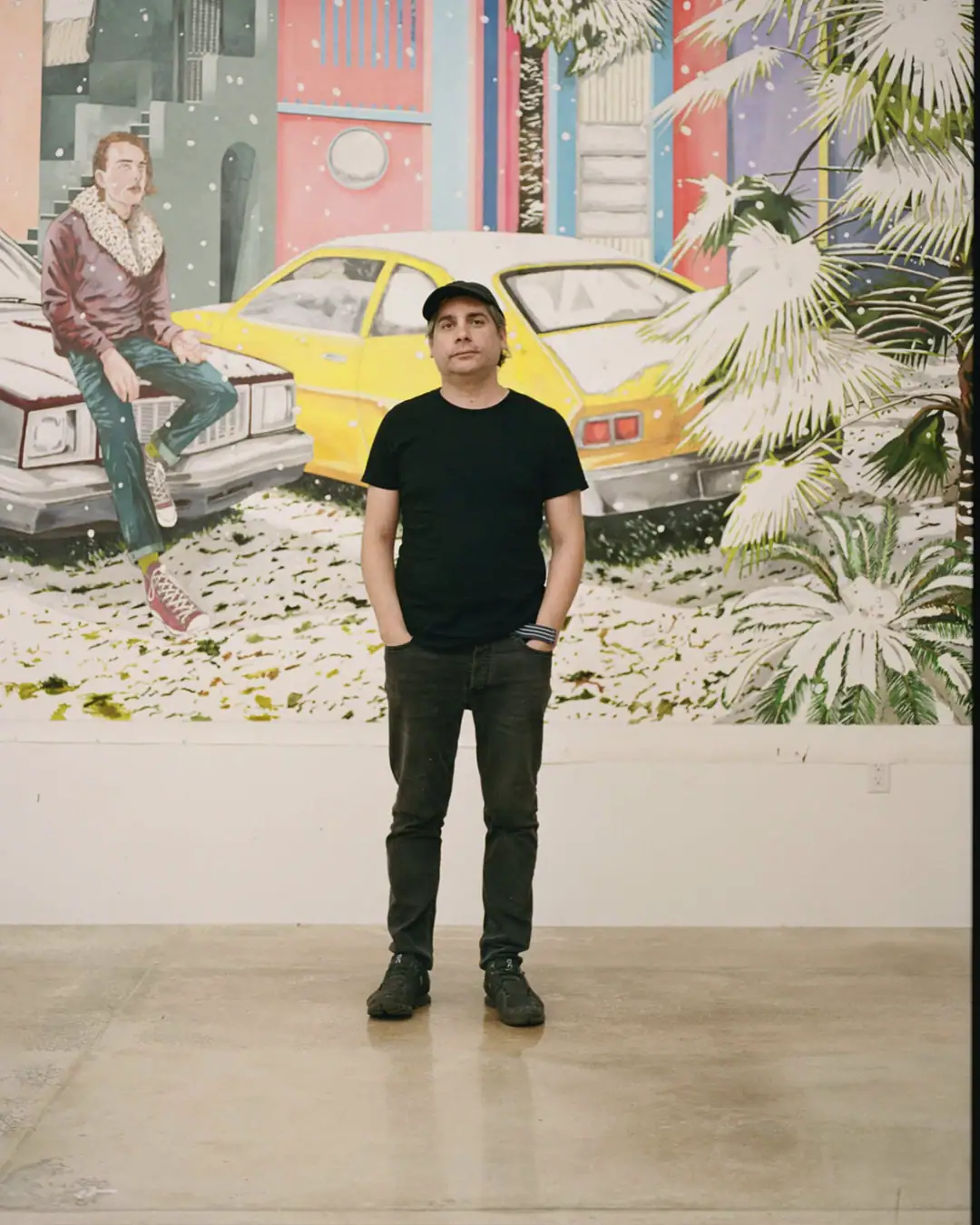
The Future Perfect, founded by David Alhadeff in 2003, staged its largest presentation yet: a dual-curated space conceived to foster optimism about our changing world. One side was given over to the narrative metalwork of Vikram Goyal, whose repoussé bronze reliefs tell stories in relief; the other assembled an exceptional roster including Chris Wolston, Lindsey Adelman, Piet Hein Eek, Sophie Lou Jacobsen and Floris Wubben. Elsewhere, the self-taught designer Anna Karlin showed her “usable sculptures”, born of hundreds of iterations, while the debutant studio Nader Gammas built layered, block-like fixtures from a spirit of curiosity and questioning, and the Australian artist Nick Thomm brought his hyper-colour, light-saturated canvases to a solo showing.


The Future Perfect
Sculpture at the Edge of Function
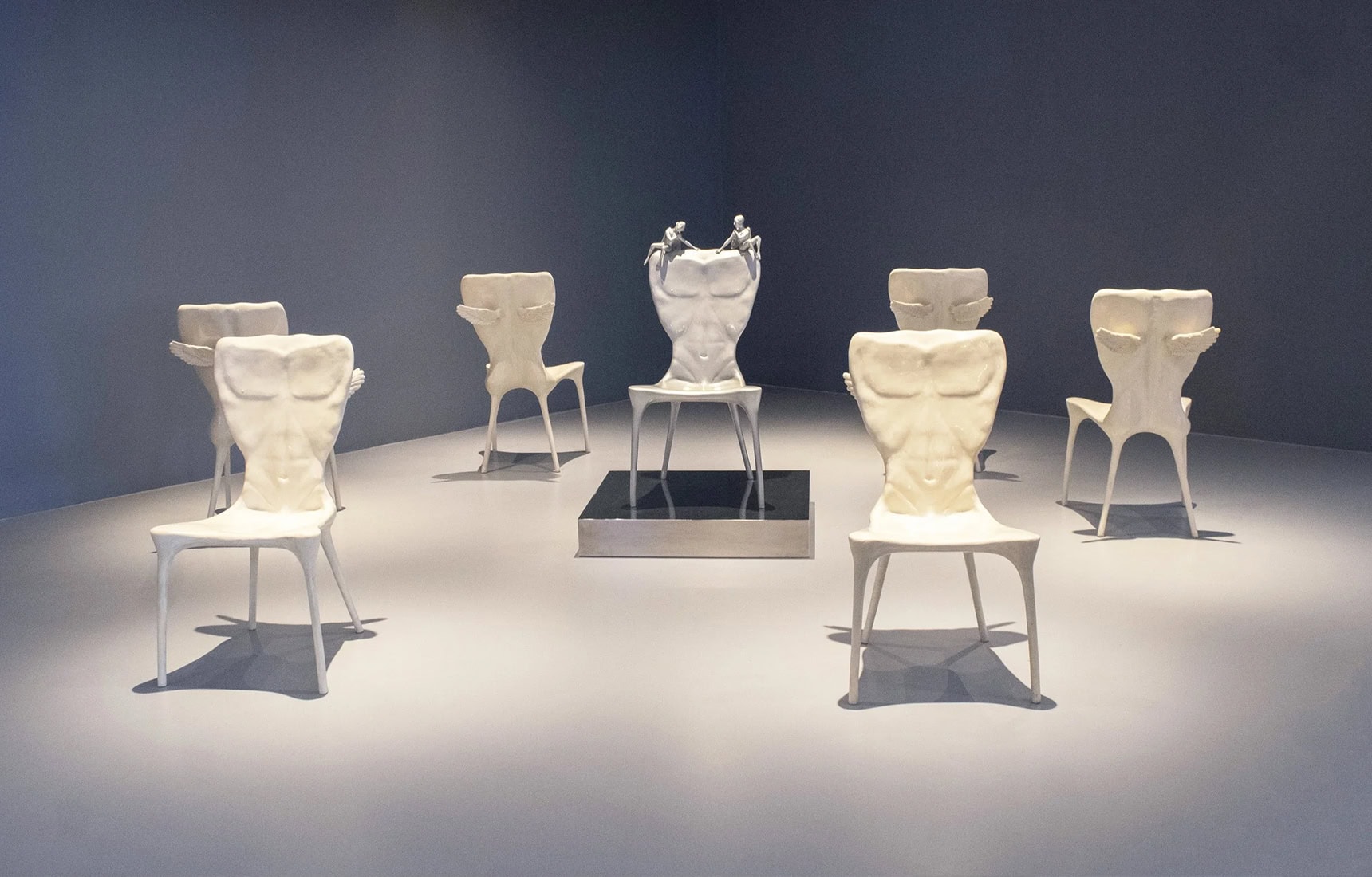
Rounding out the highlights, Carpenters Workshop Gallery, a fixture of the collectable-design world, presented functional sculpture by artists working well beyond their usual registers, among them Vincenzo De Cotiis, Ingrid Donat, DRIFT, Marcin Rusak and Yinka Shonibare. The booth ranged widely across style, material and technique while circling themes of identity, culture and history, embodying the gallery’s mission to blur the lines between art, sculpture and design altogether. Against the fair’s optimistic backdrop, it was a potent reminder that “collectable design” has become one of the most intellectually ambitious corners of the contemporary art world.


Friedman Benda
Why Design Miami 2024 Mattered
Twenty years is long enough for a fair to become an institution, and long enough to earn real authority. Design Miami’s anniversary edition drew on that authority by returning to first principles. Adamson’s “Blue Sky” theme reframed the whole enterprise as a shared act of imagination, a proposition that design, at its best, is a form of optimism made tangible.
What the fair confirmed, more than anything, is the sheer breadth of contemporary practice: heritage ceramics houses and fashion maisons, self-taught sculptors and organic architects, all converging on the same idea that objects can carry meaning, memory and hope. As Design Miami enters its third decade — now spanning four cities across two continents — it does so having made an unanswerable case for the field it helped invent. Long after the booths came down, it was that upward tilt of the horizon, and the belief that the same sky hangs over all of us, that lingered.

Leave a Reply