
Products & Objects · Leicestershire
Reading Time: 8 minutes
The material history of the domestic light switch is a story about brass giving way to Bakelite in 1909, and cost and manufacturing scale winning out over craft for most of the century that followed. deVOL‘s Heritage Light Switches, the Dolly and the Jelly, hand-cast in pressed brass and ceramic by metalsmiths working inside a sixteenth-century watermill, quietly reverse that decision, and they do it inside a company whose entire identity was built on restoring exactly the kind of object mass production had made disposable.
Introduction
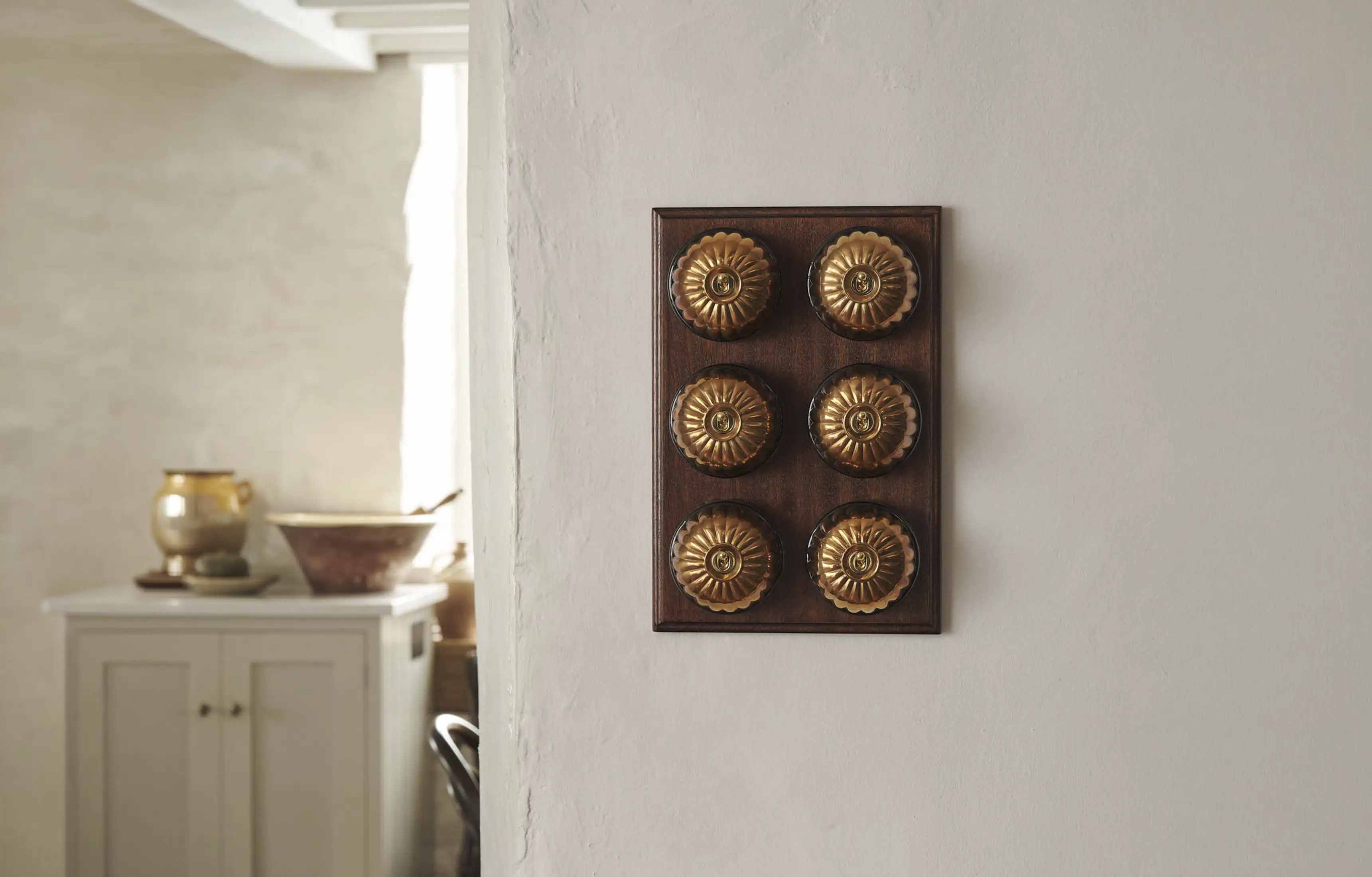
deVOL, the British kitchen and furniture company founded in 1989 by Philip deVries and Paul O’Leary, has introduced Heritage Light Switches, a range of pressed brass and glazed ceramic toggle switches sold under two names, the Dolly and the Jelly. Both are handmade to order by metalsmiths at deVOL’s Cotes Mill workshops in Leicestershire, available in Heirloom, Aged or Oxidised brass finishes, with black or white ceramic bases and an option of a wood pattress in a mahogany finish or primed maple, or direct mounting to the wall.
Most coverage of small hardware like this treats it as an accessory story, a nice-to-have upgrade for a renovation budget with room to spare. The more interesting way to read it is as a company applying its founding instinct to the smallest object in a room. deVOL began by restoring antique furniture by hand. Thirty-six years later, it is restoring a piece of domestic hardware to a material standard the entire electrical industry deliberately moved away from in 1909, and it is doing so from a workshop the company itself rescued from decay.

A brass fitting that plastic was invented to replace
The dolly, or tumbler, switch has been part of British homes since the 1880s and 1890s, when Thomas Edison and his contemporaries developed it alongside the first domestic electricity supply networks. Early switches used ribbed brass covers, polished when new and left to darken with handling and age, the same living patina deVOL’s own finishes are built to develop. Their base colours followed the mourning conventions of the day: black bases after Prince Albert’s death in 1861, giving way to white once Queen Victoria’s own death in 1901 shifted the era’s aesthetic mood, and then to the nickel plating and more streamlined forms that came to define Edwardian taste.

That brass-and-ceramic material story ended, for most of Britain, in 1909, when the plastic Bakelite was patented. Bakelite’s insulating properties and its suitability for cheap mass production made it the obvious material for a country about to build millions of new homes over the following decades, and switch designs such as the Crabtree Lincoln, made from it, remained the standard fitting in British houses into the 1960s. It was a genuinely useful material shift, not a decline, brass switches did not disappear because they stopped working, they were priced and manufactured out of the market by a material built specifically to be cheaper and faster to produce at scale. deVOL’s Heritage range does not argue with that history. It simply chooses the other material again, for anyone who wants it.

The Dolly and the Jelly, built the way the original was
The Dolly and the Jelly toggle switches are constructed from pressed brass housings, made using the same traditional pressing methods as the original nineteenth-century fittings, combined with glazed and pressed ceramic bases rather than the moulded plastic that eventually replaced ceramic as well as brass. Each switch measures roughly 76mm square, with a depth of around 41 to 44mm depending on the model, and mounts either directly to the wall or onto a wooden pattress finished in mahogany or primed maple. The three brass finishes on offer, Heirloom, Aged and Oxidised, are built around the same idea that made the original nineteenth-century fittings interesting in the first place: a polished brass surface is a starting point rather than a finished state, and the Oxidised finish in particular is deliberately blackened and then wire-wool buffed back to reveal bronze undertones underneath, a hand process rather than a factory coating. Each switch is rated to 240V and 20A, UKCA and CE marked, and handmade and assembled in the UK, specifications that matter more to the electrician fitting it than to the person choosing a finish, but that confirm the range is engineered as a working electrical fitting rather than a decorative shell built around standard components.

The range extends the naming and material language deVOL first established with its original switches and sockets collection, launched in June 2020 and inspired by 1920s Art Deco styling, with toggle knobs originally styled from old Bentley and Spitfire dashboard fittings. That first collection was described in-house as “little pieces of jewellery for the home,” a phrase that applies just as directly to the newer Heritage range, and both are designed by deVOL’s own in-house team and made by metalsmiths on site rather than sourced from a hardware supplier.
Prices start at £95 for a single one gang Dolly or Jelly switch and rise through the gang configurations to £635 for a six gang bank, positioning Heritage as a considered specification decision rather than an impulse hardware swap, broadly in line with the rest of deVOL’s kitchen and furniture pricing. That places the new range alongside two things already on deVOL’s own shelves. One is deVOL’s existing Classic Toggle Switches, a simpler in-house design that Heritage now sits above. The other is Forbes & Lomax, a British switch and socket maker founded in 1987 that deVOL already stocks as an aesthetically driven alternative to standard plastic fittings. The distinction between that range and this one is authorship. Forbes & Lomax is curated by deVOL, selected because its designs earned a place on the same shelves as deVOL’s own furniture. Heritage is the first switch collection deVOL has designed and made itself, brass pressed and ceramic cast under its own roof rather than sourced from a specialist supplier and resold.

Cotes Mill is not an incidental workshop location
deVOL bought Cotes Mill, a sixteenth-century water mill on the banks of the River Soar outside Loughborough, in 2012, and turned its five storeys and twelve acres into the company’s flagship home, now housing its full kitchen collections alongside the metalsmithing workshops where the switches are made. A company making brass switches by hand inside a genuinely centuries-old mill building it restored itself is not a coincidence of geography. It is the same instinct that founded the business in the first place, when Philip deVries and Paul O’Leary, two design graduates from Loughborough University, began by renovating antique furniture and making bespoke pieces from a rented workshop rather than manufacturing anything new. The switches are a continuation of that founding act at a much smaller physical scale: taking an object whose original material and manufacturing method had been discontinued, and making it again properly.

Helen Parker, deVOL’s creative director since 2011, has described her own design instinct in terms that map directly onto this range: a preference for “traditional styles such as Victorian and Georgian, but with a contemporary twist,” and a belief that good design starts from “a special item, something that just makes you think” rather than from a mood board. A brass toggle switch, handled dozens of times a day by anyone standing near a doorway, is about as far from a statement piece as domestic hardware gets, which is exactly the kind of overlooked object that instinct is built to notice.
deVOL’s own recognition has tended to follow the same arc, from hand restoration to institution. The company’s workshops featured in the Emmy-nominated documentary series For The Love of Kitchens in 2021, and it received a King’s Award for Enterprise in 2024, two markers that sit on the same continuum as a hand-pressed brass switch: reputation built by continuing, at a larger scale, to do what the company began doing by hand in a rented Loughborough workshop in 1989.

What the design argument actually is
Strip away the finish options and the underlying decision is legible: deVOL identified the exact point in the light switch’s material history where craft gave way to mass production, 1909, and chose to build the earlier version again, properly, rather than decorating a modern plastic switch to look old. That is a meaningfully different proposition from most “heritage style” hardware on the market, which tends to mould plastic into a brass-look shell. deVOL’s switches are pressed brass and ceramic because the originals were pressed brass and ceramic, made in a workshop that exists because the company bought and restored a genuinely historic building rather than renting a modern unit, by a business whose first ever product was someone else’s damaged furniture made whole again. The switch is a small object. The argument behind it is the same one the company has been making about furniture for thirty-six years, applied for the first time to something most renovations budget for last.

Frequently asked questions
What are deVOL’s Heritage Light Switches?
They are a range of pressed brass and glazed ceramic toggle light switches sold as the Dolly and the Jelly, handmade to order by deVOL’s metalsmiths at Cotes Mill in Leicestershire.
What finishes are available?
Three brass finishes, Heirloom, Aged and Oxidised, paired with black or white ceramic bases, and an option of a wooden pattress in a mahogany finish or primed maple, or direct wall mounting.
Why is the dolly switch called that?
The dolly, or tumbler, switch has been the common name for this lever-action switch type since British homes were first wired for electricity in the 1880s and 1890s; the exact origin of the term itself is not documented in deVOL’s own materials or in the wider historical record consulted for this piece.
When were dolly switches first used, and why did they stop being common?
Brass tumbler switches were standard in British homes from the 1880s and 1890s. Bakelite, patented in 1909, offered cheaper, faster mass production and largely replaced brass and ceramic switches over the following decades, remaining the dominant material into the 1960s.
Where are deVOL’s switches made?
At Cotes Mill, deVOL’s five-storey, sixteenth-century water mill workshop and flagship showroom outside Loughborough, which the company bought and restored in 2012.
Who designs deVOL’s hardware?
deVOL’s in-house design team, under creative director Helen Parker, who joined the company in the early 2000s and has led its creative direction since 2011.

Final thoughts
A light switch is handled more often, in a given week, than almost anything else in a house that is not a door handle or a tap, and it is routinely the object a renovation budget spends the least thought on. deVOL’s Heritage range treats that fact as the whole brief rather than a marketing line: the material story of the brass switch giving way to Bakelite in 1909 is a real, documented shift, and the Dolly and the Jelly are a considered, hand-built reversal of it, made by metalsmiths inside a mill deVOL restored itself, by a company that started out thirty-six years ago restoring other people’s furniture rather than manufacturing anything new. The switches are a small object carrying a genuinely long argument.


Leave a Reply