
ART & CULTURE · MIAMI
Reading time: 9 minIn November 2022, Dolce & Gabbana took over three floors of a Miami Design District showroom for the brand’s first Casa presentation in the United States, built around a new gold-toned collection called Oro 24K. Every piece in the building was made by Luxury Living Group, the Italian manufacturer that has spent nearly four decades translating fashion houses into furniture, and that builds the Bentley Home collection under the same roof. The Miami takeover was less a fashion event than a rare public look at how that translation actually happens.
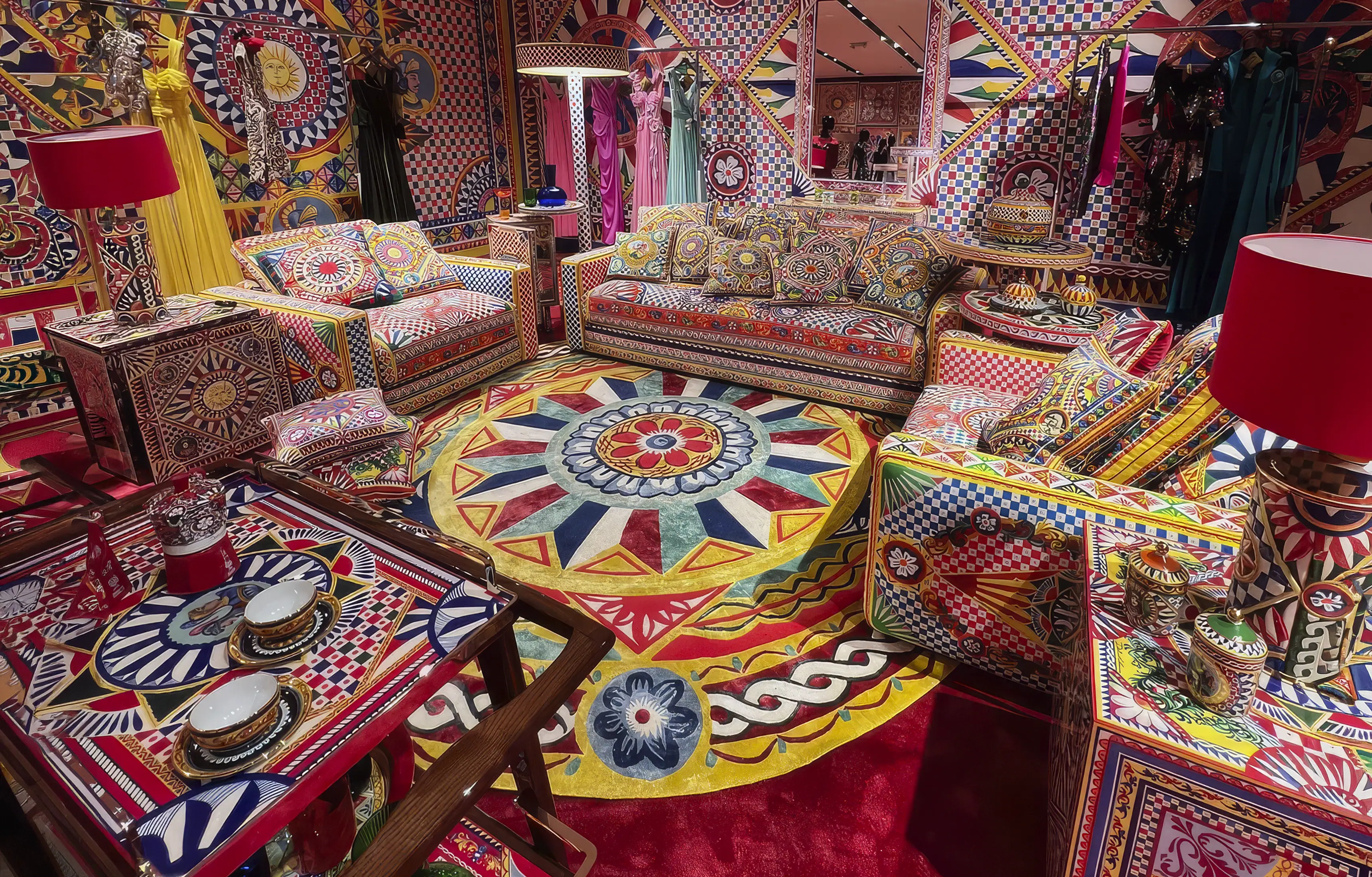
Dolce & Gabbana Casa opened its United States debut on 30 November 2022, occupying the full Luxury Living Group store at 50 NE 39th Street in the Miami Design District for the length of that year’s Art Week, through 4 December. Domenico Dolce and Stefano Gabbana filled roughly 2,700 square metres across three floors with upholstered furniture, cabinets, bar units, rugs, lamps, dining tables and decorative objects, organised around four established print collections and a new one making its first appearance anywhere: Oro 24K.

The showroom sat inside a much larger week of Dolce & Gabbana events across the city, from the Four Seasons to South Beach, but the furniture presentation was doing something the parties and the runway looks were not. It was the first time the American public could walk through a complete, three-floor articulation of what Dolce & Gabbana Casa actually is: a licensed furniture line, designed by the fashion house and manufactured, floor by floor, by a family firm in Emilia-Romagna that has been doing exactly this, for other names, since 1987.
That firm is Luxury Living Group, and its role is the part of the Miami story that rarely gets told. Understanding it changes what the showroom on 39th Street was actually showing.

Four collections, and one new one
The Miami presentation was built around Oro 24K, a collection Dolce and Gabbana have described as a homage to Baroque opulence, translated into furniture through smooth and hammered gold surfaces and a wave-like relief finish achieved by hand. The effect depends on inconsistency: no two panels catch the light identically, because the wave is worked into the surface rather than moulded or printed.

Alongside it stood three collections already established in the Dolce & Gabbana Casa range and one further debut. Carretto Siciliano takes its name and its palette from the Sicilian cart, the island’s traditional hand-painted wooden cart, historically decorated with scenes from chivalric legend and bright, saturated colour; the collection carries that palette onto coffee tables, bar units, rugs, cushions and vases. Blu Mediterraneo enlarges the blue-and-white geometry of Mediterranean maiolica tilework onto upholstery and wallpaper, scaling a pattern usually seen on a few centimetres of ceramic across whole pieces of furniture. Zebra, shown in Miami alongside its less-publicised companion print Leopardo, applies monochrome animal markings to upholstered seating rather than accessories, so the pattern carries structural pieces instead of decorating the edges of a room. The fifth strand shown for the first time in Miami, alongside Oro 24K, was a new DG Logo treatment carrying the house’s monogram directly onto furniture surfaces.

Each collection works from a Dolce & Gabbana reference that predates the furniture by years, sometimes decades, on the runway and in accessories. Sicilian folklore, Mediterranean ceramics and animal print have all appeared across the house’s clothing and accessories long before they reached a cabinet or a sofa, which is part of why the transition to furniture reads as continuity rather than licensing for its own sake. The Miami showroom was the first place all of them appeared together at this scale, in a single building, organised as a coherent furniture range rather than a runway motif translated once and moved on from.

The hands behind the surfaces
Dolce & Gabbana Casa’s claim to craft is unusually easy to verify, because the workshops behind it are named rather than implied. The glasswork in the collection comes from a cluster of Murano furnaces with their own long histories: Barovier & Toso, one of the island’s oldest working glasshouses; Venini, founded in 1921 and central to twentieth-century Murano design; Salviati; and Barbini. The textiles are woven by Tessitura Bevilacqua, a Venice house that still operates eighteenth-century hand looms for its jacquard velvets and brocades. Sicilian ceramicists hand-paint the maiolica references, and cabinetmakers working in intarsia and straw marquetry produce the case pieces.
That is a genuine list of makers, not a general claim to Italian craft. It means a buyer, or a reader, can trace an individual piece back to the furnace or the loom that made it, which is the test that separates a collection with real provenance from one that has simply bought the look of one.

The production timeline reflects it. A single Oro 24K cabinet or upholstered chair can take months to complete, because the gold finish is worked by hand rather than applied as a uniform coating, and because the Murano houses and Tessitura Bevilacqua’s looms are producing to order rather than from stock. That timeline is the trade-off a collection makes when it insists on named workshops over a faster, moulded alternative, and it is the reason the Miami showroom functioned as much as a demonstration of process as a display of finished pieces.

From Venice to Milan to Miami
Dolce & Gabbana Casa did not begin in Miami, and its route there is part of what the presentation was arguing. The collection launched on 28 August 2021 at the Scuola Grande della Misericordia in Venice, the house’s first full home collection under its own name. Domenico Dolce and Stefano Gabbana have described the intent behind it as building “a unique lifestyle” around “impeccable craftsmanship, love for the fatto a mano, respect for tradition.”

Ten months later, in June 2022, the collection took permanent retail form in Milan, with two adjoining addresses: a Corso Venezia accessories boutique and a full furniture showroom at Via Durini 23, built in partnership with Luxury Living Group. Miami followed that November, as the collection’s first sustained American presentation and its first appearance during Art Week, a week the Design District has spent the past decade turning into one of its two annual anchor events alongside December’s fair calendar.
The sequence, Venice to Milan to Miami, tracks a fashion house furniture line’s normal path from launch to flagship retail to international export. What is less normal is who was building it at every stop.

One workshop, six fashion houses
Luxury Living Group is based in Forlì, in Emilia-Romagna, and the relationship it has with Dolce & Gabbana is not exclusive. The company also manufactures and distributes Fendi Casa, Versace Home, Trussardi Casa, Bugatti Home and, most tellingly for a Miami-adjacent audience, Bentley Home, the furniture collection produced under licence from the British car maker.

The arrangement began with a single meeting. In 1987, the group’s founder, Alberto Vignatelli, met Anna Fendi, and the two built the model Luxury Living Group still runs on: a fashion house’s design language, studied by a team of product developers after every show and adapted into upholstery, cabinetry and lighting, manufactured under the same roof as the fashion house’s other licensed partners. Vignatelli’s daughter, Raffaella Vignatelli, now chairs the company and leads its creative direction, describing the group’s method as reading a maison’s “language” from its garments, its colours and its techniques before a single furniture sketch is drawn. She runs the business with her siblings, Daniele in management and Olga in sales and marketing, a structure that has kept the company under family direction through six licensing partnerships and, by its own account, more than 300 stockists worldwide.

Since 2020, that Forlì operation has sat inside a larger structure still. Haworth, the American contract furniture group, acquired Luxury Living Group that year in partnership with Lifestyle Design, the licensing arm of Poltrona Frau Group, itself part of the Haworth family of brands. The practical result is that the gold-leaf Baroque furniture unveiled in a Miami showroom in November 2022, and the Bentley Home collection sold from showrooms across the same Design District, are products of the same Forlì workshops, the same design studio and, several ownership layers up, the same American parent company. Dolce & Gabbana and Bentley design nothing in common. Their furniture, on the way to being built, passes through the same hands.

What the Design District gave it
Miami’s Design District has spent the years since 2010 assembling exactly this kind of audience: buyers, architects and specifiers who come for the fair calendar and stay to walk the permanent showrooms around it. A furniture presentation timed to Art Week does not compete with the art fairs for attention so much as borrow their footfall, which is why a fashion house choosing to debut a home collection there, rather than folding it into a runway show, is a deliberate piece of retail strategy as much as a design statement. The three-floor scale of the Dolce & Gabbana Casa presentation, matched against the more modest Milan boutiques it followed, reflects that: Miami was built to be walked as a complete collection, not sampled as a single room. Dolce & Gabbana’s presence in the city runs beyond furniture, too: the house has also shaped Miami real estate, lending its aesthetic to 888 Brickell, a residential tower rising nearby.

That distinction matters for a licensed furniture line specifically, because the format lives or dies on whether a buyer can see enough of it at once to read it as a considered range rather than a single motif stretched across a showroom. Three floors, four established collections and two debuts gave Dolce & Gabbana Casa room to make that case in a way a boutique-scale space could not.

Final thoughts
The obvious way to write up a fashion house’s furniture showroom is as a season’s worth of new upholstery: a gold collection here, an animal print there, arranged across a temporarily rented building for a week of parties. Dolce & Gabbana Casa’s Miami debut carried all of that, and it was not the most interesting thing about it.

The more durable story is in Forlì, where a single company has spent since 1987 learning to read a fashion house’s design language and turn it into furniture without losing what made it that house’s language in the first place. Six maisons currently trust Luxury Living Group with that translation, from an Italian car marque’s home collection to a Sicilian cart pattern painted onto a coffee table, and the discipline required to keep those languages distinct, working from the same benches and the same Murano furnaces, is the actual craft on display.
Miami got to see the furniture. The workshop is the part worth remembering.

What is Dolce & Gabbana Casa?
Dolce & Gabbana Casa is the fashion house’s home furnishing line, launched in Venice in August 2021 and manufactured under licence by Luxury Living Group, which produces the furniture, upholstery, lighting and accessories in its own Italian workshops.
Where did the Miami presentation take place?
It took place inside the Luxury Living Group store at 50 NE 39th Street in the Miami Design District, across roughly 2,700 square metres on three floors.
When did it run?
The Miami presentation ran from 30 November to 4 December 2022, during that year’s Miami Art Week.
What is Oro 24K?
Oro 24K is a Dolce & Gabbana Casa collection built around gold-toned surfaces, finished by hand in smooth and hammered textures with a wave-like relief, referencing Baroque ornament. It made its debut in Miami alongside a new DG Logo treatment.
Who manufactures Dolce & Gabbana Casa?
Luxury Living Group, based in Forlì, Italy, designs and manufactures the collection in partnership with Dolce & Gabbana. The same company also produces Fendi Casa, Versace Home, Trussardi Casa, Bugatti Home and Bentley Home.
What is Carretto Siciliano?
Carretto Siciliano is a Dolce & Gabbana Casa collection drawing on the Sicilian cart, the island’s traditional hand-painted wooden cart, applied to coffee tables, bar units, rugs, cushions and vases in bold colour.
Who makes the glass and textiles in the collection?
The glasswork comes from Murano furnaces including Barovier & Toso, Venini, Salviati and Barbini. The woven textiles are produced by Tessitura Bevilacqua in Venice.
Had the collection been shown anywhere before Miami?
Yes. It launched in Venice in August 2021 and opened permanent retail space in Milan, at Corso Venezia and Via Durini, in June 2022. Miami was its first sustained United States presentation.


Leave a Reply