
Products & Objects · Maranello
Reading Time: 8 minutes
The headline fact about the Ferrari Luce is that Jony Ive and Marc Newson designed it. The more interesting fact is who invited them: Flavio Manzoni, the man who built Ferrari’s first-ever autonomous design studio in 2010 and has run it for sixteen years, brought in an outside collective specifically to escape the conventions his own department had spent a decade and a half establishing.
Introduction
Ferrari Luce, internally designated Type F222 and developed under the codename Elettrica, is Ferrari’s first fully electric production car and the marque’s first five-seat model. It was designed by LoveFrom, the creative collective founded by Sir Jony Ive and Marc Newson, working alongside Ferrari‘s in-house design team under Flavio Manzoni, Ferrari’s Chief Design Officer since 2010. The car reached the public across a staged reveal: previewed under its codename at Ferrari’s Capital Markets Day on 9 October 2025, its interior and interface design unveiled in San Francisco on 9 February 2026, and the finished production car presented in Rome on 25 May 2026.
Almost every piece of coverage since has led with the same fact, that the man who shaped the iPhone has now designed a Ferrari. That framing is not wrong, but it skips past the more interesting decision underneath it. Manzoni did not simply accept a celebrity collaborator handed down from Ferrari’s board. He is the executive who spent sixteen years building and running Ferrari’s own design language, and by his own account, the entire point of bringing in LoveFrom was to get outside his own department’s accumulated conventions rather than to refine them further.

Ferrari’s own design chief invited the outside eye in
Manzoni joined Ferrari in January 2010 as Director of Design, and in doing so created, in his own words, an internal, complete and autonomous Style Centre for the first time in the marque’s history. Before Ferrari, he had led design at Lancia, SEAT, Fiat and the Volkswagen Group’s “north” design pole, overseeing work across Volkswagen, Skoda, Bentley and Bugatti. At Ferrari he went on to lead the design of the LaFerrari and more than a decade of subsequent models, effectively writing the modern grammar of Ferrari design from the ground up.

Bringing an outside studio into that process, for the first time in sixteen years, is a genuine departure, and Manzoni has described the reasoning plainly rather than leaving it to speculation: “The idea was to avoid the conventions and codes of car design.” That is a design leader confident enough in his own department’s foundations to invite external pressure against them, which is a harder thing to do than simply commissioning a flattering celebrity credit. Newson has described LoveFrom’s side of the same arrangement in similar terms: “We were approached as an outside entity, so our approach was going to be different.”

Five years, six months of research, four bound volumes, before a line was drawn
The collaboration ran for roughly five years in total, and it did not begin with sketches. The first six months were spent on research alone, producing four bound volumes analysing Ferrari’s own design heritage before LoveFrom proposed a single form. That research phase matters for how the finished car should be read: this was not an outside studio imposing an unrelated design language onto a Ferrari body, but a deliberately slow study of Ferrari’s own history, conducted by people with no institutional stake in defending how that history had most recently been interpreted.

The division of labour that followed was equally deliberate. LoveFrom’s design work was carried out from San Francisco, while Maranello retained engineering, drive testing and the physical realisation of the car. Ferrari’s own account of the project describes the result as a singular design language that unites the exterior, interior and interface with clarity and refined simplicity throughout, which is a claim easier to make than to deliver across three normally separate disciplines, and one the finished car’s interior detailing goes some way to support.

The interior treats a physical switch as seriously as a digital display
Ive has been explicit about the interface philosophy driving the interior, pushing back on an assumption he considers lazy: “It’s a bizarre and lazy assumption that the interface should be digital if the power source is electric.” The Luce’s cabin keeps physical toggle switches for climate and seat controls rather than folding them into a touchscreen, and pairs that analogue instinct with genuine digital sophistication where it earns its place, dual overlapping OLED displays developed with Samsung, cut with strategic openings to create three-dimensional depth rather than a flat panel.

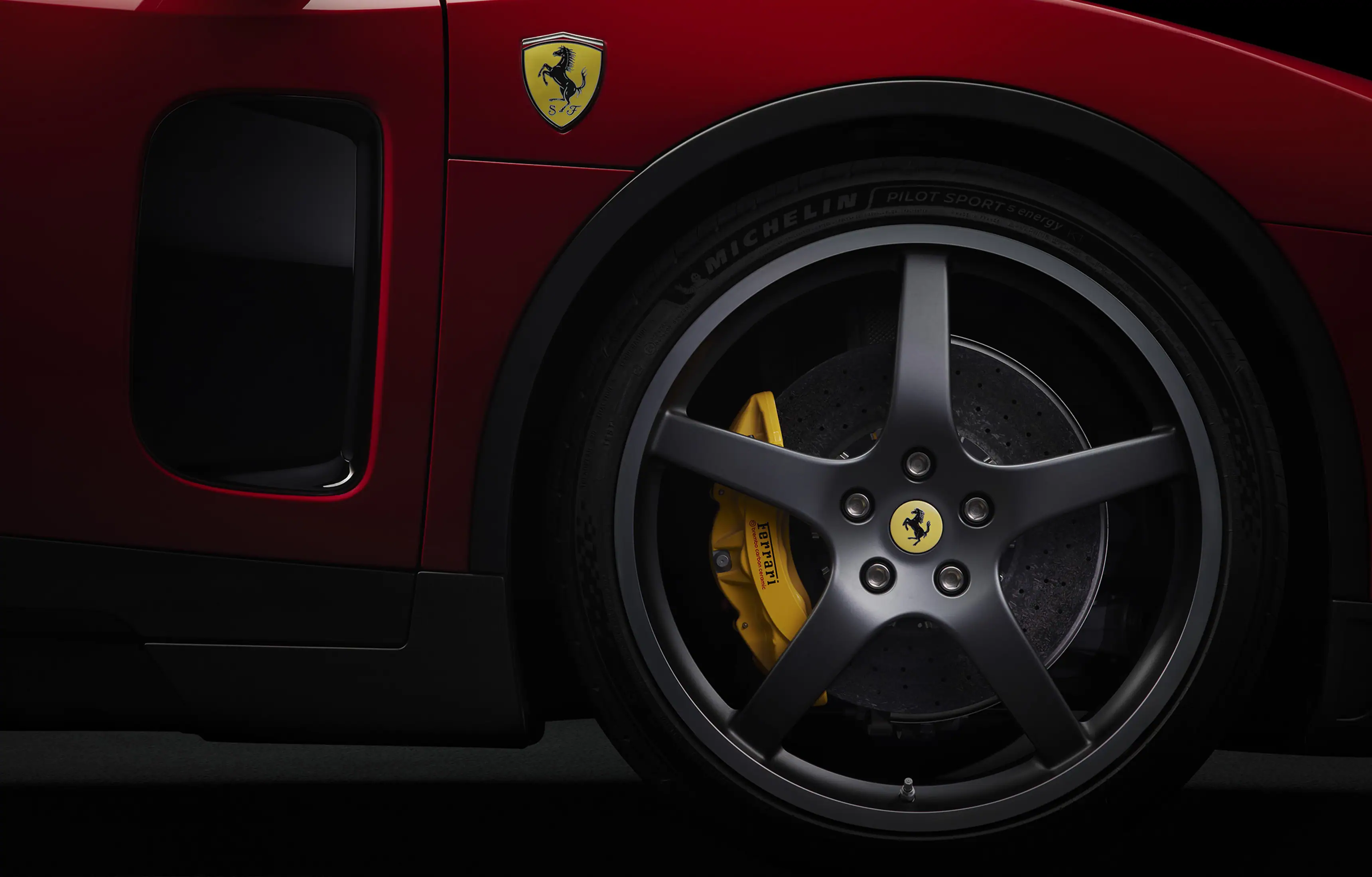
The clearest expression of that balance is a feature LoveFrom calls Multigraph, a clock-style dial with three independent motors driving physical aluminium hands rather than a rendered digital face, drawing its logic from aviation instrumentation and high-end horology rather than from consumer electronics. The steering wheel is machined from 100 per cent recycled aluminium across 19 separate CNC-machined parts, roughly 400 grams lighter than a standard Ferrari wheel, in a three-spoke layout that references Nardi wheels from the 1950s. The gear shifter and central console are Corning Gorilla Glass, with laser-etched graphics bored at roughly half the width of a human hair, and the car’s key is set with an E Ink display, the first automotive application of the technology, that changes appearance depending on how it is docked. A dedicated typeface, LF Maranello, designed by Antonio Cavedoni, runs through the car’s interface rather than a licensed system font.

The numbers behind the design brief
Four independent electric motors, one per wheel, produce a combined 1,035 horsepower, taking the Luce from 0 to 100 km/h in 2.5 seconds and on to a top speed beyond 310 km/h, figures that would have been unthinkable from Maranello a decade ago regardless of body style. The 122 kWh battery, built as a structural element of the chassis rather than a separate pack bolted beneath it, runs an 800V architecture capable of recovering roughly 70 kWh in 20 minutes on a 350 kW charger, for a real-world range beyond 500 kilometres. Wheels measure 23 inches at the front and 24 inches at the rear, the largest fitted to any production Ferrari, and the body achieves the lowest drag coefficient in the marque’s history, a genuinely functional outcome of the glass-house upper volume and floating aerodynamic wings rather than a styling flourish layered on afterwards.

Ferrari’s engineers also built a patented acoustic system rather than defaulting to a synthesised engine note, an approach increasingly common among electric performance cars but rarely executed with this degree of specificity: real mechanical vibration from the drivetrain is captured, filtered, equalised and amplified in much the same way an electric guitar treats a string’s vibration, so the sound the driver hears originates from the car’s own moving parts rather than from a speaker playing a recording.

Rome, and a date that was not chosen at random
Ferrari presented the finished Luce in Rome on 25 May 2026, a date that lines up precisely with the marque’s own competition history: Franco Cortese won Ferrari’s first-ever race in Rome on 25 May 1947, exactly seventy-nine years earlier. Ferrari marked the connection publicly five days later with a free public exhibition at the Vela di Calatrava, the sail-shaped structure designed by architect Santiago Calatrava as part of Rome’s Città dello Sport, where visitors could view the car alongside historic Ferrari models and an evening light installation. Choosing a building by one of the world’s most prominent living architects, in the city where the marque’s competition history began, to stage the public unveiling of its first electric model is a considered piece of design context in its own right, not incidental event logistics.

What the design argument actually is
Strip away the specification sheet and the underlying decision is legible: Ferrari treated electrification as an opportunity to bring in outside discipline against its own established conventions, while keeping the actual engineering, testing and manufacturing entirely within Maranello. That is a more considered structure than either a full outsourcing of the design or a defensive refusal to change anything at all. Manzoni’s sixteen years building Ferrari’s internal design language gave the collaboration something to research and push against, rather than a blank page, and the six months LoveFrom spent studying that history before drawing anything is the clearest evidence that the resulting car is an argument about Ferrari’s own design lineage, made by people with the outside distance to see it clearly, rather than a generic outside aesthetic wearing a Ferrari badge.

Frequently asked questions
What is the Ferrari Luce?
The Ferrari Luce is Ferrari’s first fully electric production car and the marque’s first five-seat model, internally designated Type F222 and developed under the codename Elettrica.
Who designed the Ferrari Luce?
LoveFrom, the creative collective founded by Sir Jony Ive and Marc Newson, designed the car’s exterior, interior and interface, working alongside Ferrari’s in-house design team led by Chief Design Officer Flavio Manzoni.
When was the Ferrari Luce revealed?
It was previewed under its Elettrica codename on 9 October 2025, its interior and interface were unveiled in San Francisco on 9 February 2026, and the finished production car was presented in Rome on 25 May 2026.
What are the Ferrari Luce’s key performance figures?
Four electric motors produce a combined 1,035 horsepower, giving 0 to 100 km/h in 2.5 seconds, a top speed beyond 310 km/h, and a range beyond 500 kilometres from a 122 kWh battery.
Why was Rome chosen for the reveal?
The 25 May 2026 reveal date marks exactly seventy-nine years since Franco Cortese won Ferrari’s first-ever race in Rome, on 25 May 1947.
Is the interior fully digital?
No. The Luce deliberately retains physical toggle switches for climate and seat controls alongside its digital displays, a decision Jony Ive has described as a direct rejection of the assumption that an electric car’s interface should default to digital.

Final thoughts
The Ferrari Luce will likely be remembered first for the names attached to it, and Jony Ive and Marc Newson’s involvement is a genuine event in industrial design. The more durable story is the one Flavio Manzoni actually describes: a design chief secure enough in the studio he spent sixteen years building to invite outside collaborators in against his own house style, and disciplined enough to give them six months of pure research before a single line was drawn. Ferrari kept engineering, testing and manufacturing entirely in Maranello throughout, which is the detail that separates this from a badge exercise. The car’s early market reception in China, where its full allocation sold out immediately on launch day, suggests the argument has landed with at least one audience exactly as intended.
Leave a Reply