
INTERIORS · PARIS
Reading time: 7 minGUBI House Paris opened on Rue de Monceau in April 2026 as an apartment nobody can buy and almost nobody can walk into. It is open by appointment only, spans two floors of a Haussmannian building, and was designed by the Copenhagen studio File Under Pop, whose founder spent her first career as a professional musician before she ever touched a tile. This is the Danish furniture brand’s second House format outside Copenhagen, and it argues its case for Nordic design by refusing to look like a shop at all.
Introduction
GUBI House Paris opened in April 2026 at 81 Rue de Monceau, in the city’s eighth arrondissement, inside a Haussmannian apartment with the high ceilings, tall French windows and classical mouldings the address implies. It is GUBI’s third showroom overall and its second dedicated House location outside Copenhagen, following GUBI House London, which opened in Clerkenwell in May 2024. Neither House sells anything directly off the wall. Both are open by appointment only, and both exist to answer a question a conventional showroom cannot: not what does this chair look like on a plinth, but what does it do in a room somebody actually lives in.
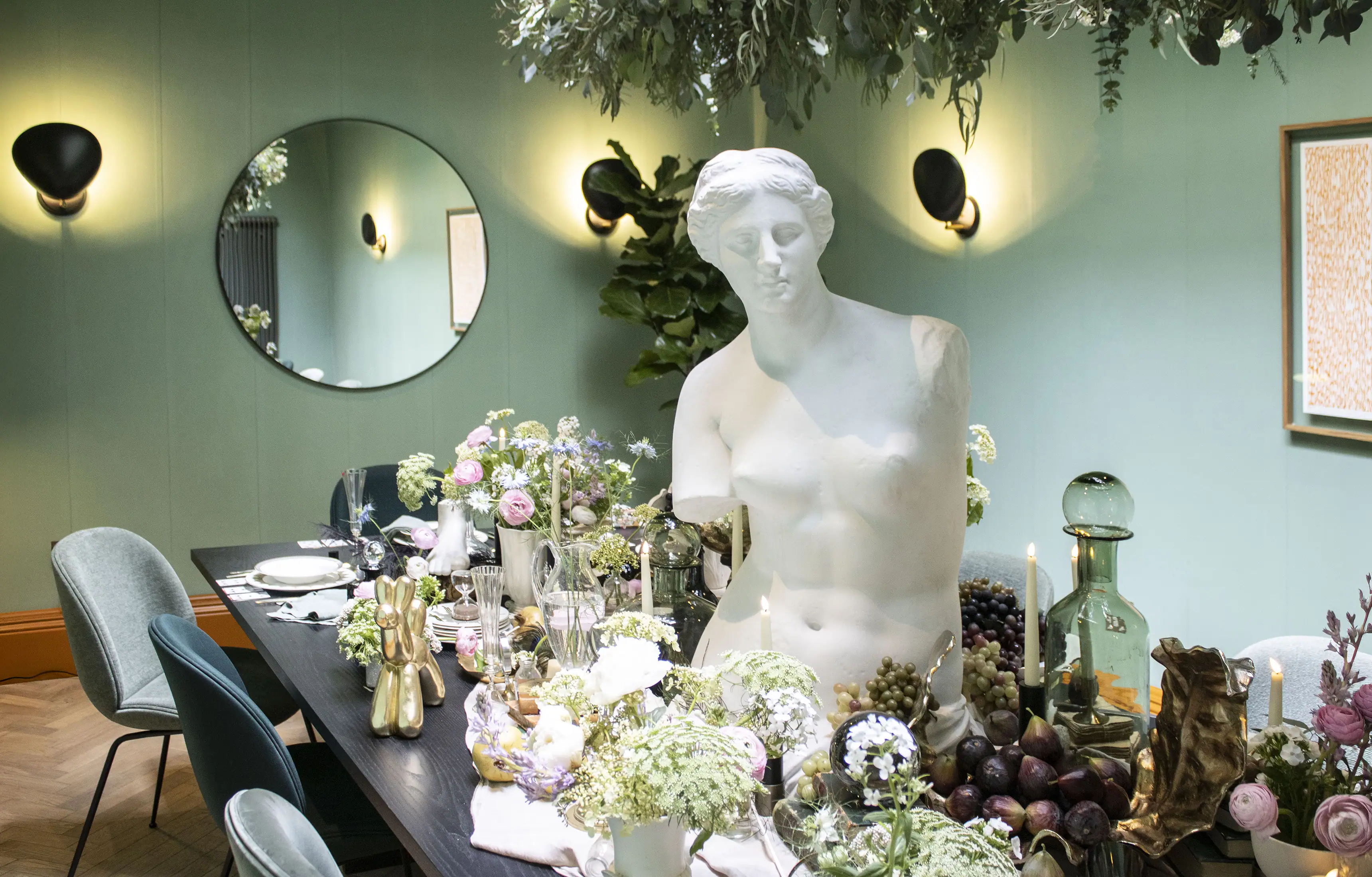
The Copenhagen studio File Under Pop designed the Paris apartment, working across two floors to build a sequence of rooms with a specific function each, a salon, a dining room, a working space, a winter garden and a bedroom styled like a boutique hotel suite, rather than a single continuous display. GUBI’s chief executive, Marie Kristine Schmidt, has described the thinking behind the format directly: “Design behaves differently when it’s placed in a real environment.” Paris, she has said, suits that argument specifically, because it is “a city where design is not isolated; it exists in constant dialogue.”


The eighth arrondissement location is not incidental to that argument either. Rue de Monceau sits among galleries, design studios and the kind of dense Haussmannian architecture that gives Paris its most recognisable domestic register, tall windows, carved stone facades and generous ceiling heights that most contemporary retail spaces simply cannot offer. Building a showroom inside that architecture, rather than in a converted warehouse or a ground-floor unit built for retail, means the apartment’s classical bones are doing real work alongside File Under Pop’s own material choices, the moulded ceilings and parquet floors GUBI’s furniture now has to hold its own against rather than compete with a neutral white box.


A surface designer who used to sing for a living
The name behind File Under Pop’s material choices, the lava-stone tiles and the paint finishes that run through both the Paris and London Houses, is Josephine Yaa Akuamoah, and her route into interior design did not start in a studio. Akuamoah spent her first career in music, founding her own band, studying music in New York, and working as a professional choir singer, before a trip to Sicily in 2000 introduced her to lava stone from Mount Etna, the volcanic material that has anchored her practice ever since. She launched her first tile company the following year, then founded File Under Pop in 2015, building a studio around the idea, in her own words, that in a well-considered interior “nothing is left alone. Everything coexists.”


That background is worth naming rather than treating as incidental colour, because it explains something specific about how File Under Pop’s rooms actually work. A composer thinks about how individual parts sit against each other over time rather than in isolation, and Akuamoah’s interiors read the same way: a lava-stone floor, a hand-painted wall and a piece of upholstery are treated as parts of a single arrangement rather than three separate decisions made by three separate people at three separate points in a project.
The connection is not only conceptual. File Under Pop’s own textile collection includes a pattern called Note Sheet, drawn directly from musical notation, alongside a range of more than fifty glazed lava-stone and clay tile colours and a hundred-colour paint universe produced with the Danish manufacturer Jotun. A studio built by a former professional musician naming one of its own fabric patterns after sheet music is not a metaphor a writer has imposed on the work afterward. It is the studio saying so directly.


Two Houses, two different arguments
GUBI House London, File Under Pop’s first collaboration with the brand, opened at 12 Charterhouse Square in Clerkenwell in May 2024, GUBI’s first permanent UK showroom. It runs across four floors and organises its rooms around decades and moods rather than domestic function: a nod to 1970s leisure, a boho-styled floor, a boutique-hotel register, a communal living space, dressed in Spanish clay tiles, Italian lava stone, custom limestone basins and hand-painted wallpaper, including a ground-floor dining room in forest green fabric striped with tangerine.
GUBI House Paris makes a different argument with the same designer and largely the same material palette. Rather than organising rooms by era or mood, it organises them by what actually happens in a home: gathering, eating, working, resting. Two floors instead of four, an intimate salon and a winter garden instead of a themed decade, and a bedroom dressed like a boutique hotel suite rather than one of several competing narratives. The London House asks a visitor to imagine several different lives a GUBI piece could belong to. The Paris House asks them to imagine one specific, plausible life, structured the way an actual apartment is, which is a more disciplined brief and arguably a harder one to satisfy convincingly.
A brand does not usually commission a second version of the same format with a genuinely different curatorial premise unless the first one worked. GUBI already sells through retailers and its own commercial showrooms across multiple markets, which makes the House format’s appointment-only, nothing-for-immediate-sale structure a deliberate departure from how the rest of the business operates, not a necessity. Building a second one, and asking the same studio to solve a different problem rather than repeat itself, reads as a brand treating the format as a genuine design exercise rather than a one-off marketing stunt it happened to get right once.


The kitchen a furniture brand didn’t design
The single object most likely to surprise a visitor expecting only chairs and lighting is the kitchen: a REFLECT installation, designed by the architect Jean Nouvel for the Danish kitchen company Reform, built largely in stainless steel and defined by the way its polished and brushed surfaces catch and scatter light across the room rather than sitting flat and matte the way most fitted kitchens do. GUBI does not make kitchens, and the choice to build the Paris House’s dining and gathering floor around someone else’s flagship product, rather than around more GUBI furniture, is a specific curatorial decision rather than a gap in the brand’s own catalogue.
It is also consistent with the House format’s premise. If the point is to show how design behaves in a real environment rather than how a single brand’s catalogue looks in isolation, a kitchen has to be there, and it has to be a genuinely considered one rather than a neutral backdrop for the furniture around it. Nouvel’s REFLECT gives the space a second, unrelated design argument running alongside GUBI’s own, which is a more honest way to stage a home than filling every surface with product from a single supplier.
The name suits the object. REFLECT is built specifically so its stainless steel surfaces behave differently depending on where a person stands and how the light in a room changes across a day, closer to how a piece of jewellery or a mirrored sculpture behaves than how a conventional kitchen cabinet does. Set inside a room that also carries File Under Pop’s own lava-stone tiles and parquet flooring, the kitchen becomes the one surface in the apartment that is never quite the same twice, which is a genuinely different kind of design decision from the fixed, matte materials that make up most of the rest of the House.


What is actually in the rooms
The furniture on show reads as a genuine cross-section of GUBI’s archive rather than a single collection pushed for the season, and several pieces come with prices attached that are worth naming, since they place the collection somewhere between accessible and genuinely considered rather than at either extreme. Pierre Paulin’s sculptural seating anchors several rooms, alongside Greta M. Grossman’s ’62 Desk, the elliptical Epic dining table at just under eight thousand pounds, Beetle chairs at under three hundred pounds each, Tito Agnoli’s P3 lounge chair, the Tavolo a Dischi table at around four and a half thousand pounds, the Stay bed, the Multi-Lite floor lamp and the Keen shelving system. The single largest upholstered piece is a velvet Elogio sofa, designed by Tobia and Afra Scarpa, a husband-and-wife design partnership whose work for GUBI sits alongside Paulin’s as one of the brand’s more significant historical reissues.
Textiles come from Nordic Knots, in handwoven rugs and curtains rather than off-the-shelf soft furnishing, and the art on the walls is on loan from Galerie Allen, the Paris gallery, integrated into the rooms rather than isolated in a dedicated gallery zone. That last decision matters more than it sounds: hanging real, gallery-represented art directly in a bedroom or a salon, rather than in a curated corner, is a specific bet that a visitor will read the whole room as considered rather than notice the art as a separate, sponsored addition.


Frequently asked questions
Where is GUBI House Paris?
At 81 Rue de Monceau, in the eighth arrondissement of Paris, inside a Haussmannian apartment building. It is open by appointment only.
When did GUBI House Paris open?
In April 2026. It is GUBI’s third showroom overall and its second House-format location outside Copenhagen, following GUBI House London, which opened in Clerkenwell in May 2024.
Who designed GUBI House Paris?
The Copenhagen studio File Under Pop, led by founder Josephine Yaa Akuamoah, who also designed GUBI House London. The apartment spans two floors, organised around specific domestic functions including a salon, a dining room, a working space, a winter garden and a bedroom.
What is the REFLECT kitchen at GUBI House Paris?
A kitchen designed by the architect Jean Nouvel for the Danish company Reform, built largely in stainless steel. GUBI does not manufacture kitchens itself, so the REFLECT installation is a curatorial choice rather than a GUBI product.
Can the public visit GUBI House Paris?
Only by appointment. It functions as a showroom rather than a retail space open to passing visitors, in keeping with the same appointment-only model used at GUBI House London.
Final thoughts
It would be easy to read GUBI House Paris as a marketing exercise dressed up as an apartment, and on some level it obviously is one. What makes it worth taking seriously as a piece of design, rather than dismissing it as theatre, is how specific its brief actually was. File Under Pop had already built one House for GUBI in London, organised around mood and decade, and rather than repeat that formula in a second city, Josephine Yaa Akuamoah’s studio built Paris around function instead, a genuinely different curatorial argument using largely the same material vocabulary. A kitchen the brand did not design, art borrowed from a real gallery rather than commissioned as set dressing, and a founder whose first instinct for how surfaces relate to each other came from years spent arranging sound rather than stone. None of that is necessary for a showroom to move furniture. All of it is why this one reads as a considered argument rather than a sales floor with better lighting.


Leave a Reply