
Architecture · Abu Dhabi
Reading time: 6 minThe man who designed Bilbao, the museum that changed a whole city’s fortunes, has spent nearly twenty years building its successor in the desert. It will be the largest Guggenheim in the world. And its most surprising move is that Frank Gehry, the great sculptor of pure form, took his signature shapes from the oldest cooling device in Arabia.
There is a good reason the world has watched the Guggenheim Abu Dhabi so closely, and it has a name: Bilbao.
In 1997 Frank Gehry completed the Guggenheim Museum Bilbao, a swirling titanium sculpture that did something almost no building had done before. It turned a fading industrial city in northern Spain into a destination overnight, and gave the world a new phrase, the “Bilbao effect,” for the power of one great building to remake a place. So when Abu Dhabi set out to build its own Guggenheim on Saadiyat Island, it did the boldest thing possible. It hired the very architect who had invented that effect, and asked him to do it again, larger than he had ever done it before.
The result has been nearly two decades in the making. Plans were first revealed in 2006, work began on site in 2011, and the programme has taken the time a project of this ambition requires. Now Gehry’s desert museum is arriving. It will be, at around 42,000 square metres, the largest Guggenheim in the world, bigger even than Bilbao. And the most interesting thing about it is how little it repeats Bilbao at all.

Not Bilbao again
This is the part that deserves attention, because it is where the project shows its judgement.
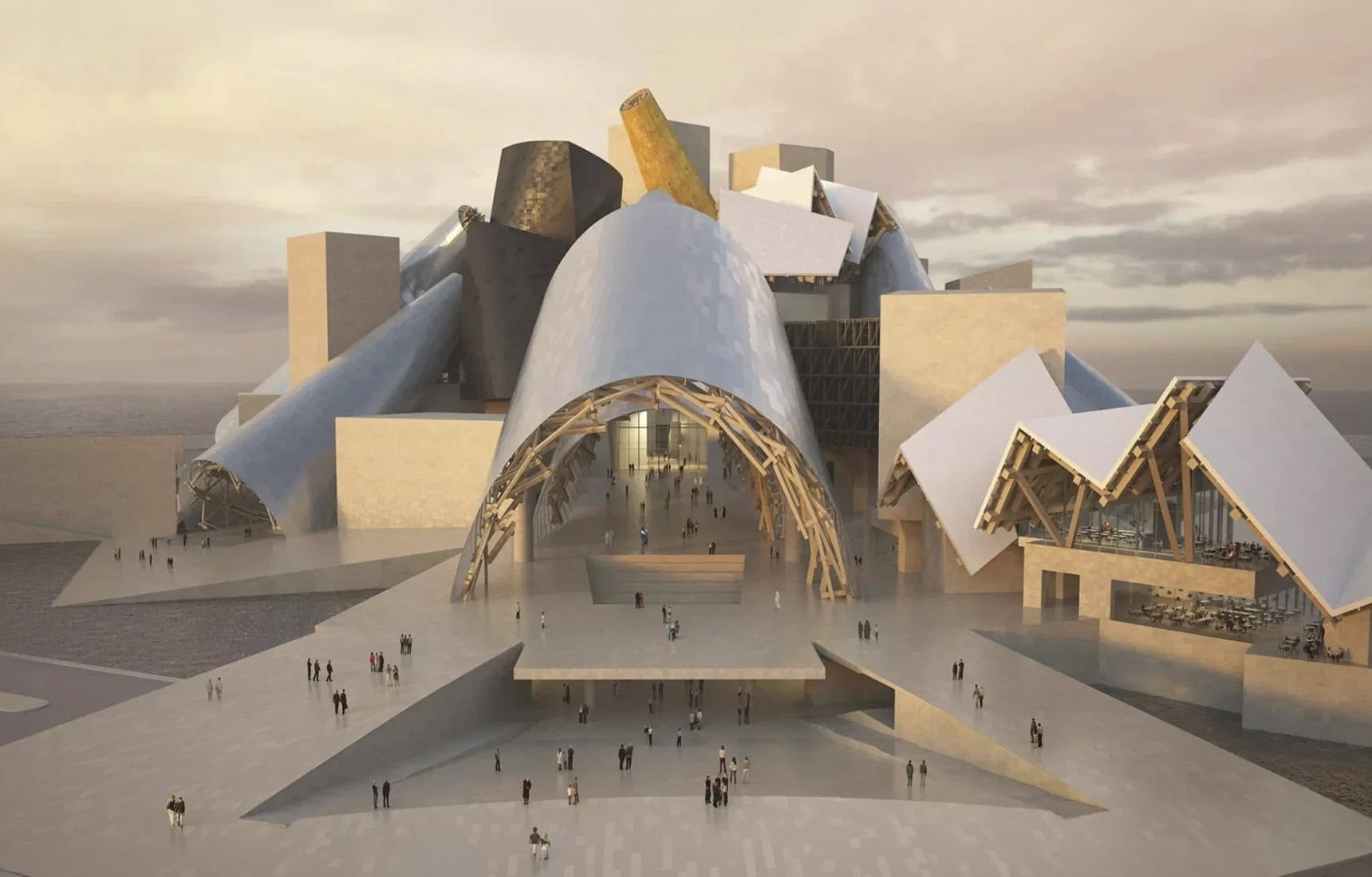
Another cascade of titanium curves on Saadiyat would have carried the Guggenheim name on its own. Gehry went further. He looked at where he was building, at the heat, the light, and the long architectural memory of the Gulf, and he let the desert reshape his own language. The Guggenheim Abu Dhabi is unmistakably a Gehry building, all fragmented volumes and restless geometry. But its defining element does not come from his sculptural imagination. It comes from the Arabian past.

The eleven cones, and the wind tower reborn
The signature of the museum is its cones, and they are the key to everything.
Eleven great cone-like structures rise through the building, some of them vast, together holding around 13,000 square metres of gallery space. At first glance they read as pure Gehry, strange sculptural funnels breaking up the skyline. Look closer, and they are something much older and much cleverer. The cones are drawn directly from the barjeel, the traditional Arabian wind tower, the tall shaft that for centuries has stood over desert houses to catch the breeze, draw it down, and cool the rooms below without a scrap of electricity.
Gehry has taken that ancient device, scaled it up to the size of a museum, and made it the building’s engine. The cones are designed to naturally cool and ventilate the covered courtyards at the museum’s heart, shading them from the sun and moving air through them the way a wind tower always has. So the most spectacular sculptural gesture in the building is also its climate system. The thing that looks like the boldest flight of an architect’s imagination turns out to be the desert’s own oldest answer to its own oldest problem, rebuilt at monumental scale.
That is a genuinely lovely piece of thinking, and it places the Guggenheim Abu Dhabi squarely within the most intelligent current in Gulf architecture. Again and again, the best recent buildings here reach the same conclusion, that the region’s traditional answers to heat and light were the right ones, and that the job of contemporary design is to translate them rather than replace them. Muraba Veil rebuilt the mashrabiya as a steel veil. Desert Rock carved itself into a mountain to be cooled by rock. Gehry, of all people, reached for the wind tower. That he arrived at the same instinct, in his own wild sculptural language, tells you how sound the instinct is.

Galleries that float
Inside, the museum keeps the sense of a place that refuses to sit still.
Gehry has arranged the exhibition spaces as a cluster of floating galleries, suspended volumes linked by catwalks and walkways, so that moving through the museum becomes a journey across bridges and levels rather than a march down corridors. The idea is that the architecture and the art are experienced together, that you are always aware of the extraordinary space you are moving through even as you look at the work it holds. Between the metallic outer surfaces, which catch and change the desert light through the day, and the shaded, wind-cooled courtyards within, the building is designed to feel like a small city of art rather than a single hall.
Around the galleries sits a full cultural institution. The museum will house a centre for art and technology, a children’s education facility, archives, a library and a conservation laboratory, the working machinery of a museum built to last generations rather than seasons.

A collection with its own point of view
The Guggenheim Abu Dhabi is not only Gehry’s building. It is also a deliberate act of cultural repositioning, and its collection is where that ambition shows.
Developed in partnership between the Department of Culture and Tourism Abu Dhabi and the Solomon R. Guggenheim Foundation, the museum will focus on modern and contemporary art from around the world, with a particular commitment to the art of the Middle East, North Africa and South Asia, the region often abbreviated to MENASA. That focus matters. The museum sets out to tell the story of global contemporary art with this region near its centre, giving established and emerging artists from the wider Gulf and its neighbours a stage of genuine international weight. Painting, sculpture, photography, video and digital media will all sit within a programme designed to start conversations across cultures and to build a collection with lasting scholarly depth.
Frequently asked questions
Who designed the Guggenheim Abu Dhabi?
Frank Gehry, the architect of the Guggenheim Museum Bilbao. The Abu Dhabi museum is a partnership between the Department of Culture and Tourism Abu Dhabi and the Solomon R. Guggenheim Foundation, on Saadiyat Island.
How big is it?
Around 42,000 square metres, which makes it the largest Guggenheim museum in the world, larger than Gehry’s own Bilbao.
What are the cones?
Eleven large cone-like structures inspired by the traditional Arabian wind tower, or barjeel. They provide gallery space and naturally cool and ventilate the museum’s covered courtyards, so they are both sculptural and functional.
What is the project timeline?
Plans were first revealed in 2006 and construction began in 2011, with the project paused for several years before resuming. It is opening nearly two decades after it was first announced.
What will the collection focus on?
Modern and contemporary art from around the world, with a particular emphasis on the Middle East, North Africa and South Asia (MENASA) region.

Final thoughts
The Guggenheim Abu Dhabi will be remembered for a great deal more than its scale. What makes this building matter is the intelligence that runs all the way through it. Abu Dhabi asked the architect of the most influential museum of the last fifty years to work his magic again, and rather than repeat himself, Gehry read the place he had been given and built something that belongs to it.
The lasting image is those eleven cones, rising over Saadiyat like the sculptures only Gehry makes, quietly doing the work of a wind tower that has cooled desert houses for a thousand years. After nearly twenty years in the making, the largest Guggenheim in the world is arriving not as a foreign object set down in the sand, but as a building that learned the desert’s oldest lesson and made it beautiful all over again. It joins Jean Nouvel’s Louvre Abu Dhabi and Mecanoo’s Natural History Museum to complete Saadiyat’s trio of landmark museums.


Leave a Reply