
ARCHITECTURE · ABU DHABI
Reading time: 7 minA building shaped like a rock formation, telling the story of 13.8 billion years. And inside it, two objects that make that number real: a meteorite older than the Earth that still smells of rotten peanut butter, and the most expensive dinosaur ever sold. Mecanoo‘s Natural History Museum Abu Dhabi, now open on Saadiyat, is deep time you can walk into.
Most museums tell you about deep time. The Natural History Museum Abu Dhabi hands it to you.
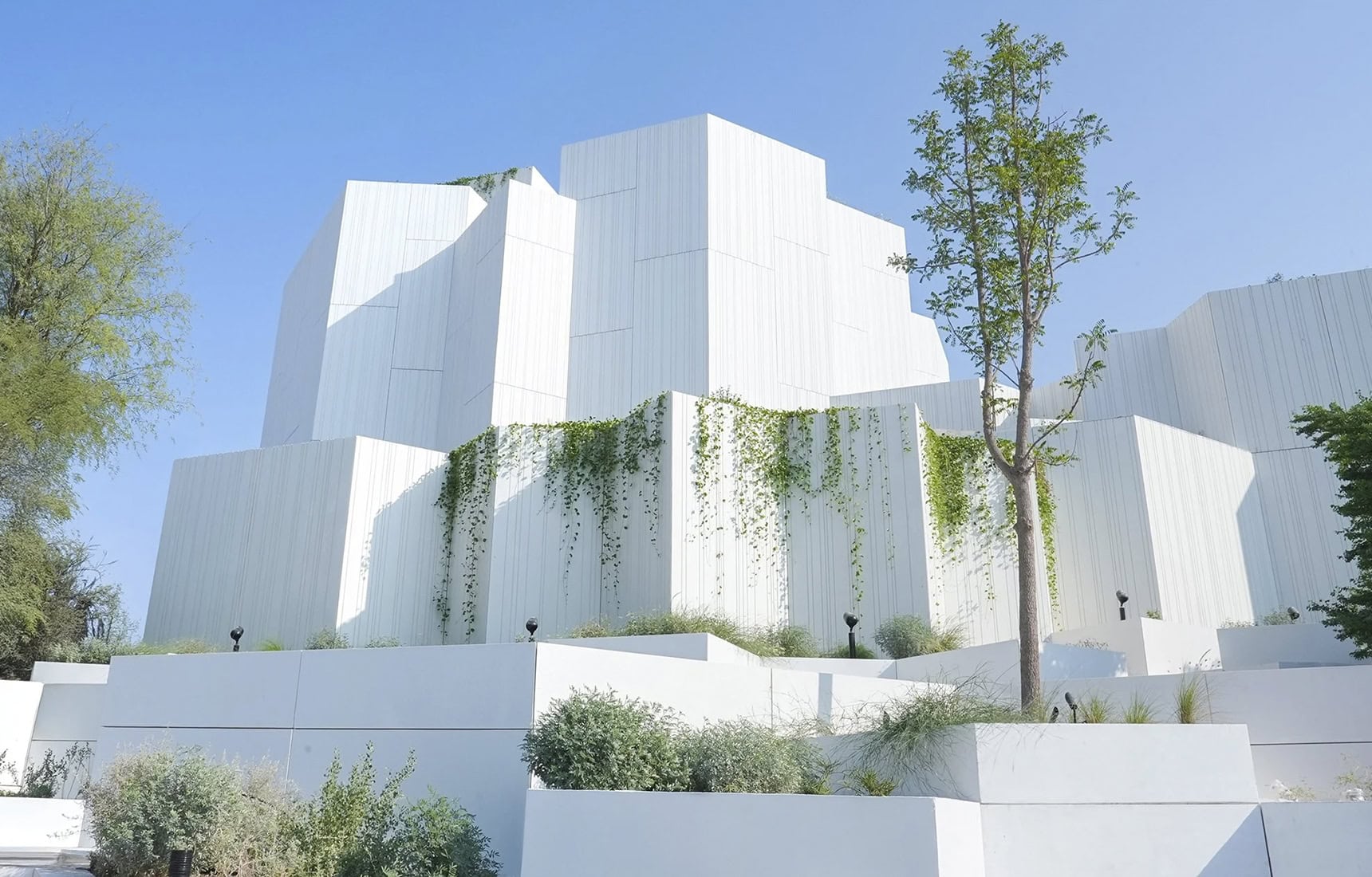
Now open on Saadiyat Island, it welcomed its first visitors on 22 November 2025. It is the largest of its kind in the Middle East, and it sets itself an almost absurd brief: to tell the story of 13.8 billion years, from the Big Bang to the future of the Earth, in a single building. Designed by the Dutch practice Mecanoo, it rises from the island like an eroded rock formation, less a constructed object than something the desert pushed up over millennia.
The temptation with a building like this is to talk only in the abstract, architecture as time, space as narrative, the museum as a “journey.” All of that is true, and I will come to it. But it risks missing the thing that actually makes this museum thrilling, which is not a concept at all. It is the objects. Because the Natural History Museum Abu Dhabi doesn’t just describe 13.8 billion years. It owns pieces of it, and two of them are among the most extraordinary things you can stand in front of anywhere on Earth.

A meteorite older than the world
Start with the oldest thing in the building, because nothing puts a human life in proportion quite like it.
The museum holds a fragment of the Murchison meteorite, a lump of primitive space rock that fell on Victoria, Australia, in 1969. Its parent asteroid formed around 4.5 billion years ago, at the very birth of our solar system, which makes it older than the Earth itself. More astonishing still, buried inside it are pre-solar grains that predate the Sun, specks of solid matter forged around other, dying stars before ours had even ignited. It is, quite literally, some of the oldest material human beings have ever held.
And here is the detail that makes it unforgettable, and that no wall text could improve on: it smells. Because of the organic compounds locked inside it, the Murchison meteorite gives off a faint whiff of rotten peanut butter or Brussels sprouts, a scent it has carried since before the planet existed. There is something wonderful about that. The birth of the solar system, and it smells like an overcooked Sunday lunch. It is exactly the kind of small, humbling, human fact that turns a science museum from a lecture into a memory.

The most expensive dinosaur on Earth
Now the crowd will gather somewhere else: in front of Stan.
Stan is one of the most complete Tyrannosaurus rex skeletons ever found; a 66-million-year-old apex predator and one of the best-preserved to come out of the ground. He is also, and this is the part that made headlines, the most expensive fossil ever sold: in 2020, Stan went under the hammer at Christie’s in New York for $31.8 million, roughly four times his highest estimate, to a then-anonymous buyer. That buyer, it turned out, was Abu Dhabi, acquiring him for exactly this museum.
That is a serious statement of intent, and Mecanoo’s architecture rises to it. Rather than stand Stan alone in a glass case, the museum stages him in a world-first scene: locked in combat with a second T. rex and a Triceratops, a moment of Cretaceous violence frozen mid-lunge beneath the building’s soaring central volume. It is theatre, unashamedly, but it is the right kind, the kind that makes a nine-year-old go very quiet.
Between a meteorite older than the planet and a predator that ruled it, the museum has bracketed almost the entire story of matter and life. And that, finally, is what makes the architecture make sense.

Architecture shaped like time itself
Mecanoo’s building is the vessel these objects deserve, and its logic is geological.
The practice, led by Francine Houben, one of the most thoughtful architects working today, drew directly on geological strata and desert rock formations, grounding the museum in the physical language of the Arabian Peninsula. The massing is monolithic yet fragmented, all shifting planes and angular geometry, so that the building reads like a landscape shaped by erosion and sedimentation rather than a single designed façade. Its surfaces are textured, layered and weighty, in the tones of desert stone. Among the landmarks of the Gulf, this is a deliberately quiet, deeply embedded kind of building, one that looks like it belongs to the ground it stands on.
Inside, across roughly 35,000 square metres, the architecture turns fluid. Spaces expand and contract to carry visitors on a chronological journey: the Big Bang, the forging of the solar system, the rise and fall of the dinosaurs, the riot of life, the planet’s future, so that the building itself becomes the storytelling device, not merely the container for it. At its heart is a vast, cathedral-like atrium where scale does the work of awe, and where Stan’s frozen battle hangs in space as part of the architecture rather than an exhibit dropped into it.
The cleverness is the fit. A building that looks like compressed geological time, holding objects that are geological time, telling the story of time itself. Form, content and idea are, for once, the same thing.

The science wing of a cultural capital
The museum also completes something bigger than itself.
It sits within the Saadiyat Cultural District, alongside the Louvre Abu Dhabi, the Guggenheim Abu Dhabi, and the Zayed National Museum; a masterplanned cluster in which Abu Dhabi is, quite deliberately, treating culture as infrastructure. But where its neighbours tell stories of art and national identity, the Natural History Museum adds a dimension they don’t: science and planetary-scale perspective. It brings climate, biodiversity and deep time into a district otherwise devoted to human history, a fitting move for a nation whose whole story is bound up with landscape, resources and a hard, beautiful environment.
There is a scientific ambition here too, and it is a substantial one: through research laboratories, world-class specimens and international partnerships, the museum establishes Abu Dhabi as a centre for scientific enquiry, not just a keeper of treasures. That research will shape how the region reads its own landscape for decades. A city that will buy a meteorite older than the world, and a dinosaur nobody else could afford, and then build them a home shaped like the earth itself, is a city that has decided wonder is worth paying for.

Frequently asked questions
When did the Natural History Museum Abu Dhabi open?
It opened to the public on 22 November 2025 in the Saadiyat Cultural District, and is the largest natural history museum in the Middle East.
Who designed it?
The Dutch architecture practice Mecanoo, led by Francine Houben, whose design draws on desert rock formations and geological strata.
What are the highlight exhibits?
Stan, one of the most complete Tyrannosaurus rex skeletons ever found and the most expensive fossil ever sold ($31.8 million at Christie’s in 2020), displayed in a world-first battle scene; and the Murchison meteorite, older than the Earth, containing grains that predate the Sun.
Why does the Murchison meteorite smell?
Organic compounds inside it give off a faint odour often compared to rotten peanut butter or Brussels sprouts — a scent it has carried since before the solar system formed.
What story does the museum tell?
A single continuous journey through 13.8 billion years, from the Big Bang and the formation of the solar system to the evolution of life and the future of the planet.

Final thoughts
The original promise of this building — architecture as time made spatial — could have stayed a lovely abstraction. What makes the Natural History Museum Abu Dhabi genuinely moving is that Mecanoo built the concept a home worthy of what goes inside it, and what goes inside it is real: a rock older than the world, a monster from the end of the age of dinosaurs, and 13.8 billion years strung between them.
Stand in that great atrium, with Stan mid-roar above you and, somewhere nearby, a meteorite quietly smelling of the beginning of everything, and the point lands without a single wall of explanatory text. Architecture, at its most powerful, isn’t only about space. Here, on the edge of Saadiyat, it’s about time — and about a city bold enough to put the whole of it under one roof.

Leave a Reply