
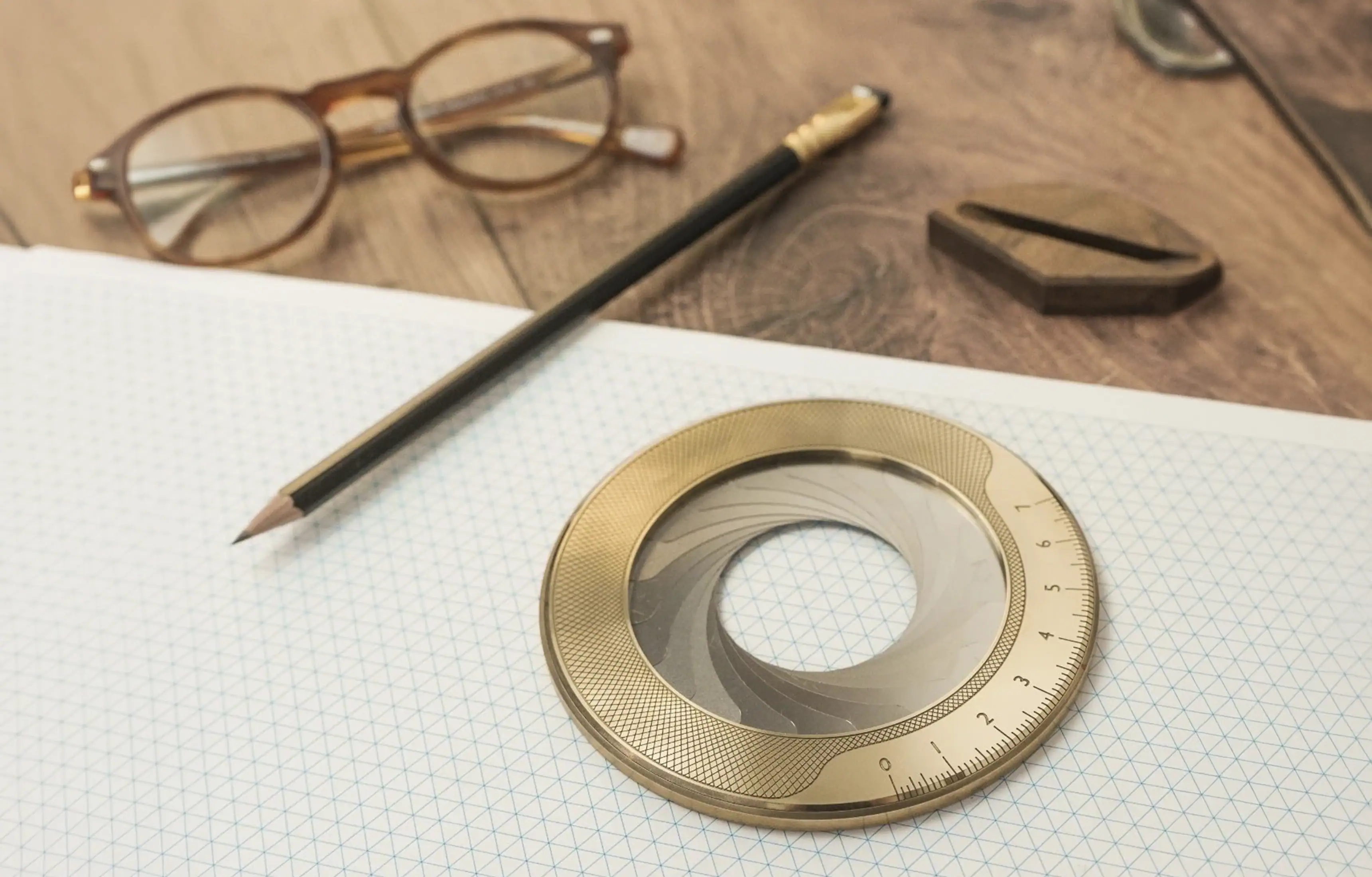
Makers Cabinet builds pencil sharpeners, compasses and rulers by importing mechanisms from trades that have nothing to do with stationery: a woodworking hand plane, a camera aperture, a cabinetmaker’s dovetail joint. The London studio, founded by three product design students at Central Saint Martins in 2017, has spent the years since proving that a tool engineered to last a lifetime does not have to look like it belongs in a museum. What began as one Kickstarter-funded pencil sharpener has grown into a catalogue built entirely on the same idea, borrow the mechanism, keep the material honest, design for repair rather than replacement.
Makers Cabinet: from a broken pencil sharpener to a design studio
Odin Ardagh, Ben Weininger and Noah Bier met in their first year studying product design at Central Saint Martins. By the time they graduated, in 2020, they had already been running a company for three years. It started, like a lot of the best design briefs, with a small and specific irritation: a pencil sharpener that chewed up good pencils instead of pointing them. The fix Ardagh landed on was not a better version of a sharpener. It was a different tool altogether, borrowed from a discipline that has nothing to do with stationery, and it set the pattern for everything the studio has made since.
The company launched in 2017 under the name Brahman Design, and rebranded to Makers Cabinet in early 2019, a name that turns out to be more literal than it first sounds. Its three signature tools, a pencil sharpener, a drawing compass and a folding ruler, each work by taking a mechanism developed for an entirely different job and re-engineering it for the stationery drawer. A hand plane becomes a sharpener. A camera aperture becomes a compass. A cabinetmaker’s dovetail joint becomes a ruler’s hinge, which, for a studio named after a workshop, is the kind of detail worth noticing. That habit, reaching outside the discipline for the working part rather than styling a familiar one more expensively, is the actual design argument behind a catalogue that could otherwise be filed under “nice stationery” and forgotten.

A hand plane becomes a pencil sharpener
The idea for the Høvel, Norwegian for “plane,” came from Ardagh’s own family workshop rather than a mood board. Back in Norway for Christmas during his first year at Central Saint Martins, he picked up a hand plane to help with some woodwork and had what the studio has since described as a eureka moment: the same shaving action that squares off a piece of timber could, at a much smaller scale, put a custom point on a pencil. Where a standard sharpener forces every pencil through one fixed cone, a plane lets the user choose the angle and the length of the point, and keep choosing, blade pass by blade pass, until it is right for the job.
Ardagh, Weininger and Bier built roughly thirty prototypes on the university’s 3D printers before they had a version worth showing anyone, then took it to Kickstarter on 13 June 2017 with a modest £10,000 target. It closed at £25,533 from 432 backers, funded well before the trio had finished their degrees. The finished object is precision-machined brass or anodised aluminium, weighs 90 grams, and ships with a set of carbon steel replacement blades, so a blunt Høvel is a five-minute fix rather than a reason to buy a new one. An optional wooden base, in ash or cherry, catches the shavings and doubles as a stand.
The idea proved sturdy enough to travel beyond the studio’s own workshop. In 2022, the pencil maker Blackwing commissioned a limited edition, the Blackwing Høvel, in anodised aluminium with a matching black wooden base and ten carbon steel blades, extending the same plane mechanism to charcoal, pastel and cosmetic pencils as well as ordinary graphite. It is a useful measure of how sound the original idea was: a pencil brand with its own strong point of view chose to build on Ardagh’s mechanism rather than commission something new.

A camera aperture, reengineered for paper
The Iris compass exists because Høvel’s own backers said so. Once the studio had a community of people who cared about drawing tools, Ardagh, Weininger and Bier asked them what else in the stationery drawer was underperforming, and heard the same complaint about circle-drawing tools again and again: unreliable, awkward to hold steady, prone to slipping mid-line. The studio’s answer came from a hobby rather than a textbook. As Weininger has explained it, the three of them were amateur photographers, and it struck them as odd that the iris diaphragm at the heart of a camera lens, a ring of overlapping blades that opens and closes with total precision, had never been redirected toward drawing.
The Iris compass carries that mechanism over almost exactly. Twenty stamped stainless steel leaves rotate inside a solid brass ring, closing to a point at the centre and scaling outward to draw a circle of the chosen radius, with the diameter read directly off a scale laser-etched at one-millimetre intervals and marked with a red dot for repeat settings. A natural rubber base keeps the leaves gripped to the paper, and a small wooden stand holds the whole assembly upright, and locates the circle’s centre point, when it is not in use. The tool launched on Kickstarter on 8 May 2019, was half-funded within a single day, and eventually closed more than seven times over its original goal. The studio has since added an Iris Large Format for architects and illustrators working at a bigger scale, using the same aperture principle to reach radii the original was never built for.
The dovetail joint that gave a ruler a memory
Stria, launched on Kickstarter in August 2020, is where the studio’s borrowing habit closes a loop. A folding ruler needs a hinge, and the hinge the team chose is a dovetail joint, the same interlocking, glue-free joint that has held cabinet drawers and furniture carcasses together for centuries, and the same joint a cabinetmaker’s workshop, the kind of place the studio’s own name gestures toward, would recognise on sight. Machined into a ruler’s spine rather than a drawer corner, it gives Stria something a standard hinge cannot: a positive, engineered click at 45, 90 and 135 degrees, so the ruler can be set to a precise angle by feel, without looking down to check it against a protractor.
The ruler itself is CNC machined from solid brass or steel and hand-finished by the studio’s manufacturing partners, extends to roughly 30 centimetres, and carries metric on one edge and imperial on the other. Where the Høvel and the Iris both answered a specific, named frustration, Stria reads as the more confident move, a studio secure enough in its own design language to reach for a joinery technique rather than a mechanism plucked from an unrelated hobby, and trust that the connection back to its own name would hold.

Three years running a company before finishing a degree
What is easy to miss in the run of Kickstarter figures is that none of this happened after graduation. Ardagh, Weininger and Bier launched Høvel in their first year at Central Saint Martins and were still running the company, fulfilling orders, sourcing manufacturers and building Iris, when they finished their degrees in 2020, into the middle of the pandemic. Early manufacturing runs were sourced through Alibaba before the studio built more reliable relationships through dedicated sourcing agents, a detail that matters less for what it says about supply chains than for what it says about three students learning to run a factory relationship at the same time as they were learning to draw. A brief attempt at conventional wholesale, showing the products at trade stands, did not stick, and the studio settled instead on direct-to-consumer sales through its own site and successive Kickstarter and Indiegogo campaigns, a model it has kept for every product since.
The studio’s ambitions were never confined to stationery. As Bier has put it: “We dream that one day we might produce a fridge or something similar, but for now, in stationery, we share that experience and aim to disrupt the whole industry.” It is a useful line for understanding why every Makers Cabinet tool, from the Høvel’s swappable blades to Stria’s serviceable hinge, treats the moment of purchase as the start of a long relationship with an object rather than the end of a transaction.
What the catalogue looks like now
The three founding products have since been joined by a wider range built on the same logic: the Lazlo ballpoint pen in polished brass or anodised aluminium, the Ferrule brass pencil holder, and the Elipso ellipse-drawing tool, alongside the Iris Large Format. The studio has also taken on collaborators rather than working in isolation. Beyond the 2022 Blackwing partnership, it worked with the watercolour brand Etchr on a solid brass Brass Palette, complete with a removable glazed porcelain paint tray and a lid that doubles as a mixing surface, which shipped to backers in April 2026.
That Etchr relationship has since grown into something more structural. In April 2026, Makers Cabinet announced that Etchr would take over its day-to-day operations, logistics and customer experience, while the founding team keeps hold of design. It is a shift in how the objects reach people, not in who designs them or what they are made of, and the studio has framed it as room to take on more ambitious projects rather than a step back from the workshop floor. Eight years after three students launched a pencil sharpener from a university 3D printer, the same working method, look outside stationery for the mechanism, then engineer it properly, is still what the catalogue is built on.

Frequently asked questions
What is Makers Cabinet?
A London design studio that makes precision drawing and writing tools, including a pencil sharpener, a compass and a folding ruler, engineered from solid brass, steel and FSC-certified wood and designed to be repaired rather than replaced.
Who founded Makers Cabinet, and when?
Odin Ardagh, Ben Weininger and Noah Bier, who met studying product design at Central Saint Martins in London. They launched their first product in 2017 under the name Brahman Design, while still students, and rebranded to Makers Cabinet in early 2019.
What is the Høvel, and how is it different from a normal pencil sharpener?
A precision-machined pencil sharpener, in brass or anodised aluminium, that works on the same shaving principle as a woodworking hand plane rather than forcing the pencil through a fixed cone. It gives the user control over the angle and length of the point and uses replaceable carbon steel blades.
How does the Iris compass work?
Twenty stainless steel leaves rotate inside a solid brass ring, using the same mechanism as a camera aperture, closing to a point and opening to the chosen radius, which is read off a scale laser-etched at one-millimetre intervals.
What is Stria?
A folding ruler in solid brass or steel that uses a dovetail hinge, the joint traditionally used in cabinetmaking, to click into place at 45, 90 and 135 degrees. It carries metric and imperial scales on opposite edges.
Where are Makers Cabinet’s tools made, and is there a warranty?
The studio designs in London and manufactures through partner workshops, using CNC machining and hand finishing. Products carry a lifetime warranty covering repair, and blades and other wearing parts are sold as standalone replacements.
Final thoughts
It would be easy to describe Makers Cabinet as a brand that makes nice stationery out of brass, and technically that would even be true. It would also miss the actual design decision that runs through every product the studio has released since 2017: none of its mechanisms were invented for stationery in the first place. A hand plane, a camera aperture and a cabinetmaker’s dovetail joint were each built to solve a completely different problem, and each has been re-engineered, blade by blade and joint by joint, into an object that fits in a pencil case. That the studio named itself after a cabinetmaker’s workshop, then years later built its most literal tribute to that trade into a ruler’s hinge, is the kind of detail that only becomes visible once you look at the whole catalogue rather than one product at a time. It is also the clearest evidence that the borrowing was never a gimmick. It is the studio’s actual method.


Leave a Reply