
DESIGN TRAVEL · SWEDEN
Reading time: 10 minAlmost everything written about Icehotel treats it as a spectacle. It is more interesting than that. It is a building made from two materials that behave in completely opposite ways, put up by eighty-nine people in six weeks, on a site where the material changes faster than the drawings. Its creative director describes the relationship between designer and material as, in his words, almost upside down.
Icehotel stands at Jukkasjärvi in Swedish Lapland, about 200 kilometres north of the Arctic Circle, on the bank of the Torne River. The village name comes from the Sámi Čohkkiras, roughly a meeting place by the water, and the settlement dates to the seventeenth century.

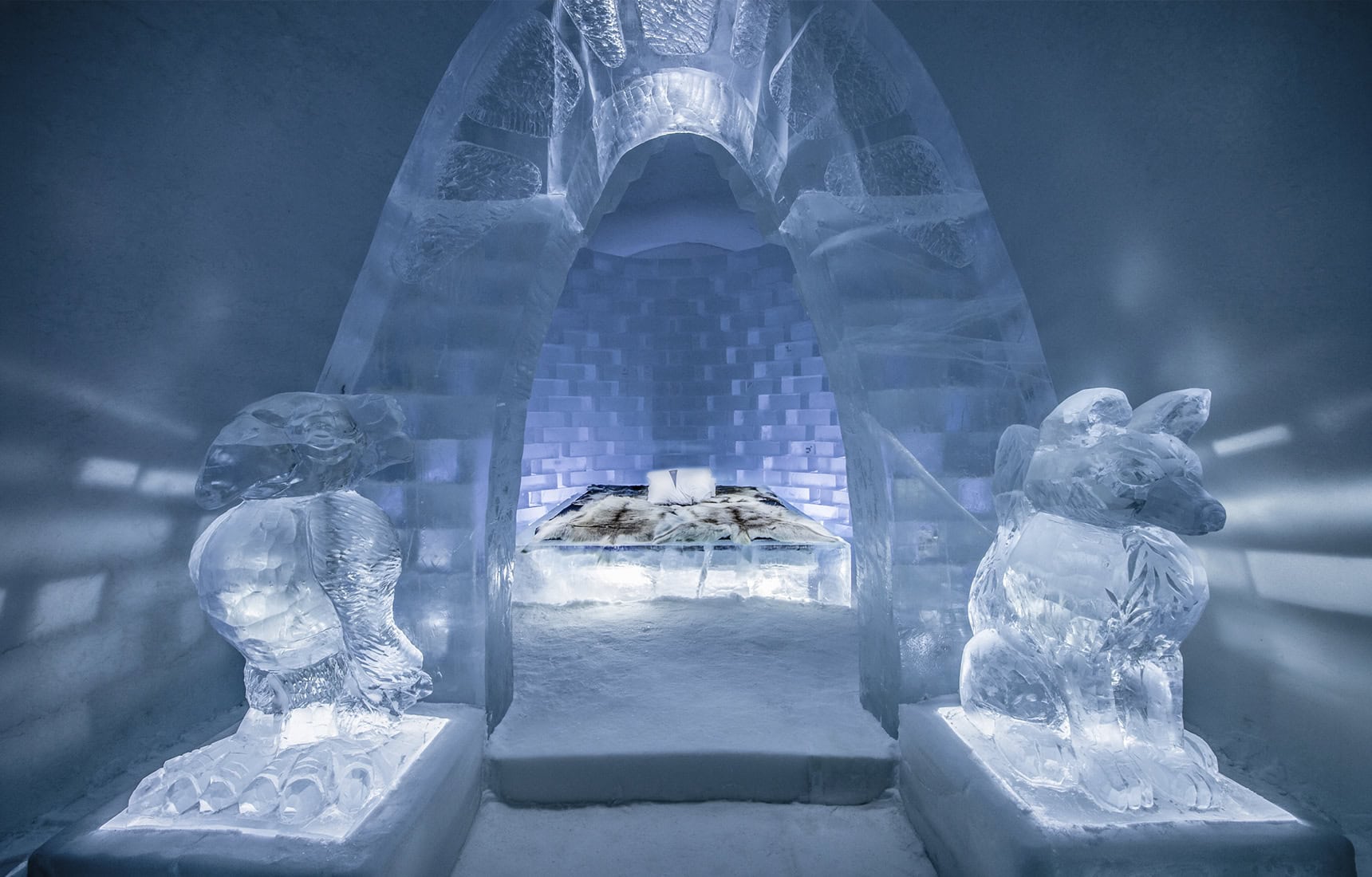
The winter hotel is built new every November and melts back into the river every spring. The most recent edition, Icehotel 36, ran to 2,800 square metres, was made by 89 builders, artists, lighting designers and support staff in six weeks, and held 33 artists from 12 countries. Alongside it stands Icehotel 365, a permanent, solar-cooled building of 2,100 square metres that has been open all year since 2016.
It is worth saying clearly, because it changes what you can do with the information: in summer, only Icehotel 365 is standing. Icehotel 36 melted in the spring. Icehotel 37 opens on 11 December 2026, and is being built from 24 November.
What follows is about how it is made, because the making is the design.

Clear ice and snice do two different jobs
The single most useful thing to understand about this building is that it uses two materials, not one, and they behave in opposite ways.
Clear river ice is the precious one. It is cut from the Torne between mid-March and mid-April, when the ice reaches around 80 centimetres thick, in blocks weighing up to two tonnes, by machinery built for the purpose. Icehotel harvests roughly 5,000 tonnes a year and holds it through the summer at about minus five degrees. The winter hotel consumes something in the order of 550 tonnes of it. This is the transparent, sculptural material: the art, the furniture, the bar, the windows, the drinking glasses.
Snice is the structural one. It is snow and river water combined, and it is not carved at all. It is sprayed onto steel moulds, left to harden for about two days, and then the moulds are struck and the shell stands up on its own. Icehotel 36 used around 32,700 cubic metres of it, roughly ten Olympic swimming pools. It is white and opaque, and that opacity is functional: snice reflects sunlight and slows melting in a way clear ice does not.

So the logic of the building is legible the moment you know the difference. The white material holds the place up. The clear material is what you look at. Walls, floors and ceilings in snice; everything designed to be seen, in ice.
The geometry follows from that too. The moulds produce arches, and Icehotel’s own description is refreshingly plain about why: corridors and rooms are built in the same way as classic arches, which are incredibly stable. A material with no tensile strength worth speaking of, formed into the one shape that does not need any.
And the harvest figure worth keeping is the studio’s own: roughly ten seconds of the Torne’s flow supplies the material for an entire year’s building.

The material outranks the designer
Luca Roncoroni has been creative director since 2019. He trained as an architect, arrived at Icehotel early in his career as a builder’s apprentice, and has worked there every winter since 2010.
His account of designing in ice is the most interesting thing any of the people involved have said, and it is worth quoting properly, because it inverts the usual relationship.
“The ice chair, the walls, they are moving and changing,” he says. “We don’t have the same power as we would normally have.” And, more directly: “You don’t own the product in the same way, the power of the relationship is almost upside down.”

That is a rare admission from a designer and it is the honest description of the discipline here. Elsewhere he puts the same thought positively: “The goal is to work with the material in a very flexible and organic way, following the ‘frames’ set by the climate.” And: “Ice changes by the day, and artists need to adjust to those changes.”
He is also good on why this stays fresh rather than becoming a formula. “Every year the ice is different, and we are reminded of the ephemerality and the allure of our project.”
His predecessor Arne Bergh, creative director from 1997, set the rule that keeps it honest: “We don’t accept anything but original art. It has to be original and we never copy, not even ourselves.” Nothing is repeated except the chandeliers.

A third of the artists have never touched ice
The annual open call is the mechanism, and one detail in it is genuinely admirable.
Around 150 proposals arrive each year, from architects, designers, engineers, graphic designers and artists, and roughly fifteen are selected. For Icehotel 37 the call accepts twelve. The jury judges on concept, innovation, visualisation and description, and deliberately looks for contrast between the schemes it picks, balancing gender, origin, age and experience.

Then this, from Roncoroni: “Through this competition we have the goal that 30 per cent of artists we choose are ‘rookie’. People that have never worked with ice and snow.” His reason is the good one. “They come with a completely open mind, and no restrictions. That is what keeps us a reference point.”
Deliberately handing a third of the annual output to people who have never used the material is a bold and generous thing to build into a selection process, and it is the reason the suites never settle into a house style.
The selected artists come to Jukkasjärvi for two weeks in late November and early December, are housed and fed, given a tool kit, warm clothing, an instructor and a support team of experienced ice artists, and are paid an honorarium plus travel. They are sent downloadable 3D models of the room shells in advance so they can design against the real geometry. Then they work the frozen shells with chisels and irons.

Light is the second material
Jukkasjärvi in December is close to permanent darkness, so light is not a finishing layer here. It is structural to the experience.
Every artist is paired with a lighting designer, and Roncoroni is explicit that the artists lead it: “With light we have no limitations. It is completely in the artists’ hands.” Icehotel’s own framing is that light does not simply illuminate the work but enhances and highlights it.
That matters because of what the two materials do to light. Snice scatters it and glows softly. Clear ice transmits it, refracts it and carries it several metres through a block. Lighting a room made of both is closer to lighting glass than lighting a wall.

Craft, and where it comes from
The most enjoyable thing about the recent editions is watching skills arrive from other trades.
Soap Bubbles, one of the Icehotel 36 suites, was made by Coralie Quincey and Peter Hobbs, and both of them trained as stonemasons. Quincey apprenticed with stonemasons for over a decade; Hobbs specialised in historic building restoration. Carving technique developed for limestone, transferred to a material that will be gone by April.

Elsewhere in the same edition, Pieke Bergmans and Peer de Wit made ICE AS MIRROR, a designer and a contractor working together, with a statement that describes the whole enterprise as well as their own room. The ice, they wrote, is “cut from the flow, carried here, out of context, exposed” and shown “Not as objects, but as something alive: holding memory, presence, transformation” until it “softens, dissolves, and flows back to the living river it came from.”
Kristina Möckel and Sebastian Scheller filled a room with sculpted books, each one standing for a story from a previous Icehotel. Brian McArthur and Dawn Detarando made the thirty-metre main hall, Cathedral Grove. And the edition included a full-scale, playable grand piano made entirely of ice. Roncoroni on that: “Assembling it was both nerve-racking and magical. We didn’t know if it would hold until the very last minute.”

The sun that used to melt it now keeps it cold
Icehotel 365 opened in 2016 and is the cleverest thing on the site.
It is a 2,100 square metre permanent building holding eighteen suites, nine art and nine deluxe, plus a gallery, a sauna and ICEBAR, all held at minus five degrees all year. The sustainability design is by the Swedish architect Hans Eek, and his one-line description of the problem is perfect: “Normally you build to keep the heat in, but here we’re building to keep the heat out.”

The cooling comes from solar. Between May and July, during the midnight sun, an array Icehotel now gives as 875 square metres captures continuous daylight and converts it into cooling energy, with a further 800 square metres of panels on the roof of the ice storage warehouse. The original 2016 specification was rated at 75 kilowatts in summer, with surplus feeding the rest of the site.
Arne Bergh put the paradox best at the time: “The sun which melted the art in the past, is essential for making the year-round art experience possible.”
That is a genuinely elegant piece of environmental design, and it is the reason a summer visit is possible at all.

Where it came from, and the glass
The origin is a good story and it is worth telling accurately.
In 1989, Yngve Bergqvist, who ran an inn in the village, came back from the Sapporo winter festival in Japan and organised a workshop with two Japanese ice sculptors to teach local artists the technique. The result was Arctic Hall, an igloo-form gallery on the frozen river that started at 60 square metres and grew to 250, serving as gallery, church, cinema and bar. The construction technique was patented in Sweden and Norway. His motto was “dig where you stand.”

The hotel itself arrived by accident. The village cabins were full, so visitors were offered sleeping bags and reindeer skins inside the igloo. Accounts of exactly which night counted as the first differ, and the hotel proper emerged over the following two or three winters, but that is where it starts.
More than 500 artists have worked there since, and more than a million people have visited.
The other invention worth knowing about happened in 1995, when the architect Åke Larsson and Arne Bergh were drinking whisky and asked why they were using plastic cups when they were surrounded by ice. They carved the first glasses from river ice, and the phrase “in the rocks” came out of that evening. The design has barely changed since, and Icehotel now produces well over a hundred thousand ice glasses a year, shipped in refrigerated containers to the Icebars in Stockholm, London and Copenhagen. Each of those runs at a different temperature: London at minus four, Copenhagen at minus five, Stockholm at minus seven point two.

Frequently asked questions
Where is Icehotel?
At Jukkasjärvi in Swedish Lapland, on the Torne River, about 200 kilometres north of the Arctic Circle.
Is it open in summer?
Icehotel 365, the permanent solar-cooled building, is open all year. The winter hotel is built each November and melts in spring.
When does the next edition open?
Icehotel 37 opens on 11 December 2026, built between 24 November and 9 December.
What is it made of?
Two materials. Clear ice cut from the Torne River in blocks of up to two tonnes, used for art, furniture, the bar and the glasses; and snice, a mixture of snow and river water sprayed onto steel moulds, used for walls, floors and ceilings.
How is it built?
Snice is sprayed onto steel moulds and left to harden for around two days. The moulds are then removed and the arched shells stand on their own. Icehotel 36 took six weeks and 89 people.
How much ice is used?
Roughly 5,000 tonnes are harvested each year, of which the winter hotel uses in the order of 550 tonnes of clear ice alongside about 32,700 cubic metres of snice.
How cold is it inside?
Around minus five degrees, in both the winter hotel and Icehotel 365.
Who designs the rooms?
Artists selected through an annual international open call. Around 150 proposals are received and roughly fifteen chosen, with a deliberate target that thirty per cent have never worked with ice and snow before.
How does Icehotel 365 stay frozen?
Solar cooling. Panels capture the continuous daylight of the midnight sun between May and July and convert it into cooling energy.
When did it start?
With an ice sculpting workshop led by Japanese artists in 1989 and a gallery called Arctic Hall, founded by Yngve Bergqvist.


Final thoughts
Icehotel photographs so well that the pictures tend to do the talking, and understandably so.
Explained rather than photographed, it turns out to be an unusually rigorous piece of design. Two materials, each doing the job it is suited to, one white and structural and one clear and expressive. An arch, chosen because it is the only geometry that works when your material cannot be asked to hang. A six week programme with eighty-nine people on it. A brief that arrives as a downloadable 3D model of the shell. A rule that nothing may be repeated, including by the people who made it last year. A deliberate policy of handing a third of the work to people who have never touched the material. And a permanent building that is kept frozen by the same sun that used to melt everything.

Roncoroni is right that the power in the relationship is upside down. He is also, quietly, describing the ideal condition for design. The material has an opinion. The weather has a deadline. The whole thing goes back in the river in April, and everyone knows it while they are making it.
Very few designers get to work like that. The ones who do seem to like it enormously.

Leave a Reply