
ART & CULTURE · LONDON
Reading time: 9 minJonathan Baldock’s installation for the Gallery at sketch did not begin in Mayfair. The eighty-four ceramic masks trace back to a ceramics fellowship he held nearly a decade ago, and the flower sculptures around the bar carry his own family’s history of hop-picking in Kent. The Gathering is the first time both strands of his practice have shared a single room.
Introduction
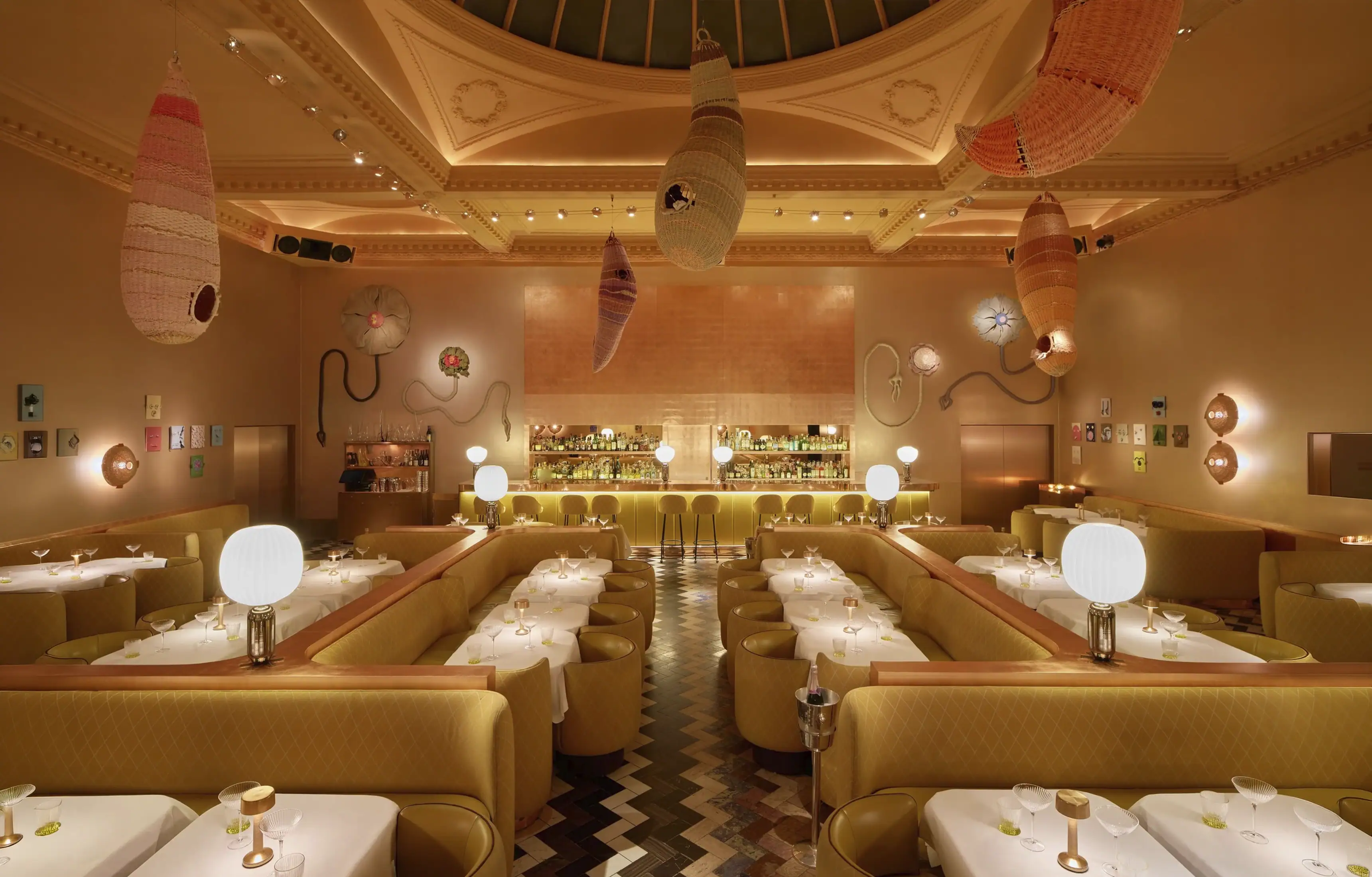
Eighty-four ceramic masks run in a staggered line around the copper walls of the Gallery at sketch. Flower sculptures gather around the bar and the maitre d’s stand, their petals opening into faces and hands. Overhead, in the room’s central dome, hand-spun wool cocoons hang suspended, each one split open to reveal a cast hand or foot inside.
The installation is called The Gathering, and it opened to the public on 13 January 2026. It is the work of Jonathan Baldock, a British artist working in ceramics, textiles and basketry, and it is the fourth body of work to occupy this particular room since the restaurant opened in 2002, following commissions by David Shrigley, Martin Creed and, most recently, Yinka Shonibare CBE RA.
What makes The Gathering worth reading closely is not that a well-known Mayfair dining room has a new artist on its walls. It is that almost none of what is hanging there was made for sketch. The masks are the current chapter of a series Baldock has been building since 2019, and the series itself traces back further still, to a fellowship he held at Camden Arts Centre in 2017 and 2018. The flowers draw on a family history of hop-picking in Kent that Baldock had already worked into a major public commission three years before sketch approached him. The Gathering is less a new work than a room built to hold two strands of an existing practice at the same time, in the same space, for the first time.

The masks started as a fellowship, not a commission
The rectangular ceramic plaques that make up Baldock’s Maske series are, in his own words, “my bread and butter.” He has said the format has been foundational to his practice since 2019, and eighty-four of them now run around the Gallery’s walls at sketch, hand-rolled, decorated, cast and glazed, each one distinct.
That date is not incidental. In 2017 and 2018, Baldock held the Freelands Lomax Ceramics Fellowship at Camden Arts Centre in north London, a programme built to give one artist sustained access to a ceramics studio and technical support across two full years. The fellowship culminated in Facecrime, his solo exhibition at Camden Arts Centre from 12 April to 23 June 2019, which hung forty-two rectangular ceramic tiles down a corridor alongside totem-like standing and fallen structures in the main gallery. The tiles combined fired clay, loosely applied glaze, cast ears and fingers, basketry sections and small clay tokens engraved with emoticons, a deliberate collision between the logograms on Ebla tablets from around 2500BC and the symbols people now use to signal emotion on a phone screen. The exhibition’s title borrowed from Orwell’s Nineteen Eighty-Four, where facecrime is the offence of wearing an unauthorised expression.
Facecrime is where the plaque format that became Maske first appeared at this scale, and the fellowship that funded it is where Baldock built the technical fluency in clay that makes eighty-four masks at sketch possible without any single one repeating. It is a detail that gets lost in coverage of the installation itself, because a fellowship at a public arts centre in 2017 does not photograph as well as a Mayfair restaurant wall in 2026, but it is the reason the wall works. The masks at sketch are not a one-off commission executed to a brief. They are the newest instalment of a series with a seven-year working history, made by an artist who has had time to get very good at exactly this.

The flowers carry his own family’s hands in the soil
Around the bar and the maitre d’s stand, Baldock’s flower sculptures do something the masks do not: they turn into bodies. Petals open into faces. Stems become limbs. The effect reads, at first, as pure invention, the kind of hybrid creature that belongs to folklore rather than to a garden.
It is not entirely invention. Baldock is a descendant of hop-gatherers and gardeners, and that ancestry surfaced directly in his 2023 to 2024 solo exhibition Touch Wood at the Yorkshire Sculpture Park, staged in the Weston Gallery and running until 7 July 2024. Among the works was Becoming Plant (A hop), a sculpture made specifically for that show that fused human and plant characteristics into a single hop-bine form, developed in dialogue with the carved medieval misericords in nearby Wakefield Cathedral and with sacred geometry found in nature. The senior curator on that exhibition, Sarah Coulson, described Baldock’s installations as work that “celebrates the history of sculpture and makers locally” while bringing “joy as well as challenge.” Baldock’s own account of the exhibition was direct: “The show deals with serious subjects, but with joy and humour. I believe these can be powerful tools of empowerment, which are very necessary today when we feel so numb to the very real crises the world is facing.”
The flower sculptures at sketch are built from the same idea, transplanted from a Yorkshire sculpture park to a Mayfair bar: the human body understood as something that grows, roots and belongs to the land, rather than something separate from it. Kent’s hop industry, which supplied the beer trade for centuries and drew whole East London families out for the annual hop-picking season, is not dressing on top of the work. It is where the work’s logic of bodies becoming plants started, in Baldock’s own family history, before it appeared in a sculpture park and now again at sketch.

What is inside the cocoons
The suspended forms in the room’s central dome are titled Warm Inside, and they are made from willow and wool, woven into cocoon shapes with openings that reveal a cast hand or foot within. Baldock hand-dyed and hand-spun the wool himself, from raw fibre, before weaving it into the finished structures. Read against a room, cocoons suggest shelter. Read against a body part visible through the opening, they suggest something closer to a womb or a chrysalis, a state of transformation rather than rest.
The technique matters as much as the image. Baldock has spoken about his commitment to hand production and to what he calls its “intimate imperfections,” in deliberate contrast to the smoothed, filtered surfaces that circulate on social media. He learned sewing, embroidery, knitting and crochet from his grandmother as a child, while his mother worked, and has said he chose craft processes partly because they were “affordable” and gave him creative autonomy without needing to rely on expensive fabricators. Hand-spinning wool from raw fibre for a set of cocoons destined for one of Mayfair’s most photographed rooms is that same working method, unchanged, applied at a larger scale.

A queer folklore, not a nostalgic one
Baldock’s interest in folk art, masks and ritual forms is not costume. He has described folk art as speaking to “what it is to be human”, skills and stories passed between generations with “incredibly ancient origins”, and has said his own focus sits with European folk traditions rooted in nature and in pre-Christian pagan civilisations. As a queer artist, he has been explicit that this material offers something more than aesthetic interest: “As a queer person this opens potential for alternative histories and societies that existed outside the dominant status quo whereby I am embraced.”
That framing matters for a room like the Gallery at sketch, which has a habit of being photographed as spectacle first and read second. The masks, the plant-bodies and the cocoons are not simply decorative motifs borrowed from a folklore aesthetic. They are Baldock’s own extended argument that pre-Christian ritual forms, mask-wearing, seasonal cycles, bodies understood as continuous with plants and land, offer a version of belonging that predates and sits outside conventional religious and social structures. He has made that case at Camden Arts Centre, at the Yorkshire Sculpture Park, and now at sketch, in a room several thousand diners a month will pass through without necessarily knowing any of it.
Why sketch, and what the room already knows
Baldock is represented by Stephen Friedman Gallery in London, the same gallery that represents Yinka Shonibare, whose Modern Magic hung in this exact room from 2022 until The Gathering replaced it in January 2026. Sketch’s owner, Mourad Mazouz, framed the commission as a continuation of that lineage rather than a fresh start: “I am pleased to unveil this next chapter of the Gallery, created with Jonathan. At sketch, I have always believed in championing British artists.” Baldock, for his part, described the invitation as arriving with some history attached: “I am grateful for the opportunity to exhibit my work at sketch restaurant, following in the footsteps of artists I admire. I have been a fan of sketch since visiting in my early 20s.”
The room itself, designed twice over by India Mahdavi, first in Hollywood pink for David Shrigley’s drawings in 2014 and then in copper and yellow for Shonibare’s quilts in 2022, was built the second time specifically to be rehung. Its full design history, including the building’s own past as the Royal Institute of British Architects and briefly Christian Dior’s London atelier, is its own story, told in full elsewhere on this site. What matters here is that Mahdavi’s copper and Mandarine au Lait scheme was designed to flatter whatever gets hung on it next, and Baldock’s palette of pink and cream clay against a metallic copper ground is the clearest evidence yet that the design brief worked exactly as intended.

From Kent to Mayfair
Baldock was born in 1980 in Kent and did not grow up in an artistic household. He studied painting for his BA at Winchester School of Art from 2000 to 2003, then completed an MA in painting at the Royal College of Art in London, graduating in 2005. His practice since has moved decisively away from painting into sculpture, ceramics, textiles and performance, work he has described as combining humour and wit with an uncanny, macabre undertone drawn from mythology and folklore.
Solo exhibitions have followed at Southwark Park Galleries (2017), Tramway in Glasgow and Camden Arts Centre (both 2019), Kunsthall Stavanger in Norway (2020), Bluecoat in Liverpool and La Casa Encendida in Madrid (2021), and the Yorkshire Sculpture Park (2023 to 2024), alongside participation in the inaugural Towner International Biennial at Towner Art Gallery, Eastbourne, in 2020. His work is held in the Arts Council Collection. He remains based in London.

Frequently asked questions
What is The Gathering at sketch?
The Gathering is an installation by British artist Jonathan Baldock in the Gallery at sketch, London, which opened on 13 January 2026. It comprises eighty-four ceramic masks from his Maske series around the walls, flower sculptures around the bar and reception, and hand-woven willow and wool cocoons suspended in the room’s central dome.
Where did the mask series come from?
The plaque format Baldock calls Maske has been central to his practice since 2019, and traces back to the Freelands Lomax Ceramics Fellowship he held at Camden Arts Centre in 2017 and 2018, which culminated in his 2019 solo exhibition Facecrime.
What are the flower sculptures made from, and why do they turn into bodies?
They continue a human-plant hybrid form Baldock first developed for his 2023 to 2024 exhibition Touch Wood at the Yorkshire Sculpture Park, drawing on his own family history of hop-picking and gardening in Kent.
What is the Warm Inside series?
Suspended cocoon forms woven from willow and hand-spun wool, with openings that reveal a cast hand or foot inside. Baldock hand-dyed and hand-spun the wool himself from raw fibre.
Who represents Jonathan Baldock?
Stephen Friedman Gallery in London, which also represents Yinka Shonibare, whose work previously hung in this room.
Is The Gathering the first artwork in this room?
No. The Gallery at sketch has held commissions by Noé Duchaufour-Lawrance, Martin Creed, David Shrigley and Yinka Shonibare before Baldock. The room’s full design and exhibition history is covered separately.
Final thoughts
The easiest way to write about a new installation in a well-photographed London dining room is to treat it as an event: an artist arrives, a wall changes, the pictures go up. The Gathering resists that treatment, because almost nothing in it started at sketch. The masks carry seven years of technical development from a public ceramics fellowship. The flowers carry a family’s working history in the Kent hop fields, already tested at scale in a Yorkshire sculpture park. The cocoons carry a hand-spinning practice Baldock has used since he was a child learning from his grandmother. What sketch has done is give all three strands a single room to share for the first time, on a copper and yellow set built four years ago specifically to hold whatever came next.
Sketch’s wider design programme, including the venue’s two decades of collaborative interiors and the other rooms built during its 2018 refresh, is covered in full elsewhere on this site.



Leave a Reply