
ART & CULTURE · MILAN
Reading time: 9 minExtrapolation Factory turned a Queens street corner into a stage where residents scripted their own neighbourhood’s future. Eriko Yokoi turned a wardrobe’s worth of unwanted clothing into soil. A Portuguese studio wrote algorithms that grow furniture out of cork thread. Five projects, one theme, and a Grand Prix that went to the one built entirely out of other people’s ideas.
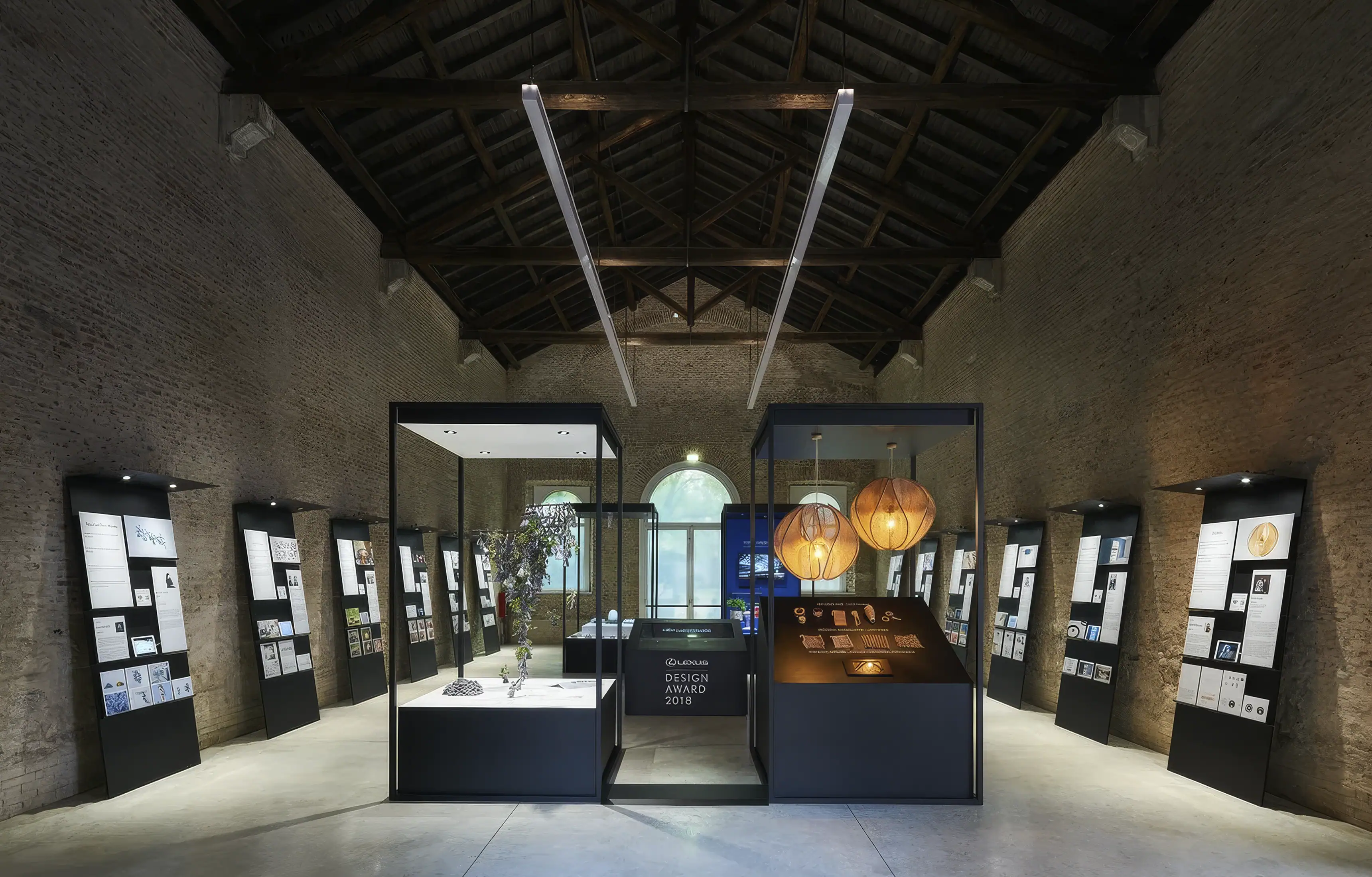
The Lexus Design Award reached its sixth edition in 2018, and the brief it set was deliberately abstract: “CO-,” the Latin prefix meaning with or together, asked entrants to design for a harmonious coexistence between nature and society. The competition drew 1,319 entries from 68 countries, a scale that makes it one of the largest open calls in global product design, and narrowed them to twelve finalists. Four of those twelve were developed into working prototypes under the guidance of an established designer as mentor, and shown alongside the rest of the field during Milan Design Week, from 17 to 22 April 2018.
Martyn attended the exhibition at Salone del Mobile, spending time with the designers and the judges on site and watching how differently each entrant had answered the same two-letter prompt. The four prototype finalists ranged from a participatory workshop staged with residents of a New York neighbourhood to a cork lamp generated by computer script, and between them they made the theme’s abstraction concrete: coexistence, it turned out, could mean a community deciding its own future, a landfill-bound fabric finding a second life as soil, or an eggshell that tells you the truth about what is inside it.
This piece sets out who won, who else made the shortlist, how each of the four prototypes actually worked, and where the judging panel’s own thinking pointed the award. One of the four prototypes has since gone further than Milan, a detail worth knowing before the rest of the story.

The brief, the panel and the scale of the field
Lexus established the Design Award in 2013 specifically to support emerging, global design talent rather than established names, and by its sixth year the format had settled into a clear shape: an open call judged down to twelve finalists, four of whom are paired with an industry mentor and a production budget to build a working prototype, with the remaining eight shown as panel presentations. The 2018 judging panel brought together Sir David Adjaye, the architect; Shigeru Ban, the Pritzker laureate known for building with paper and bamboo; Paola Antonelli, senior curator of architecture and design at the Museum of Modern Art; Birgit Lohmann, chief editor of designboom; Alice Rawsthorn, the design commentator and critic; and Yoshihiro Sawa, president of Lexus International.
The four prototype finalists were each assigned a mentor with a body of work in a related field: Formafantasma, the Amsterdam-based Italian duo of Andrea Trimarchi and Simone Farresin, worked with Extrapolation Factory; the architect Sou Fujimoto worked with Eriko Yokoi; Jessica Walsh, the graphic designer and then-partner at Sagmeister & Walsh, worked with aesthetid; and the lighting designer Lindsey Adelman worked with DIGITALAB. That structure, a working prototype built over several months with an established mentor rather than a finished object submitted cold, is what distinguishes the Lexus Design Award from most open calls of its size, and it shows in how resolved all four prototypes were by the time they reached Milan.

Testing Hypotheticals: the workshop that won
The Grand Prix went to Testing Hypotheticals, by Extrapolation Factory, the Brooklyn-based studio founded in 2012 by Elliott P. Montgomery and Chris Woebken. The studio describes its own practice as design-based research for participatory futures studies, and its wider body of work bears that out: previous projects include the Interspecies Postal Service, which explored climate futures through correspondence addressed to non-human recipients, and Pawn Tomorrow, an imagined 2050 pawn shop stocked with speculative future objects. Extrapolation Factory’s projects have been developed with institutions including IDEO, TED and the Museum of Arts and Design, and the studio’s working method is consistent across all of them: rather than designing an object, it designs a situation in which other people generate the ideas.
Testing Hypotheticals applied that method to a single neighbourhood. Montgomery and Woebken piloted the project in Corona, Queens, close to the sites of the 1939 and 1964 World’s Fairs, and ran workshops in which local residents were asked to identify the concerns and possibilities they saw in their own streets, then to propose solutions. Residents generated ideas including growing food inside disused subway cars, an underground network for distributing recyclable materials, and installations that connect people to memories tied to specific places and times. Designers and improvisational actors then built props and staged models from those proposals, turning the results into a live, immersive “test city” that let the community’s own speculative futures be walked through and evaluated rather than simply described. Montgomery has said the pair are interested in taking the same platform “to different neighbourhoods with distinct stories,” treating the Corona pilot as a repeatable method rather than a single finished artwork.
Adjaye’s comment on the panel’s thinking, made when the award was announced, gets at what set the project apart from more conventional entries: “Products play less of a role, and design education and teaching and thinking are at the forefront.” The Grand Prix, in other words, went to a piece of design methodology rather than a design object, an unusual outcome for a competition whose other three prototypes were all physical products.

Recycled Fiber Planter: Eriko Yokoi’s fibre soil
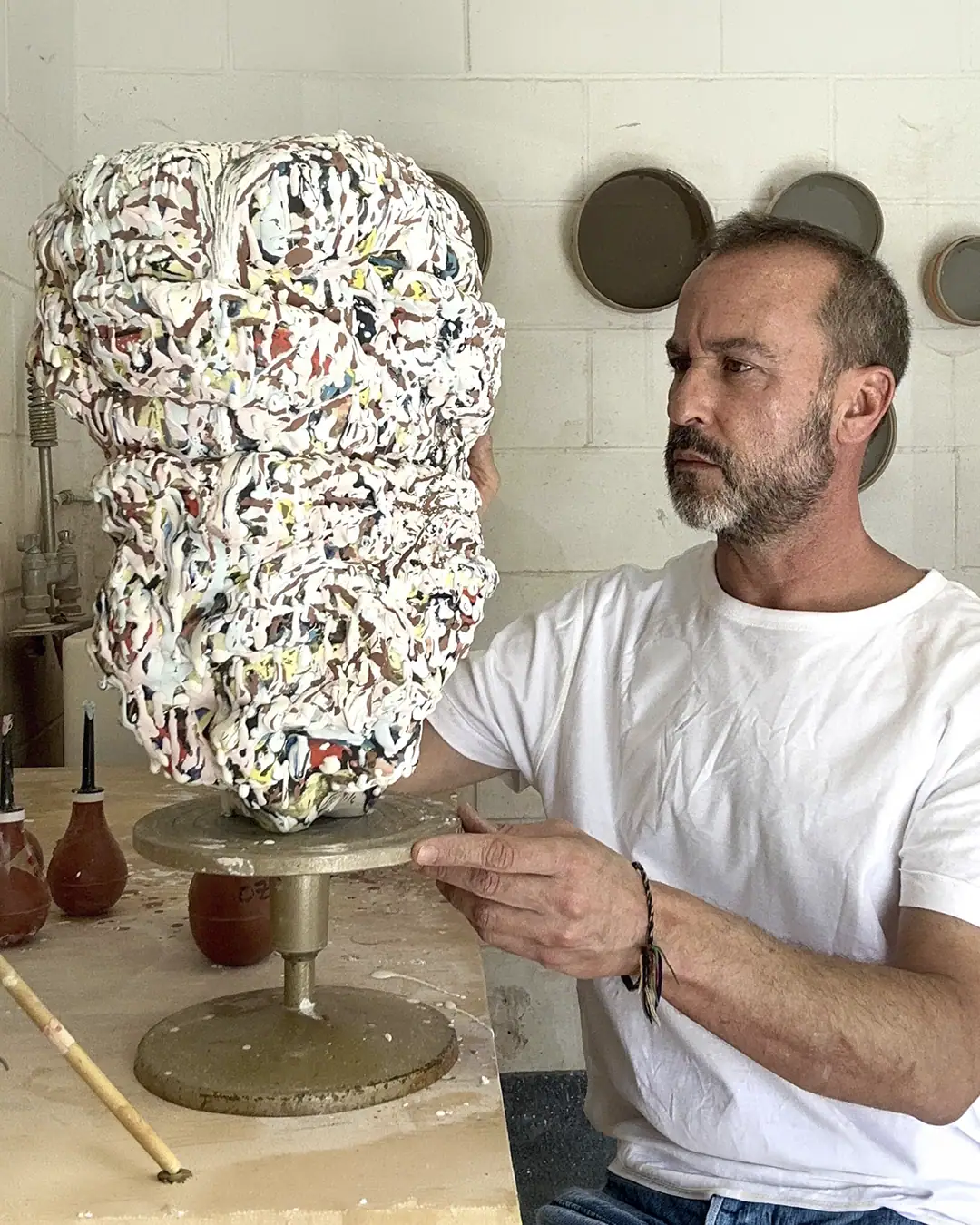
Eriko Yokoi, a Japanese textile designer working under mentor Sou Fujimoto, addressed the coexistence brief through Japan’s textile waste stream. Her Recycled Fiber Planter takes discarded polyester clothing, tears it down and reconstructs the fibres into what she calls fibre soil, a batten cotton material compressed to hold the moisture and air a seed needs to germinate. Because the source clothing arrives in a range of colours, sorting and mixing the collected garments before compression produces a fibre soil with its own layered, marbled colouring, so the growing medium carries a visible record of the clothing it replaced rather than disguising it. Seeds can be sown directly into the compressed material, which functions as a lighter, self-contained alternative to a conventional pot of potting soil.
The project responds to a specific gap: Japan’s textile recycling infrastructure has historically lagged behind other recovery streams, leaving worn synthetic clothing with few practical second lives once it is beyond resale. Turning that material into a growing medium rather than fibre for reweaving sidesteps the technical difficulty of recycling mixed synthetic blends back into new fabric, and instead puts the material to work doing something fabric was never asked to do before.
Honest Egg: aesthetid’s ink that reads an eggshell
aesthetid, the Malaysian studio of Paul Yong Rit Fui and Jaihar Jailani Bin Ismail, built Honest Egg around an intelligent ink pigment printed directly onto the shell. The ink is calibrated to shift colour over a set timeline, but it is not a simple countdown: the studio’s system also accounts for storage conditions, adjusting its reading in response to a cracked shell, a sudden shift in carbon dioxide levels, or a change in temperature, any of which can shorten an egg’s safe life regardless of the date it was laid. A smiley face printed on the shell signals that the egg is safe to eat; as conditions change, the same face turns cross-eyed to signal that it is not.
The problem Honest Egg answers is a mismatch between the date printed on a carton and the egg’s actual condition, which leads to large numbers of still-good eggs being thrown out simply because a printed date has passed. Reading the shell itself, rather than relying on a fixed date set weeks earlier under different conditions, gives a household a more honest answer, which is presumably where the project’s name came from. It was also the project the Milan public responded to most directly: a People’s Choice vote, held alongside the main judging and open to the public between 16 and 21 April, was announced on 22 April and went to Honest Egg, the only finalist to be recognised by both the panel and the visiting public.

CO-RKs: DIGITALAB’s computational cork
DIGITALAB, the Portuguese architecture and design studio founded by Ana Trindade Fonseca and Brimet Fernandes da Silva, built CO-RKs around a material most furniture design still treats as a stopper rather than a structural component. Cork, harvested from the bark of the cork oak without felling the tree, is non-fibrous and can be sliced down to a thickness of around one millimetre while retaining meaningful resistance to abrasion and wear, properties DIGITALAB’s system exploits directly. The studio wrote a set of algorithmic scripts that generate furniture and lighting forms from cork thread computationally, adjusting the geometry to minimise material waste at the point of manufacture rather than cutting a fixed shape from a larger sheet. The system was demonstrated in Milan through a lamp prototype, with the same generative logic shown to scale to chairs and tables.
What the Milan prototype does not show, because it happened afterwards, is that the research behind it reached the market. DIGITALAB went on to design a cork furniture and surfaces collection with Gencork, a Portuguese cork manufacturer, extending the same material logic into seating, tables, lighting and wall surfaces that were shown at the London Design Fair as part of a Best of Portugal showcase. A Lexus Design Award prototype turning into an actual production collaboration with a manufacturer in the same material is not the outcome every finalist gets, and it is the clearest evidence among the 2018 field that a mentor-backed prototype built for one week in Milan could carry on working afterwards.
Where it was staged
The exhibition ran inside the Cavallerizze, a newly restored nineteenth-century monastery and stables complex within Museo Nazionale della Scienza e della Tecnologia Leonardo da Vinci in Milan, with the award ceremony held on 16 April ahead of the public exhibition dates. The Lexus Design Award’s twelve finalists, this year’s four prototypes among them, were shown there as one strand of a larger Lexus presence built around the same “CO-” theme. Lexus’s own experiential installation that year, staged in the same venue and centred on the architect Sota Ichikawa’s light installation, ran alongside the award as a separate, complementary piece of the same programme, covered in full here.

Final thoughts
It would be easy to read the 2018 Lexus Design Award as a showcase of individual objects, a lamp here, a planter there, each demonstrating a clever use of a sustainable material. That is true of three of the four prototypes, and it undersells what actually happened. The Grand Prix went to a project with no fixed object at its centre at all, a workshop format built to be run again in a different neighbourhood with an entirely different set of results each time. Placing that alongside a cork computation system that has since become an actual furniture collection, an eggshell that reports its own condition, and a growing medium made from clothing nobody wanted, the field as a whole argued that coexistence is less a material problem than a design process problem, one that gets solved by rethinking who gets to propose the answer.
That is a more ambitious claim than a single award ceremony usually makes, and 1,319 entries from 68 countries is the scale of interest it takes to test it properly. Four very different answers reached Milan intact, and only one of them needed a physical object to make its case.
What was the Lexus Design Award 2018?
The sixth edition of Lexus’s global open design competition, themed around “CO-,” meaning with or together. It drew 1,319 entries from 68 countries and narrowed them to twelve finalists, four of which were developed into mentored prototypes shown during Milan Design Week 2018.
Who won the Lexus Design Award 2018?
Testing Hypotheticals by Extrapolation Factory, the Brooklyn-based studio of Elliott P. Montgomery and Chris Woebken, won the Grand Prix. The project is a participatory futures workshop developed with residents of Corona, Queens, mentored by the design duo Formafantasma.
What were the other Lexus Design Award 2018 finalist prototypes?
Recycled Fiber Planter by the Japanese textile designer Eriko Yokoi, Honest Egg by the Malaysian studio aesthetid, and CO-RKs by the Portuguese studio DIGITALAB. Eight further finalists were shown as panel presentations rather than built prototypes.
Who judged the Lexus Design Award 2018?
Sir David Adjaye, Shigeru Ban, Paola Antonelli of the Museum of Modern Art, Birgit Lohmann of designboom, the design commentator Alice Rawsthorn, and Yoshihiro Sawa, president of Lexus International.
What is Honest Egg and how does it work?
An intelligent ink, developed by the Malaysian studio aesthetid, printed directly onto an eggshell. It changes colour over a calibrated timeline and adjusts that reading for storage conditions such as a cracked shell or a shift in temperature or carbon dioxide levels, showing a smiley face when the egg is safe to eat.
Where and when was the Lexus Design Award 2018 exhibition held?
At the Cavallerizze within Museo Nazionale della Scienza e della Tecnologia Leonardo da Vinci in Milan, from 17 to 22 April 2018, during Milan Design Week and Salone del Mobile, with the award ceremony held on 16 April.
Did any of the 2018 finalists’ work continue after Milan?
Yes. DIGITALAB’s cork research behind CO-RKs led to a furniture and surfaces collection developed with the Portuguese cork manufacturer Gencork, shown afterwards at the London Design Fair.


Leave a Reply