
ART & CULTURE · MILAN
Reading time: 9 minIn April 2018, the Japanese architect Sota Ichikawa filled a former monastery’s stable block in Milan with 12,000 hanging strings and a single moving laser, built so that every strand caught light and none cast a shadow. The installation, staged under the theme Limitless Co-Existence, was Lexus’s argument that a car brand’s ideas about individuality and unity could be felt physically before they were ever explained.
Milan Design Week has become the week car brands go to be believed rather than believed in from a spec sheet. In April 2018, Lexus took that logic further than most, handing its stand at Salone del Mobile not to a stage designer but to an architect who builds with algorithms. Sota Ichikawa, founder of the Tokyo studio doubleNegatives Architecture (dNA), was asked to design a physical journey through the idea behind that year’s Lexus theme, “CO-“, short for cooperation, collaboration and co-existence. What he built, Limitless Co-Existence, walked visitors through scent, sound, sugar and finally 12,000 individually lit strings before they ever saw a car.
The installation ran at the Museo Nazionale della Scienza e della Tecnologia Leonardo da Vinci from 17 to 22 April 2018, the same week as Salone del Mobile itself, with a press and awards day on 16 April. It sat inside a building with its own five-century design history, which is where the more interesting story starts.

A monastery’s stable block, repurposed for horsepower
The venue was not a neutral white box. The Museo Nazionale della Scienza e della Tecnologia Leonardo da Vinci is Italy’s largest science and technology museum, and it occupies the former monastery of San Vittore al Corpo. The site passed to the Olivetan order in 1507, who rebuilt the church between 1533 and 1568 under the architects Vincenzo Seregni and Pellegrino Tibaldi. The complex later served as a military hospital and barracks, was damaged in the bombing raids of 1943, and reopened as a science museum on 15 February 1953, inaugurated by the Italian prime minister of the day, Alcide De Gasperi.
Lexus staged its installation specifically in the Cavallerizze, the museum’s former riding stables. That detail is worth sitting with. A building whose original purpose was to house and exercise horses was handed, nearly five centuries later, to a car brand for an installation about movement, individuality and light, a coincidence of programme that no press material pointed out but that the building itself makes plain the moment you know what a cavallerizza is. It gave Ichikawa’s installation a floor plan with genuine architectural weight and proportion to work against, rather than a fabricated pavilion built for the week and torn down after it.
That choice of venue also placed the installation inside the wider ecosystem of Milan’s design week, rather than beside it. The Museo Nazionale della Scienza e della Tecnologia sits a short distance from the Salone del Mobile’s own trade fair site and within reach of the Fuorisalone’s citywide programme of showroom openings and gallery takeovers, so visitors arrived at Ichikawa’s installation having already spent the day moving between historic Milanese buildings repurposed for a week of design. The Cavallerizze’s vaulted brick and generous ceiling height, built for horses and riders rather than exhibition stands, gave the 12,000 hanging strings the vertical drop they needed and meant the installation read as something built into the room rather than dropped inside it.

Sota Ichikawa and the same “CO-” theme, told two ways
Ichikawa’s practice, doubleNegatives Architecture, works at the point where computation and physical space meet. Since founding the studio, he has designed houses in Japan where an algorithm determines window placement and structural rhythm rather than a hand-drawn elevation, and installations for museums and galleries that translate invisible data, sound, air movement, structural stress, into something a visitor can see or hear. That grounding in computational design is precisely why Lexus’s brief suited him: an idea like “co-existence” is abstract until somebody works out how to make thousands of individual elements behave as one system without erasing any of them, which is a problem of process and calculation as much as it is one of aesthetics. His broader body of work has been recognised with the Algorithmic Design Quest Architecture Vanguard Prize and honorary mentions from Ars Electronica, the long-running Austrian prize for digital and media art. For Limitless Co-Existence, he was supported by hclab, the urban research and design group of which he is a member, with his hclab colleague Takatoshi Arai named as a key contributor to the project.
Lexus ran two separate “CO-” projects in Milan that April under the same theme. Alongside Ichikawa’s installation, the brand staged the 2018 Lexus Design Award, a competition for emerging designers that reached its finalists and Grand Prix announcement across the same week, including work from the eventual winning studio, Extrapolation Factory. That award and its finalists are covered separately; what matters here is that Lexus chose to make its abstract theme legible in two different registers at once, one an installation you walked through and felt, the other a competition judged on ideas about the future of design. Seen together, the two projects say something about how a car brand now uses design week: not as a single showcase moment but as a small, self-contained programme, with its own curated competition and its own commissioned architecture, run in parallel rather than folded into a single stand.

Clearing the senses before the strings
Ichikawa structured the experience as a sequence rather than a single room, and the sequencing did real work. Visitors entered through a corridor where speakers on thin, exposed legs released short bursts of white noise, intended to clear the mind of the bright Milanese street outside, while the air itself carried a bergamot scent. The transition from daylight into this dim, sound-washed entrance was deliberately abrupt, the first cue that the installation was going to be experienced through senses other than sight alone.
From there, visitors reached a small wall-mounted piece: a box containing a single illuminated string, crossed by two perpendicular beams of light that met at its centre. It was a miniature preview of the idea the main installation would scale up considerably, one light source, precisely aimed, defining a single point.
The next stage, “Prepare Your Senses”, built the idea into a shared object. A table laid out in a figure of eight held hundreds of lollipops, seemingly scattered but placed with intent, spelling “CO-” when read correctly. A single laser, mounted centrally, projected light through 360 degrees, catching every lollipop on the table simultaneously rather than illuminating them in sequence. Guests were given bergamot-flavoured lollipops of their own, finished with black popping candy, so the installation’s themes of unity and individual attention were, briefly, edible and audible as well as visible.

Believe In Limitless: 12,000 strings, one laser, no shadows
The main chamber was the installation’s centrepiece and its clearest statement. Roughly 12,000 strings of varying lengths hung from the ceiling, filling the Cavallerizze’s volume. A single laser, positioned centrally and moving on a programmed path, travelled horizontally across the room and then descended, illuminating strings as it passed and leaving progressively fewer lit as it moved lower, before the sequence reversed and the light climbed back upward. White noise built alongside the light’s movement, then fell away as it reversed.
The technical claim behind the piece, and the one that makes it more than a decorative light show, is that every string received individual illumination and none cast a shadow onto another. Achieving that meant treating the arrangement of 12,000 strings as a computational problem rather than a decorative one. Ichikawa has said of the placement: “We positioned the strings very carefully so there was no bias in density,” a line that describes an algorithmic design process, the same discipline that governs the houses and structures his studio designs, applied here to an installation instead of a building. The strings stood in for individuals; the laser stood in for a single source of attention capable of reaching every one of them without favouring any, which was the installation’s version of “co-existence” made physical rather than argued in a press statement.
From light to the car itself
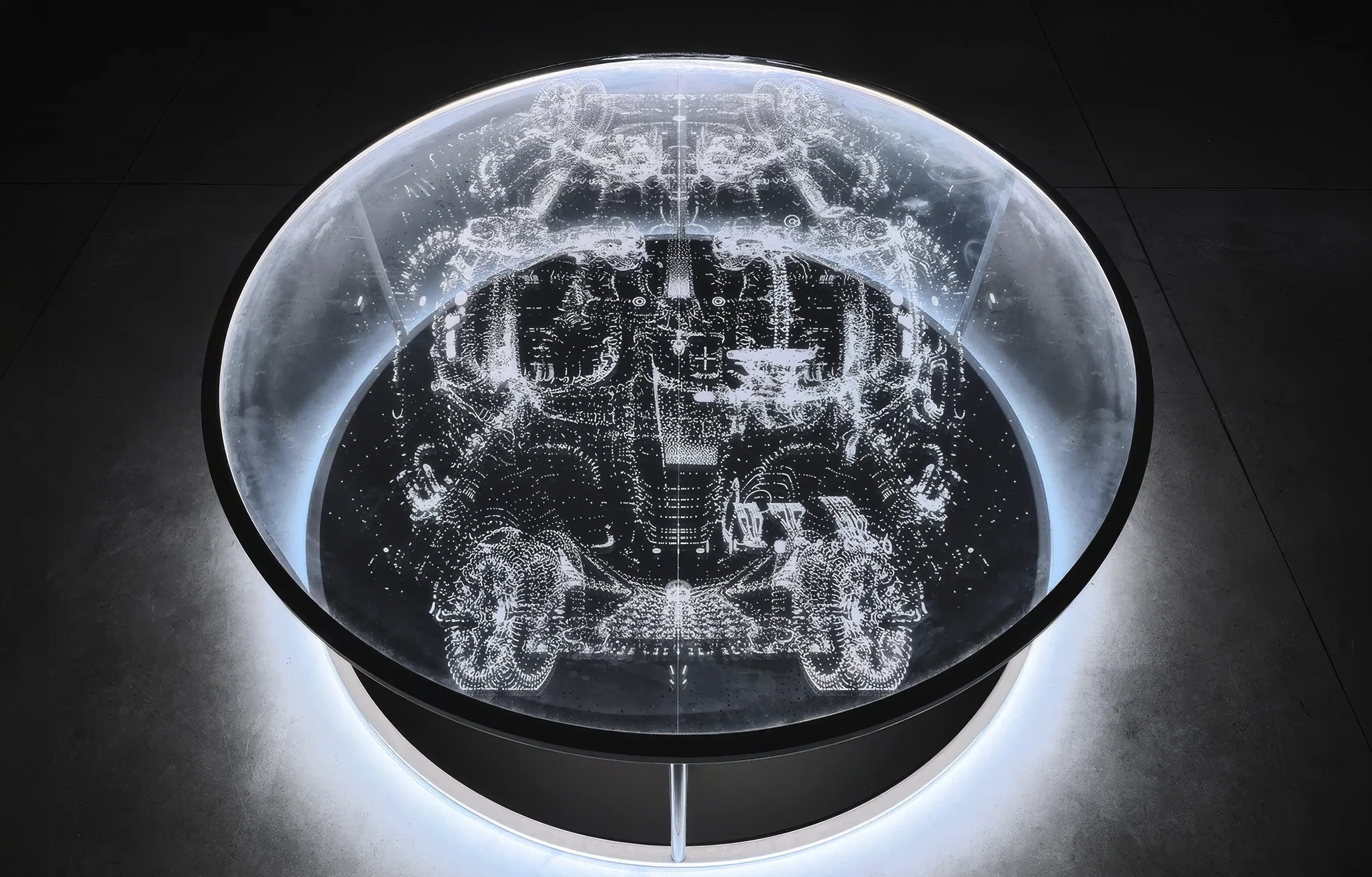
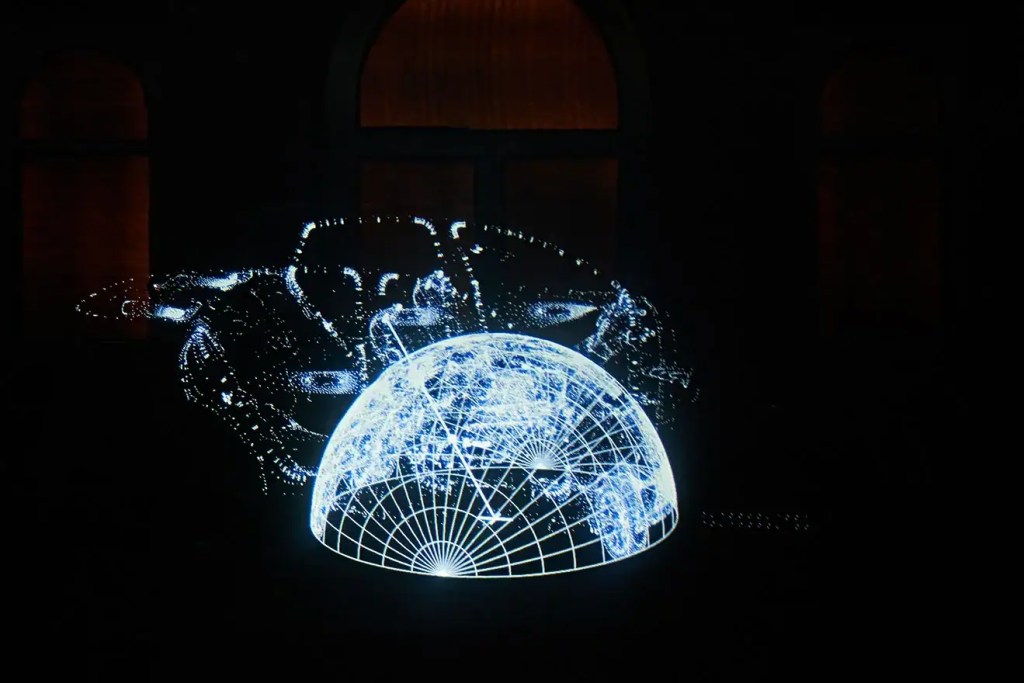
The sequence closed by turning from abstraction toward the product. In “Understanding”, visitors watched a short film revealing elements of Lexus’s design language, viewed through a porthole before the full picture was shown. The installation then delivered them to the Lexus LF-1 Limitless, the concept vehicle the whole theme had been built around, alongside a table where a projection turned the car’s silhouette from a three-dimensional form into a flattened, two-dimensional graphic and back again, a small final echo of the installation’s interest in how light defines what a viewer perceives as solid.

What the installation actually argued
Car brands have used Salone del Mobile as a stage for over a decade now, but the format usually defaults to a concept car under gallery lighting with a design story told in a wall text beside it. Ichikawa’s installation is a more specific kind of argument: that a brand’s abstract theme, here “CO-“, can be tested as a piece of sensory design before a single vehicle is shown, using scent, sound, taste and a computationally arranged field of light to make an idea about individuality and unity legible to a body rather than just an eye. It treats a car brand’s design week presence the same way a product designer would treat a showroom, as a controlled sequence of physical decisions rather than a backdrop, and it is a useful marker of how far that discipline had moved by 2018, from static display toward something closer to stage design built on genuine engineering.
That shift matters because of where it puts the competition. A motor show measures a car against other cars on horsepower, range and price. A design week installation measures a brand against galleries, museums and independent studios on a much harder question: whether the ideas behind the product hold up as design in their own right, judged by the same visitors who spend the rest of the week looking at furniture, art and architecture. Handing that job to an architect whose day-to-day practice has nothing to do with cars, and letting him build a genuinely difficult technical piece rather than a branded backdrop, is what let Limitless Co-Existence clear that bar. The installation did not illustrate the theme with a slogan on a wall. It built a working system, a laser, a scent, a field of 12,000 strings, that behaved the way the theme claimed a community of individuals should behave, and let visitors draw the connection to the car themselves once they reached it.

Final thoughts
Limitless Co-Existence is worth returning to precisely because it did not treat a car brand’s theme as a slogan to be printed on a banner. Sota Ichikawa gave “CO-” a physical mechanism, a laser and 12,000 strings arranged so that attention could be shared without ever being divided, inside a building whose own five-century history of monastery, hospital, barracks and museum gave the installation more architectural weight than any temporary pavilion could have offered. It is a reminder that the strongest design week installations tend to come from handing an abstract brief to someone whose actual discipline is solving a genuinely difficult physical problem.

What was the Lexus Design Event 2018 called, and what did it involve?
The event was titled Limitless Co-Existence, staged in Milan from 17 to 22 April 2018. It centred on a sensory installation designed by the architect Sota Ichikawa, moving visitors through scent, sound, a lollipop-laden table and a chamber of 12,000 illuminated strings before revealing the Lexus LF-1 Limitless concept car.
Who designed the Lexus Design Event 2018 installation?
The Japanese architect Sota Ichikawa, founder of doubleNegatives Architecture (dNA), designed the installation, supported by his colleague Takatoshi Arai and the urban research and design group hclab.
Where was the Lexus Design Event 2018 held?
It was staged in the Cavallerizze, the former stables, at the Museo Nazionale della Scienza e della Tecnologia Leonardo da Vinci, Italy’s largest science and technology museum, housed in the former monastery of San Vittore al Corpo in Milan.
How did the 12,000-string installation, Believe In Limitless, work?
Roughly 12,000 strings of varying lengths were hung from the ceiling and lit by a single, centrally positioned laser moving on a programmed path. The strings were arranged so that each one received individual illumination without casting a shadow, an effect Ichikawa achieved by treating the placement of every string as a carefully calculated, algorithmic problem rather than an aesthetic one.
Was the Lexus Design Event 2018 connected to the Lexus Design Award?
Yes. Both ran in Milan that April under the same “CO-” theme. The installation was an experiential piece designed by Sota Ichikawa, while the Lexus Design Award was a separate competition for emerging designers, reaching its finalists and Grand Prix result across the same week.


Leave a Reply