
A red and black dressing table, shown in Paris in 1921, was the first piece of furniture Pierre Legrain ever designed for Louis Vuitton, before Jacques Doucet made him famous. A century later the house reissued it inside a Milanese palace whose own rooms are named for a returning traveller. Neither fact was invented for the occasion. Both were simply left for someone to notice.
Introduction
Louis Vuitton took over Palazzo Serbelloni for Milan Design Week 2026, running from 21 to 26 April, pairing new pieces from its Objets Nomades collection with a room-by-room tribute to Pierre Legrain, the Art Deco designer who made the house’s first piece of furniture. A courtyard installation built with students from the Accademia di Belle Arti di Brera translated Legrain’s bookbinding patterns into a walkable floor the size of the palazzo’s own forecourt.
The framing on offer from most of the coverage was heritage meeting innovation, a phrase generic enough to fit almost any brand’s design week stand. It undersells what was actually done here. The exhibition’s own room names, Giangaleazzo and Napoleonica, are not decorative flourishes. They refer to two real, connected events in the building’s history, and nobody covering the show explained why.
That is the argument this piece makes: Louis Vuitton did not borrow a Milanese palace as a backdrop and dress it in French Art Deco. It picked a building whose own past already rhymes with the story it wanted to tell, about arrival, portability and a traveller far from home, and then built the exhibition to say so.

What was actually in the rooms
The show ran across a sequence of neoclassical rooms, each treated as its own environment rather than a plinth run. Visitors entered through the Giangaleazzo room and moved through spaces given distinct palettes: a midnight-blue sequence for layered, domestic arrangements, a cooler run of rooms pitched closer to Charlotte Perriand’s restraint, and a warmer suite in red that carried the show’s most graphic pieces.
Two Pierre Legrain pieces from the 1920s were reissued for the occasion. The Celeste dressing table, in lacquered wood and Nomade leather, keeps the Omega-shaped mirror support that made the original distinctive. The Riviera chilienne chair returned in oak, leather and mother-of-pearl marquetry, the inlay work picking up the geometric vocabulary Legrain built his reputation on.
Alongside the reissues sat new commissions. Estudio Campana, working with Géraldine Gonzalez, showed a cabinet called Kaléidoscope, its surface built from hundreds of individually cut leather facets arranged around a set of cast mermaid feet, and a Cocoon chair in dichroic material that shifts colour as the light and the viewer’s angle change. Raw Edges contributed the Stella armchair, a more angular, amorphous departure from the studio’s earlier Objets Nomades work, alongside a piece of upholstery built around an optical illusion. Franck Genser’s Acqua table paired a curved black marble top with an aquamarine base, and a football table nearby carried hand-painted mermaids across its playing surface, the show’s most playful object and a deliberate break from the Legrain room’s formality.

Two rooms, named on purpose
Here is what the coverage missed. Palazzo Serbelloni was built for Gabrio Serbelloni, with its facade redesigned in the late eighteenth century by the architect Simone Cantoni, and its grandest interior, the neoclassical hall on the first floor, decorated by Giuliano Traballesi. Gabrio’s son, Giovanni Galeazzo Serbelloni, is the reason the palace has a place in Italian history at all.
In 1796, Giovanni Galeazzo travelled to Paris on a diplomatic mission for the newly formed Cisalpine Republic. He returned to Milan accompanying Joséphine de Beauharnais, who stayed at his palazzo for three months while her husband, a young general named Napoleon Bonaparte, campaigned in the region. Giovanni Galeazzo went on to preside over the Cisalpine Republic’s founding Directory and later accompanied Napoleon on the 1799 to 1800 campaign.
Louis Vuitton named its entry room Giangaleazzo, after the palazzo’s own builder’s son, and gave its Legrain tribute the name Napoleonica, after the three months his most famous houseguests spent there. Both names describe real residents of the building, in the order they arrived. An exhibition about portable luxury, built for a traveller who carries her own history with her, was staged in the one Milanese palace with an actual returning traveller in its records, and the show said so in its floor plan rather than its wall text. That connection appears in no other coverage of the exhibition.

The dressing table that predates the myth
Pierre Legrain’s association with Louis Vuitton is usually presented as a tidy piece of heritage, the house’s first furniture designer, reissued a century later. The more interesting detail is the timing.
Legrain trained as an illustrator, studying under Robert Delaunay and Robert Bonfils at the Germain Pilon school between 1901 and 1907, before working alongside Paul Iribe on the magazine Le Témoin from 1908. He is best remembered today as the principal decorator for Jacques Doucet, the couturier and collector, a role he took on after Iribe left for America in 1914 and held through the furnishing of Doucet’s Avenue du Bois apartment and, later, his house in Neuilly.
The Louis Vuitton commission came earlier than that major body of work. Legrain showed a red and black dressing table at the Salon des artistes décorateurs in 1921, designed for Louis Vuitton, and it marked his shift toward the simpler, more geometric forms that would define his signature style. His own studio, where the bulk of the Doucet furniture and his celebrated Art Deco bookbindings were produced, did not open until 1922. The piece Louis Vuitton reissued this year as the Celeste dressing table was not a retrofitted tribute borrowing a famous name. It was there at the start of the style, before the style had a name to borrow.
Legrain went on to co-found the Groupe des cinq with Pierre Chareau and Jean Puiforcat in 1926, and to train the American bookbinder Mary Reynolds, before dying suddenly of a heart attack in 1929. The Napoleonica room’s tableware, in deep green and gold, echoes the binding he made for Joris-Karl Huysmans’ À Rebours, one of the pieces that established him as a bookbinder before furniture design.

Fourteen years of designers building the same brief
Objets Nomades did not begin as a design week stand. Louis Vuitton launched the collection at Design Miami in December 2012, with pieces shown simultaneously at its New Bond Street store in London. The founding brief asked a small group of designers, among them Fernando and Humberto Campana, Atelier Oï, Edward Barber and Jay Osgerby, Christian Liaigre, Nendo and Patricia Urquiola, to build objects around the idea of nomadic luxury, taking their cue from the house’s nineteenth-century bespoke trunks, which folded out into beds, desks and travelling wardrobes for clients who moved between houses rather than staying in one. Fernando Campana described the resulting pieces as being designed the way a piece of fruit hangs from a tree, meant to be carried away rather than admired in place.
Fernando and Humberto Campana, working now as Estudio Campana, are still contributing new pieces fourteen years after that first Design Miami showing, which puts Kaléidoscope and the Cocoon chair inside one of the longest continuous designer relationships in contemporary collectible design rather than a one-off Milan commission. Raw Edges has a similarly long run with the collection, which is what makes the Stella armchair worth reading as a departure rather than a debut: the studio has spent years establishing a vocabulary with this brief before choosing to break from it.

The courtyard, built by hand
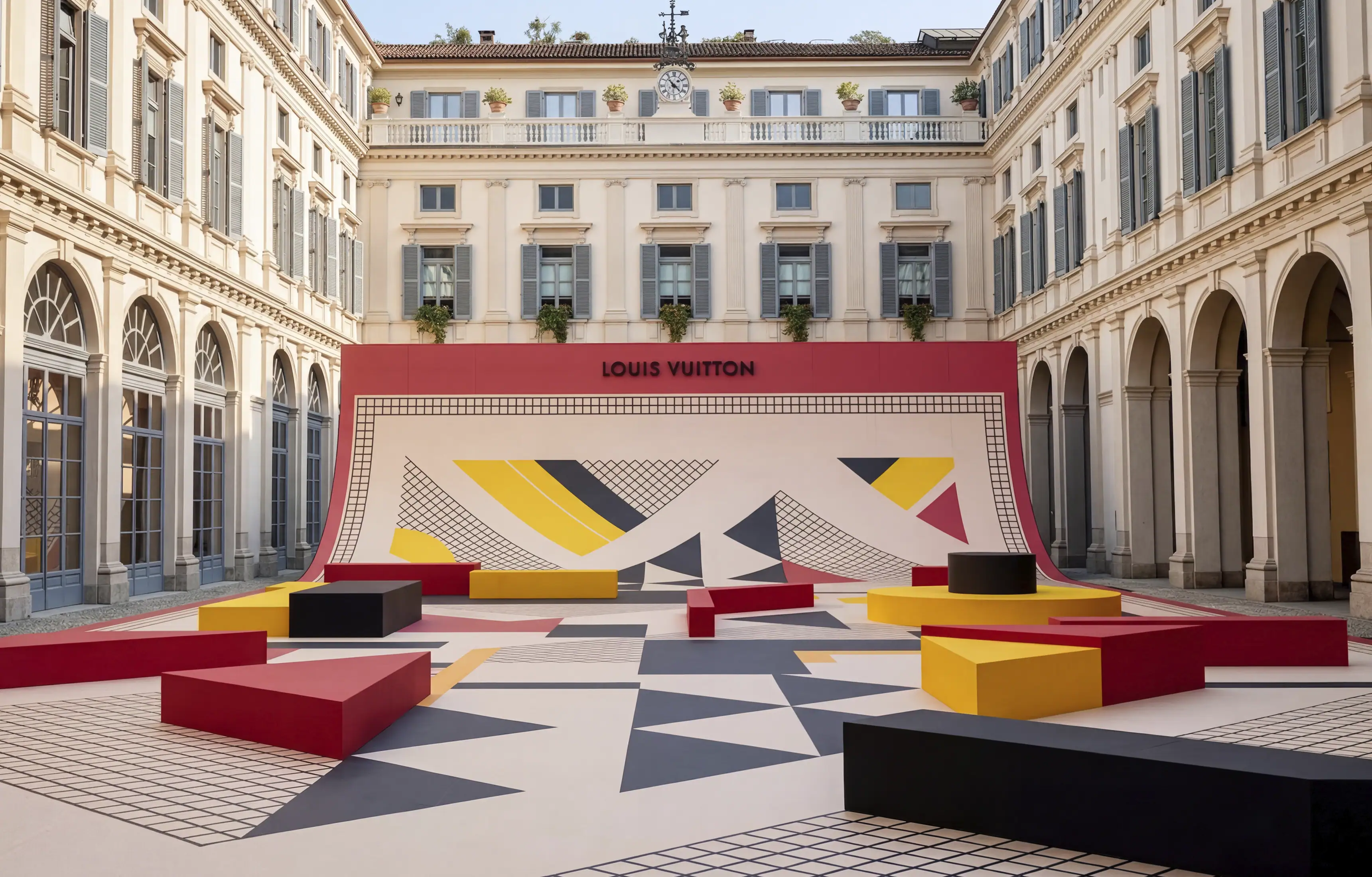
The most photographed single element of the show was outside the rooms entirely. A monumental installation, developed with the Accademia di Belle Arti di Brera and produced on site by the academy’s own students, scaled Legrain’s bookbinding patterns up into a walkable floor across the palazzo’s courtyard, turning a graphic language designed for the cover of a book into an architectural surface meant to be crossed on foot.
The choice of collaborator matters as much as the result. Brera is Milan’s own fine art academy, founded in the eighteenth century, and putting its students’ hands on the floor of a design week installation, rather than a specialist fabricator’s, ties the piece to the city hosting it rather than to Paris, where Legrain worked and where Louis Vuitton is headquartered. It is the one part of the exhibition that belongs to Milan specifically, and it is also the part that translates the Legrain tribute from an object you can buy into a surface everyone at the show, ticket or no ticket to see the rooms, could actually walk across.
A stained glass trunk, kept apart from the rest
One object sat outside Palazzo Serbelloni entirely. At the Louis Vuitton store on Via Montenapoleone, the house showed the Malle Courrier Lozine Maison de Famille, a stained-glass trunk designed by Pharrell Williams, the house’s men’s creative director, and first presented in one of his own runway shows before this appearance in Milan.
Keeping it at the store rather than folding it into the Legrain rooms was a deliberate separation, and it reads as one. Everything inside Palazzo Serbelloni argued backward, toward a century-old commission and the designer who made it. The trunk argued forward, toward the house’s current creative direction and a material, stained glass, that has no place in Legrain’s own vocabulary of lacquer, leather and mother-of-pearl. Given its own address rather than a room among the reissues, it let the palazzo tell one story without diluting it, and let Williams tell a different one a few streets away.

Frequently asked questions
What was Louis Vuitton’s Objets Nomades exhibition at Milan Design Week 2026?
A presentation at Palazzo Serbelloni from 21 to 26 April 2026 pairing new Objets Nomades pieces with a tribute to the Art Deco designer Pierre Legrain, including two reissued 1920s pieces and a courtyard installation built with Milan’s Accademia di Belle Arti di Brera.
Where was it held?
Palazzo Serbelloni, a neoclassical palace on Corso Venezia in Milan, with an additional display of trunks and heritage pieces at Louis Vuitton’s store on Via Montenapoleone.
Why are the exhibition rooms called Giangaleazzo and Napoleonica?
Both names refer to real residents of the palazzo. Giovanni Galeazzo Serbelloni, son of the palace’s builder, brought Joséphine de Beauharnais to Milan in 1796, and she stayed at the palazzo for three months while Napoleon campaigned nearby, giving the rooms their names.
Who was Pierre Legrain?
A French illustrator turned furniture designer and bookbinder, who designed Louis Vuitton’s first piece of furniture in 1921 before becoming Jacques Doucet’s principal decorator and a leading figure in Art Deco design. He died in 1929.
What new pieces were introduced?
The Cabinet Kaléidoscope and Cocoon Dichroic chair by Estudio Campana with Géraldine Gonzalez, the Stella armchair by Raw Edges, and the Acqua table by Franck Genser, alongside two reissued Legrain pieces, the Celeste dressing table and the Riviera chilienne chair.
When did the Objets Nomades collection begin?
It launched at Design Miami in December 2012, with an initial designer list that included Fernando and Humberto Campana, Atelier Oï, Edward Barber and Jay Osgerby, Christian Liaigre, Nendo and Patricia Urquiola.
Who built the courtyard installation?
Students from Milan’s Accademia di Belle Arti di Brera, working with Louis Vuitton to translate Pierre Legrain’s bookbinding patterns into a walkable floor installation across the palazzo’s courtyard.
Final thoughts
The easy version of this story is a fashion house borrowing an old palace and an older designer’s name to dress up a furniture line for a week. That version is available in most of the coverage, and it is not wrong exactly. It is just incomplete.
What actually happened is more specific. Louis Vuitton chose a building with a real, documented history of housing a traveller a long way from home, and then named its own rooms after the people who made that history, in the order they lived it. It reissued a Pierre Legrain piece that predates the version of his career most people know, from the years when he was still becoming the designer Doucet would later make famous. And it put the collection’s own bookbinding motif on a floor that Milanese art students built with their hands, rather than a factory somewhere else.
None of that required inventing anything. It required reading the building, and the designer, closely enough to notice what was already there. That is the harder version of heritage marketing to pull off, and the one that actually earns the word.
Leave a Reply