
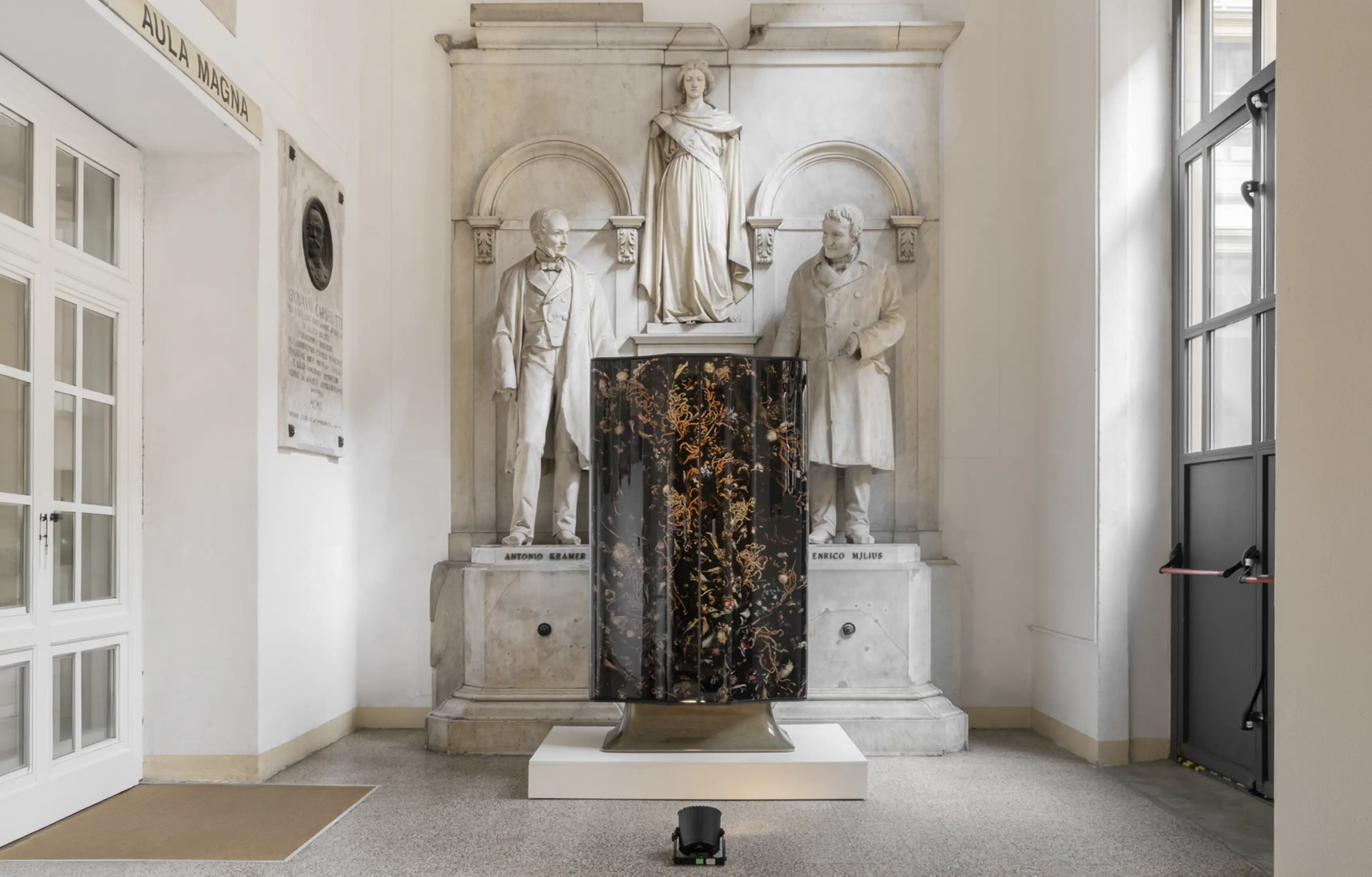
Marcin Rusak named his Milan Design Week installation after the Latin term for a flower market, then staged it inside a Milanese institution built in 1838 to teach exactly the kind of material research his studio does with flowers today. The coincidence holds up under scrutiny: SIAM was founded to instruct Milan’s makers in new techniques, and Forum Florum works the same way, treating decay, resin and glass as subjects to be studied rather than simply displayed.
Introduction
Forum Florum: Herbarium of the Present, by Marcin Rusak Studio, occupied SIAM 1838 on Via Santa Marta in Milan from 20 to 26 April 2026, during Milan Design Week. The exhibition brought together sculpture, furniture, sound and material research built around a single subject: the flower, tracked from commodity to compost, and the specific resin and glass techniques Rusak’s studio has spent close to a decade developing to hold that process still.

Rusak’s studio describes its own working method as Unnatural Practice, a deliberate combination of industrial manufacturing, manual craft and contemporary visual art rather than a single discipline chosen in advance. Forum Florum is that method laid out room by room: bronze casting and 3D printing sharing one entrance portal, a resin process refined over years standing next to furniture built for daily domestic use, sound and ultrasound sitting alongside sculpture. Forum Florum is Latin for a flower market, and Rusak’s own description of the show, an open forum rather than a fixed display, a place for research to be shown as research, is not a stretch of the name. It is a fairly literal translation of what SIAM already does. Founded in 1838 as a fund to encourage Milanese arts and crafts, the institution spent its first decades handing out grants to workers who introduced better manufacturing methods, then evolved into a teaching body running chemistry seminars, physics courses and a professional silk-weaving school, work serious enough that it helped found the Politecnico di Milano in 1863. Rusak did not need to dress up a showroom as a laboratory for the week. He put a genuinely research-led practice inside a building whose entire nineteenth-century purpose was teaching Milan how new materials actually behaved.

An 1838 trade school becomes a flower market
That resonance is worth sitting with, because it explains why Forum Florum reads differently from most Milan Design Week presentations built around a single studio. SIAM’s founders were not decorators. They were merchants and industrialists who believed, in their own words, that the best way to support a trade was to enlighten it through instruction, and they built an institution that taught silk-weavers, chemists and physicists rather than simply displaying finished goods. That teaching mission did not stay confined to the nineteenth century: SIAM went on to open Italy’s first upper-level evening technical school in 1925, and its vocational courses became part of how Milan trained the young workers who rebuilt the city’s industry after the Second World War. A hundred and eighty-eight years after its founding, Rusak filled the same rooms with the actual mechanics of his material research: the resin formulas, the glass lamination process, the specific accidents that happen when moisture tries to escape a sealed pane under heat. Visitors were not looking at finished objects with the process hidden. They were looking at a studio’s laboratory notes, staged inside a building whose entire institutional history was teaching exactly that kind of material instruction.

The industry the entrance portal is about
The exhibition’s monumental entrance, Flower Journey, set the terms before visitors reached anything else. Built partly from bronze casting and partly 3D-printed, referencing both medieval cathedral portals and Art Nouveau ornament, the piece works through eighty-seven separate scenes tracing the history of the global cut-flower industry, from cultivation and harvest through to the commercial systems that move flowers from grower to market. It is the closest thing in the show to an argument stated outright: that a flower bought at a market stall arrives with a supply chain behind it most buyers never think about, and that supply chain has its own history worth the same formal attention a cathedral facade gets.

A family in the same business, on the other end of it
Rusak’s interest in that history is not academic. He was born in Warsaw in 1987 into a family that had run greenhouses and flower gardens in the city centre since the early twentieth century, land his grandfather managed through most of the Communist era. The business did not survive the political upheaval around the year of Rusak’s birth, when the destabilising final years of the Soviet system forced the family to sell the site. He grew up, by his own account, playing among what greenhouses remained rather than working in a business that was, for practical purposes, already gone.

The connection to his current practice surfaced properly only later, and by accident. While studying at the Royal College of Art in London, a tutor’s assignment sent him back to a piece of his grandfather’s furniture, a sixteenth-century-style Dutch cabinet, and the research that followed reconnected him to the family history the business’s collapse had cut off. Around the same period, he began investigating London’s Vauxhall wholesale flower market and found what most buyers never see: the volume of unsold, still-fresh stock that gets discarded at the end of every trading day. Flower Journey’s account of the cut-flower trade’s machinery is not a designer borrowing an interesting subject. It is being told by someone whose own family lost a flower business to forces larger than the flowers themselves, and who then found the industry’s waste stream as the starting material for an entirely new practice.

Furniture that keeps decaying after it leaves the gallery
Away from the entrance portal, Forum Florum extended Rusak’s ongoing Flora series with new shelving, a coffee table and a mirror, alongside a pair of amorphous, partly 3D-printed sconces made from the studio’s own production off-cuts, one in bioplastic, the other wrapped in resin-covered leaves. The pieces are built from two techniques Rusak developed over several years of resin research: flora prema, which slices a cured resin block to expose whatever cross-section of embedded flowers the cut happens to reveal, and flora temporana, which arranges the botanical material deliberately before it is sealed in.

Neither technique freezes its subject permanently. Existing Flora pieces in collectors’ homes continue to change years after they left the studio, their embedded leaves shifting colour as the plant matter inside slowly breaks down within the resin. Rusak has described the appeal of that instability plainly: the pieces let a viewer notice details in a flower that would otherwise never be looked at closely, because for a moment, nature is genuinely held still. Buying a piece from the Flora series is buying an object that has not finished changing, which is a considerably more specific claim than the usual language of heritage or handmade quality gets to make.

The panels, the cabinets, and the glass that goes black without light
The show’s largest single gesture, the Herbarium Panels, stood up to two and a half metres tall, flowers and leaves laminated flat between sheets of glass at architectural scale rather than the small, keepsake scale a pressed-flower frame usually implies. A separate wall-mounted cabinet in pale blue used the same flower-infused glass process at a domestic scale, pink and yellow blooms sandwiched between laminated panes above reflective shelving, while an amber-toned room divider pushed the technique further, its large embedded plants surrounded by mottled crystallisation patterns that read almost like animal print. One glass panel in the show appears entirely black until a spotlight catches it, at which point a circular arrangement of preserved plants becomes visible inside, a piece built specifically around the difference between how it looks unlit and how it looks under scrutiny.

That crystallisation is not a decorative flourish Rusak added afterwards. It is moisture, sealed inside laminated glass, boiling under heat and trying and failing to escape, a genuinely uncontrollable chemical accident that the studio has learned to work with rather than eliminate. A separate credenza, blasted with bronze over a jute-and-brass structure holding real acorns and flowers, and a treasure chest cabinet with resin doors that took a team of thirty people six months to complete, extended the same logic into furniture built for daily use rather than gallery display.

Plant Pulses: what a flower actually sounds like
The exhibition’s most technically unusual work, Plant Pulses, moved away from resin and glass entirely. Developed with the champagne house Perrier-Jouët alongside the composer Justyna Stasiowska, the digital artist Eli Magaziner, and the researchers Bartłomiej Chojnacki and Klara Chojnacka of AGH University in Kraków, the installation translated ultrasound recordings taken directly from living plants into synchronised sound and projected image. Rusak has framed the piece’s intent simply: nature is already communicating in ways a gallery visitor cannot normally perceive, and the installation’s only real job is translation rather than invention.

Positioned among furniture and sculpture built from flowers that are already dead, Plant Pulses is the one work in Forum Florum concerned with a plant that is still, technically, alive and registering activity in real time. It gives the show’s argument about attention, that a flower rewards far closer looking than it usually gets, a second register: not just decay observed carefully, but a living plant’s own signals made briefly audible to a room that would otherwise walk straight past it.

A decade of research, now inside two national collections
Rusak’s Milan showing arrives with a body of work already sitting in institutions that do not accept ephemera lightly. His pieces are held in the permanent collections of the High Museum of Art in Atlanta and the Centre national des arts plastiques, France’s national contemporary art collection, and his practice has been presented at the Victoria and Albert Museum, the Design Museum in London, the Horta Museum in Brussels, the curatorial platform Ordet and BIO Ljubljana. He is represented by Carpenters Workshop Gallery, which shows his work across its London, Paris, New York and Los Angeles spaces, most recently through his solo presentation Vas Florum: Resina Botanica, staged in Paris in 2023, New York in 2024 and London in 2025, each iteration developing the resin research further rather than simply touring the same body of work. He appeared at the Dallas Art Fair and TEFAF New York in 2026, and won the Wallpaper* Design Award in 2016 and EDIDA’s Young Design Talent of the Year in 2022. None of that is new information built for this show specifically. It is the context that explains why a designer working almost entirely in dead flowers has spent a decade being taken seriously by institutions and fairs built around things meant to last.

Frequently asked questions
What was Forum Florum?
An exhibition by Marcin Rusak Studio at Milan Design Week 2026, subtitled Herbarium of the Present, bringing together sculpture, furniture, sound and material research built around the flower, its preservation and its decay.
Where and when did it take place?
At SIAM 1838, Via Santa Marta, Milan, from 20 to 26 April 2026, during Milan Design Week.
What was SIAM 1838 originally built for?
A Milanese institution founded in 1838 to encourage and teach new manufacturing and craft techniques, later running vocational courses in chemistry, physics and silk-weaving, and helping found the Politecnico di Milano in 1863.
Who is Marcin Rusak?
A Warsaw-born designer whose studio, now based in Warsaw, developed the Flora series of resin furniture and objects incorporating preserved flowers. His work is held in the permanent collections of the High Museum of Art and the Centre national des arts plastiques, and he is represented by Carpenters Workshop Gallery.
What was Plant Pulses?
An installation developed with Perrier-Jouet, the composer Justyna Stasiowska, the digital artist Eli Magaziner, and researchers from AGH University in Krakow, translating ultrasound recordings of living plants into synchronised sound and image.
What is the Flora series?
An ongoing body of furniture and lighting in which real flowers and leaves are preserved in resin or laminated glass using techniques Rusak’s studio calls flora prema and flora temporana, with pieces continuing to change colour and texture for years after they are made.
Why does Rusak work with flowers specifically?
His family ran a flower-growing business in Warsaw that closed around the political upheaval of the late 1980s. He reconnected with that history while studying at the Royal College of Art in London, and began working with discarded flowers after finding the volume of unsold stock at London’s Vauxhall wholesale flower market.
Final thoughts
Milan Design Week produces plenty of installations that borrow the language of research without doing much of it. Forum Florum is the rarer thing: a body of genuinely technical material work, resin formulas refined over years, a crystallisation process nobody fully controls, ultrasound recordings translated into sound, shown inside a building whose entire nineteenth-century reason for existing was teaching Milan’s makers how new materials actually behaved. Marcin Rusak did not need to invent a frame for that argument. SIAM had already built one, a hundred and eighty-eight years before he arrived to use it.

Leave a Reply