
Design Travel
Reading time: 7 minThe Chinese character 藏 means to hide, to store, to keep in custody. It is also the first character of the word for book collecting. Thomas Dariel took that single word as the brief for a hotel inside the 1930 residence of the greatest book collector of Republican China, and every room in the building is named after it.
Most conversions of historic Chinese buildings settle for one of two positions. They either lacquer the interiors in red and gold and sell the result as heritage, or they gut the shell and drop a contemporary hotel inside it with the old roof left on for atmosphere. Qiushuli at Nanxun does neither, and the reason is that its designer found a word that let him do something else.
The word is 藏. It means to conceal, to store away, to hold in safekeeping. Compounded as 藏书 it means book collecting, literally the keeping of hidden writing. The house that Thomas Dariel was asked to convert had been built in 1930 by Liu Chenggan, the man who assembled the most important private library in Republican China, and it existed to administer that library. Dariel made 藏 the organising idea of the whole scheme, then used it as the prefix for all four room types. It is the rare case of a concept word that is genuinely load bearing rather than decorative, and it is what separates this project from the water town hotel it could easily have been.


The man whose house this was
Liu Chenggan (1881 to 1963) was the grandson of Liu Yong, the silk merchant whose fortune made the family the first of Nanxun’s “four elephants”. The local ranking was blunt about scale. An elephant was a family worth more than ten million taels of silver, an ox more than a million, a golden dog more than a hundred thousand, and Nanxun counted four elephants, eight oxen and seventy-two golden dogs. The Liu family sat at the top of it.
What Liu Chenggan did with the money is the interesting part. He spent it on books. Between 1920 and 1924 he built Jiaye Hall, a purpose-designed library on an island site a short walk from Qiushuli, and filled it with rare editions, Song and Yuan imprints, local gazetteers and manuscripts that were coming loose from collapsing imperial households across the lower Yangtze. He is routinely described as the foremost book collector of the Republican era, and the collection he assembled is now held by the Zhejiang Library.
Qiushuli was built in 1930 as his residence and as the administrative base of that library. This distinction matters and is often lost. The books were not stored here. Jiaye Hall held the depository. Qiushuli held the collector, his family and the staff who catalogued, repaired and copied for him. The name comes from his Shanghai book room 求恕斋 and from the sobriquet he used for himself, 求恕居士, which turns on the idea of seeking forgiveness or indulgence. A rich man who spent a fortune on paper had a wry sense of what people made of him.


A courtyard house with a Shanghai alleyway inside it
Architecturally, Qiushuli belongs to the Sino-European hybrid tradition that makes Nanxun distinctive among the water towns of the Yangtze delta. Its neighbours, the Zhang family’s Xiaolianzhuang and the Red House built by Liu Chenggan’s uncle Liu Tiqing, both fold French windows, coloured glass, cast iron and Renaissance mouldings into what is otherwise a Chinese courtyard plan. Nanxun’s merchants had been selling silk into Europe for decades and they built accordingly.
The most quietly clever thing about Qiushuli is its staff quarters. Rather than the usual rear service wing, the layout recreates a Shanghai lilong, the alleyway housing type that produced the shikumen stone gate house. Liu Chenggan spent much of his time in Shanghai. When he built at Nanxun he brought a fragment of Shanghai residential planning with him and used it to house the people who worked on the collection. A hotel now runs guest circulation along that alleyway, which means the conversion inherited a piece of urban grain that no designer would have dared invent.
Before the hotel, the compound served as a public exhibition space showing photographs by Liu Xucang, Liu Chenggan’s younger brother and one of the significant Chinese art photographers of the 1930s. The building has therefore been in continuous cultural use, and it is listed as a municipal-level protected cultural relic by Huzhou.


What Dariel did with the word
Thomas Dariel is French, and he has been working in China since he founded Dariel Studio in Shanghai in 2006 at the age of twenty-four. That length of residence shows in this project, because the scheme is neither an outsider’s fantasy of China nor a deferential imitation of it.
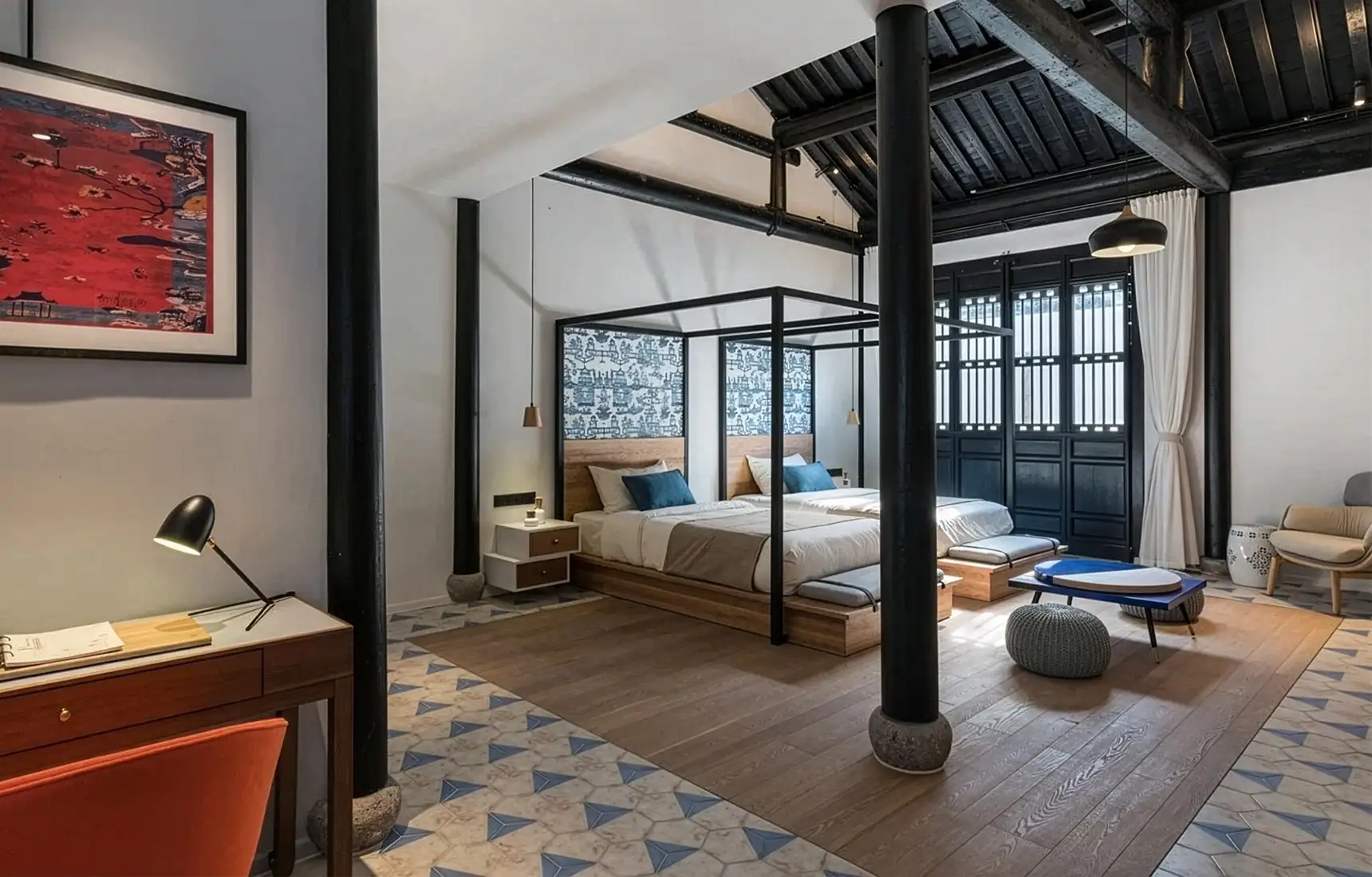
The four room types are 藏静, 藏墨, 藏溪 and 藏韵: hidden stillness, hidden ink, hidden stream, hidden resonance. Every one of them opens on the same character, so the guest who books a room is choosing which kind of concealment they want. Behind that naming sits a three-part colour scheme drawn from 渔樿耕读, the fisherman, the woodcutter, the farmer and the scholar. This is one of the oldest decorative subjects in Chinese art, the four honourable occupations, and it turns up carved into screens and painted onto porcelain across the whole Jiangnan region. Dariel used it as a palette rather than as imagery, which is the more sophisticated move. The reference is legible to anyone who knows it and invisible to anyone who does not, and at no point does it become a mural.
The furniture carries the same logic. Pieces from Maison Dada, the label Dariel co-founded in 2016, appear throughout: the Lazy Susan tables, whose top rotates on a stem in direct reference to the revolving Chinese banqueting tray, and the Little Eliah lamps. Specifying his own product in his own scheme works here because Maison Dada was set up on exactly this premise, a French design vocabulary made in and for China, and the hotel is the fullest built argument for it.
Dariel worked on the project with Caroline Magand and Tao Zhang, with Sarah Shen as project manager. The restoration ran for roughly three years before the hotel opened on 16 February 2017, across 2,874 square metres. The room count is given as 26 in Chinese, and as twenty keys in most English-language listings, which is the sort of discrepancy that follows a building where several suites can be let as one.


The approach, and the four characters in the paving
The arrival sequence is the part of the scheme most likely to be missed by a guest in a hurry. Set into the paved approach are the four characters 鷗溪小隐, Zhexi Xiaoyin, which reads roughly as a small seclusion at Partridge Creek. It is a scholar’s phrase, the sort of thing a Ming or Qing literatus would carve over a garden gate to announce that he had retired from public life to somewhere modest, and it does a lot of work at the threshold. Before a guest has entered a room they have been told that this is a place of withdrawal.
That is a properly designed transition, and it costs almost nothing. It also sets up the central tension of the building, which is that a house dedicated to keeping things hidden is now in the business of showing them to paying visitors. The scheme handles this by keeping the reveals slow. Nothing about Qiushuli announces itself from the street.


Nanxun is the reason the building exists
The town was established in 1252 and sits on the Ditang, a branch canal of the Grand Canal system. In practice this means the whole place is a logistics diagram. Silk went out on the water and money came back on it. Jili silk, the local raw filament, took a gold medal at the London World’s Fair of 1851, and the wealth that built Xiaolianzhuang, the Red House, Jiaye Hall and Qiushuli was made in the four or five decades that followed. Two components of Nanxun were included when the Grand Canal was inscribed on the UNESCO World Heritage list on 22 June 2014.
Nanxun has stayed markedly less commercialised than Wuzhen or Zhouzhuang, the two water towns most visitors reach first, and its architecture is the reason to come. The European borrowings are not a curiosity here. They are the physical record of a town that traded directly with Lyon and London and had the confidence to build what it liked.
The operator, and what happened next
Qiushuli was the nineteenth property for Blossom Hill, a Chinese group built around converting protected heritage buildings into small hotels. The model depends on doing conversions well, since the buildings are listed and the room counts are necessarily low.
In August 2018, roughly eighteen months after this hotel opened, Huazhu Group announced the acquisition of a further 71.2 per cent of Blossom Hill for around RMB 463 million, taking its holding to 82.5 per cent. Huazhu is one of the largest hotel operators in the world, and the purchase signalled that the boutique heritage conversion had become an asset class in China rather than a passion project. Qiushuli is one of the properties that made that case.
The hotel is open and trading, with a rating of 4.8 out of 5 from more than thirteen hundred reviews on Ctrip. Food and beverage runs under the group brand Duoduo’s Bread Tree. Nine years after opening, in a listed building on a canal, that is the test that matters.

Frequently asked questions
Who designed Nanxun Blossom Hill Qiushuli?
Thomas Dariel of Dariel Studio, the Shanghai practice he founded in 2006, working with Caroline Magand and Tao Zhang, with Sarah Shen as project manager.
What was the building before it was a hotel?
Qiushuli was built in 1930 as the residence of the book collector Liu Chenggan and as the administrative base of his library, Jiaye Hall. It later served as a public exhibition space for photographs by his brother, Liu Xucang.
Is Qiushuli the same building as the Jiaye Hall library?
No. Jiaye Hall, built between 1920 and 1924, is the library itself and stands separately nearby. Qiushuli housed the collector, his family and his staff.
How many rooms does the hotel have?
The count is given as 26 rooms in Chinese and as twenty keys in most English-language listings, across 2,874 square metres.
When did it open?
16 February 2017, after a restoration of about three years.
Where is Nanxun?
Nanxun is a canal town in Huzhou, Zhejiang province, roughly midway between Shanghai and Hangzhou. Two of its components are inscribed within the Grand Canal UNESCO World Heritage listing.
What does the name Qiushuli mean?
It derives from Liu Chenggan’s Shanghai book room, 求恕斋, and from the sobriquet he gave himself, 求恕居士. Both turn on the idea of seeking indulgence or forgiveness.


Final thoughts
A water town hotel can always fall back on scenery. Canal views, dark timber, a tea ceremony in the courtyard, and the history left to a line in the welcome folder.
Dariel started somewhere harder, from the building’s actual function. Qiushuli was built to administer a collection of hidden things. He took the character that means hidden, made it the concept, made it the name of every room, and then built a colour scheme on a four hundred year old decorative subject that the local audience reads instinctively and the international audience simply experiences as a palette. The Maison Dada pieces sit inside that without breaking it because they were designed on the same premise.
It is a small hotel in a town most Western visitors have never heard of, and it is one of the more intelligent heritage conversions of the past decade. The concept is not a mood board. It is a character with a dictionary definition, and the building already meant it.
Leave a Reply