
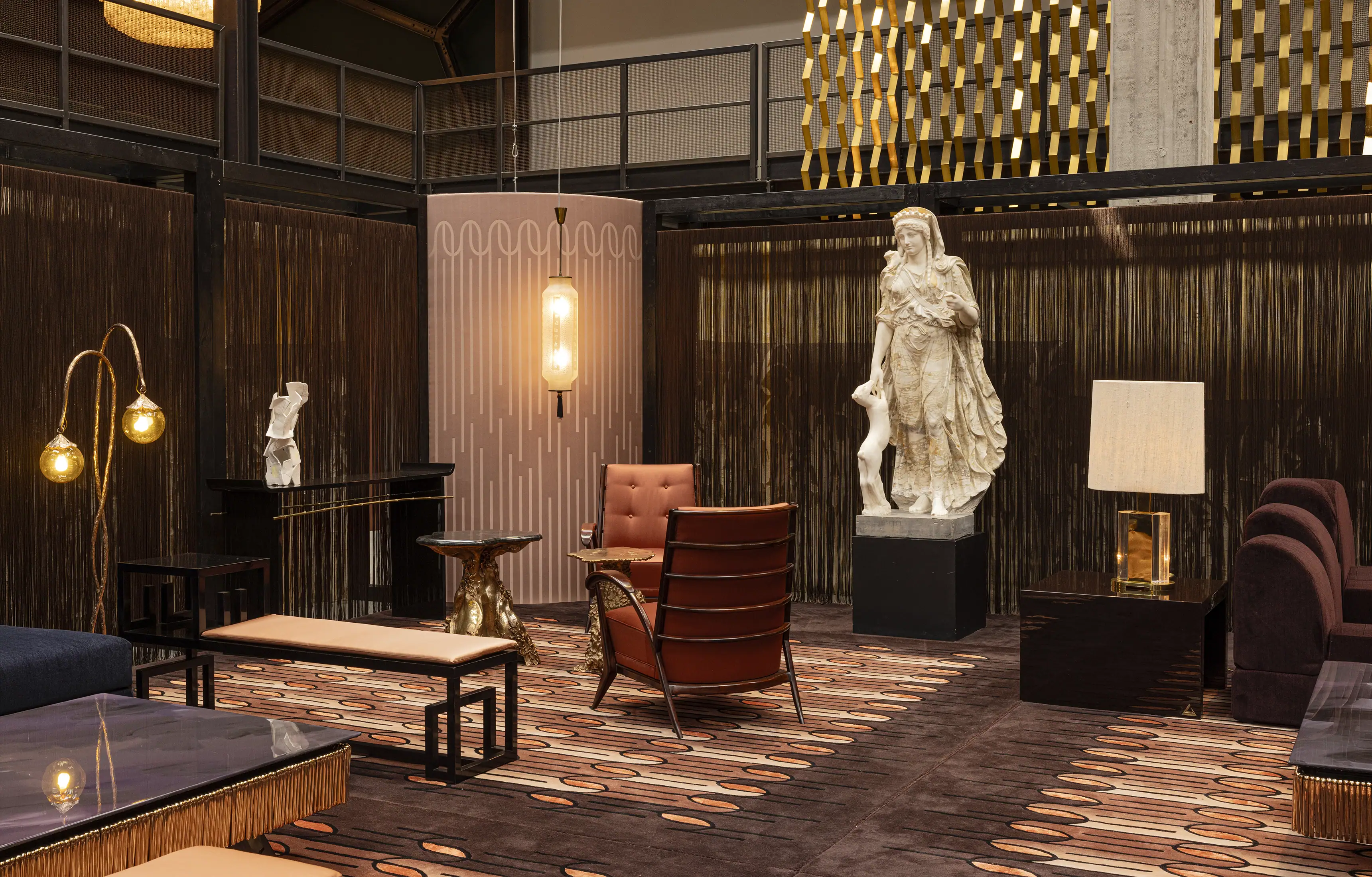
Nina Yashar built a hotel that has never taken a single booking, then filled it with furniture, lighting and art that behave as though the fiction were real. The best joke in the building is that it is not entirely a fiction: one of the show’s own pieces is made from the exact material the building itself used to manufacture, long before Yashar owned it.
Introduction
Nilufar Grand Hotel occupied Nilufar Depot on Viale Lancetti in Milan from 20 to 26 April 2026, during Milan Design Week. Nina Yashar, the gallery’s founder, conceived and curated the presentation herself, reimagining the three-storey building as a hotel that exists only for the week: a reception, bedroom suites, a dining room and fumoir, gallery floors standing in for corridors and public rooms, a penthouse, and a courtyard, each populated with collectible design rather than guests.

It was one of three presentations Yashar’s gallery staged for Milan Design Week 2026, and the way she divided the work between them is worth noting before anything else. She curated Nilufar Grand Hotel herself. She also personally curated Le Pied-à-terre Cosmopolite, a compact Milanese apartment staged concurrently at the gallery’s Via della Spiga showroom. The third, La Casa Magica, exploring the home as ritual and symbol rather than a place to live, she handed entirely to the curator Valentina Ciuffi and the studio Space Caviar. Two hospitality fictions built by Yashar herself, one at the scale of an apartment and one at the scale of a hotel; one more abstract project ceded to somebody else’s argument entirely.
Nilufar Grand Hotel is the larger and stranger of her two. It asks a design object to behave like a hotel amenity for a week, and it does that inside a building whose own history turns out to be more useful to the fiction than any prop Yashar could have commissioned.

A fictional hotel, staged inside a real factory
Nilufar Depot opened in 2015, ten years before this year’s presentation, as Yashar’s conversion of a three-storey former silverware factory on Viale Lancetti. The architect Massimiliano Locatelli led the conversion, working with the manufacturing building’s existing volumes rather than erasing them, and Yashar has described the resulting space’s scale and drama as reminding her of Milan’s La Scala opera house. That comparison is doing real work: a gallerist who already sees her own warehouse as a stage was always well placed to fill it with a fiction rather than a straightforward showroom hang.
Reusing the building’s theatrical bones for Nilufar Grand Hotel is a natural extension of that instinct. What makes this year’s presentation sharper than a simple restaging is that the fiction and the building’s actual, unglamorous industrial past turn out to intersect directly, in an object nobody had to invent a backstory for.

The silverware the building used to make
On the first floor, the design studio VON PELT Atelier showed a body of work titled Deconstructed Bourgeoisie: sculptural lighting and mirrors built from vintage silverware and fragments of Murano glass, salvaged and recomposed rather than cast new. Read on its own terms, it is a considered piece of material reuse, the kind of research-led object Nilufar’s programme has built its reputation on.

Read against the building it was shown in, it becomes something more specific. Nilufar Depot was a silverware factory before it was anything else. VON PELT Atelier’s lighting is made, quite literally, from the material that factory once produced. A hotel invented for one week sits inside a building with a real trade behind it, and one of the week’s own commissioned pieces is assembled from exactly that trade’s raw material. Whether VON PELT Atelier set out to make that connection or arrived at it independently, the building supplies the origin story for free.

Checking in: the ground floor’s cast of characters
The ground floor played reception and public room. A desk by Lola Montes stood in for the check-in a hotel is built around, lit by Christian Pellizzari‘s Calla chandelier. Nearby, a dining table by the designer Gal Gaon anchored a room built for a hotel’s communal meal, while a separate, more secluded fumoir carried furnishings from the Disposition collection by the Turkish designer Derin Beren Yalcin, a name still building an international profile beyond Istanbul. Vintage pieces by James Mont and Paul László sat alongside contemporary work by Vikram Goyal, mixing decades in the manner Nilufar has made its own: nothing pretending to be original to a single period, everything sharing a room on genuinely equal terms.

Three bedroom suites, three different ideas of privacy
A hotel’s defining room is the one nobody else sees, and Nilufar Grand Hotel gave three designers, Allegra Hicks, david/nicolas and Filippo Carandini, a bedroom suite each rather than a shared brief. The effect was less a matching set of rooms than three separate arguments about what privacy at this scale should feel like, staged next door to one another so the differences were impossible to miss. A hotel chain would have briefed one look and repeated it. Nilufar Grand Hotel briefed three points of view and let each one stand on its own.

A first floor built like a permanent collection
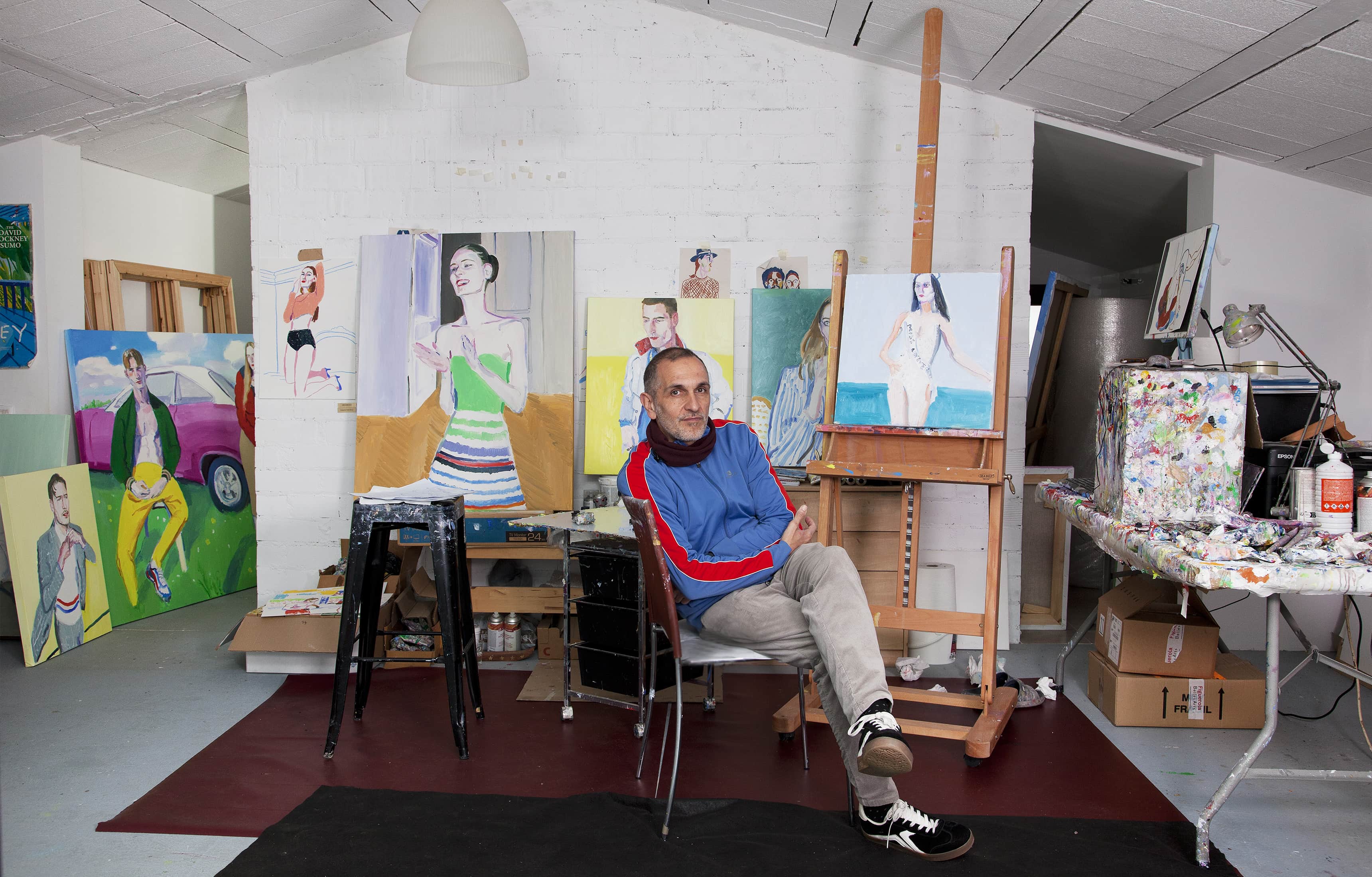
The first floor carried the presentation’s heaviest concentration of names. Vintage pieces by Gabriella Crespi, Ingo Maurer and George Nakashima shared the space with new work from Objects of Common Interest, the Beirut-founded designer Georges Mohasseb (shown through Studio Manda), the British designer Bethan Laura Wood, and the Italian designers Maximilian Marchesani and Lucia Massari. Paintings by Rebecca Moses, the New York-based fashion designer, illustrator and fine artist who spoke to this site earlier this year about the connections between her disciplines, were integrated throughout the floor rather than hung apart from it, and Moses gave live painting demonstrations across the week, keeping the room in motion rather than settled.
Assembling a floor like this is less about any single object than about the range: a gallery confident enough to let a Gabriella Crespi piece from decades ago share a wall with a working painter’s demonstration in the same week is making a case for its own eye as much as for any one name on the list.

The penthouse, and an architect’s debut
The penthouse suite closed the building’s vertical journey with new work from Bethan Laura Wood, Vikram Goyal, Audrey Large and the Greek designer Anestis Michalis. Nilufar’s own account of the room singles out one contribution specifically: the debut of the architect Rooshad Shroff, presenting design objects with the gallery for the first time. Shroff has built his Mumbai-based practice across architecture and interiors, event and window design, and furniture and product work simultaneously rather than in sequence, and Nilufar Grand Hotel’s penthouse marks the point where that furniture and product side of his practice met a European gallery audience directly. A debut is easy to overstate and easy to under-report; what can be said plainly is that an architect with an established multidisciplinary practice in India chose a fictional hotel’s top floor, rather than a conventional showroom, as the place to introduce that side of his work to Milan.

The second floor, and the courtyard that closed it
Above the first floor gallery, a second level paired new work by Andrea Mancuso and the artist Audrey Large with vintage furniture by Carlo Bugatti, Gio Ponti, Joaquim Tenreiro and Sergio Rodrigues, four names spanning Italy and Brazil across most of the twentieth century. A Sgraffito table in Nero Marquinia marble, made with the workshop Del Savio 1910, sat near mirrors by the Venetian glass house Barbini, continuing the presentation’s habit of pairing a contemporary commission with a name whose craft the commission is quietly in conversation with.
The building’s fiction ended outdoors. In the courtyard, Andrea Mancuso’s Punteggiato collection, worked in perforated aluminium, gave the week’s most tightly programmed interior a genuinely open-air close, the one room in the building that never had to pretend to be anything other than what it was.

The returning guests
Read the presentation floor by floor and a smaller pattern emerges inside the larger one. Vikram Goyal appeared twice, with contemporary work on the ground floor and again in the penthouse. Bethan Laura Wood appeared twice as well, on the first floor and again upstairs. Andrea Mancuso closed out both the second floor and the courtyard. None of this was announced as a device, and it may simply reflect how a gallery schedules a large, multi-room presentation with a working roster of names it trusts. But a hotel is a building organised around who is staying and for how long, and a design object that turns up in more than one room of Nilufar Grand Hotel reads, inside that fiction, like a guest who never checked out.

It is also, more practically, a useful way to see how differently the same designer can work across two commissions in the same week. Goyal’s ground-floor contribution sat inside a mixed dining and reception scheme built around communal use; his penthouse work answered a smaller, more private brief at the top of the building. Wood’s first-floor pieces shared a gallery-dense room with vintage names from three continents; her penthouse work had to hold its own in a much quieter setting, alongside Rooshad Shroff’s debut. The building did not ask either designer to repeat themselves, and neither did.

Two hospitality fictions, one gallerist, and where they diverge
It is worth being precise about how Nilufar Grand Hotel relates to the other two presentations Yashar’s gallery staged the same week, because all three shared a building type, a city and a founder, and reading them as interchangeable would miss what each one is actually doing. Le Pied-à-terre Cosmopolite, staged across town at the Via della Spiga gallery, is Yashar’s own vision of a single collector’s compact city apartment: one household, one imagined resident, seventy years of design compressed into rooms sized for a life rather than a stay. Nilufar Grand Hotel takes the opposite scale. It is public rather than domestic, transient rather than settled, and built around dozens of designers rather than one imagined owner’s taste.

La Casa Magica, the third presentation, sits apart from both. Yashar handed that project entirely to the curator Valentina Ciuffi and the studio Space Caviar, who built it around the home as ritual and symbol rather than as a place anyone actually lives or stays. Across one week, Yashar’s gallery therefore ran three separate arguments about what a building can stand in for: a private apartment, a public hotel, and a symbolic threshold, only the last of which she did not author herself.

Frequently asked questions
What was Nilufar Grand Hotel?
A Milan Design Week 2026 presentation by the gallery Nilufar, staged at Nilufar Depot and curated by founder Nina Yashar, reimagining the building as a fictional hotel filled with collectible design rather than guests.
Where and when did it take place?
At Nilufar Depot, Viale Lancetti, Milan, from 20 to 26 April 2026, during Milan Design Week.
What was Nilufar Depot before it became a gallery?
A three-storey former silverware factory, converted by the architect Massimiliano Locatelli and opened as Nilufar Depot in 2015.
Who curated Nilufar Grand Hotel?
Nina Yashar, Nilufar’s founder, who also personally curated a second 2026 presentation, Le Pied-à-terre Cosmopolite, at the gallery’s Via della Spiga showroom.
What did VON PELT Atelier show, and why does it matter to the building?
Deconstructed Bourgeoisie, a series of sculptural lighting and mirrors made from salvaged vintage silverware and fragments of Murano glass, shown on the first floor. The building itself was a silverware factory before Yashar converted it, so the piece is made from the same material the site once manufactured.
Who is Rooshad Shroff, and what was notable about his contribution?
A Mumbai-based architect running a multidisciplinary practice across architecture, interiors, events and furniture design. His penthouse suite contribution marked what Nilufar’s own listing describes as his debut with the gallery.
How does this relate to Nilufar’s other Milan Design Week 2026 presentations?
Nina Yashar curated Nilufar Grand Hotel and Le Pied-à-terre Cosmopolite herself. A third presentation, La Casa Magica, ran concurrently at the Via della Spiga gallery, curated by Valentina Ciuffi and the studio Space Caviar around the home as a symbolic and ritual space.

Final thoughts
Milan Design Week produces a great many fictions every April, and most of them announce themselves as fictions and stop there. Nilufar Grand Hotel does something more specific: it borrows a building with a genuine industrial past, and lets that past surface inside the fiction rather than compete with it. A hotel that never took a booking, staffed with lighting and furniture instead of guests, ends up including a set of objects made from the very material the building used to manufacture. Nina Yashar did not need to invent that detail. She only needed to notice it was already there, in a factory she had converted into a stage a decade earlier, and let one designer’s material choice do the rest of the storytelling for her.
Leave a Reply