
Architecture · Oman
Reading time: 7 minIt rises from the plain at Manah like a range of crystalline peaks, echoing the Al Hajar Mountains that stand behind it. Inside, it tells the story of 800 million years. And it carries a quieter story too, because the ruler who dreamed it laid its first stone and did not live to see it open. The Oman Across Ages Museum is a monument to time in every sense of the word.
Some buildings are about a moment. The Oman Across Ages Museum is about deep time, and it wears that ambition on the outside.
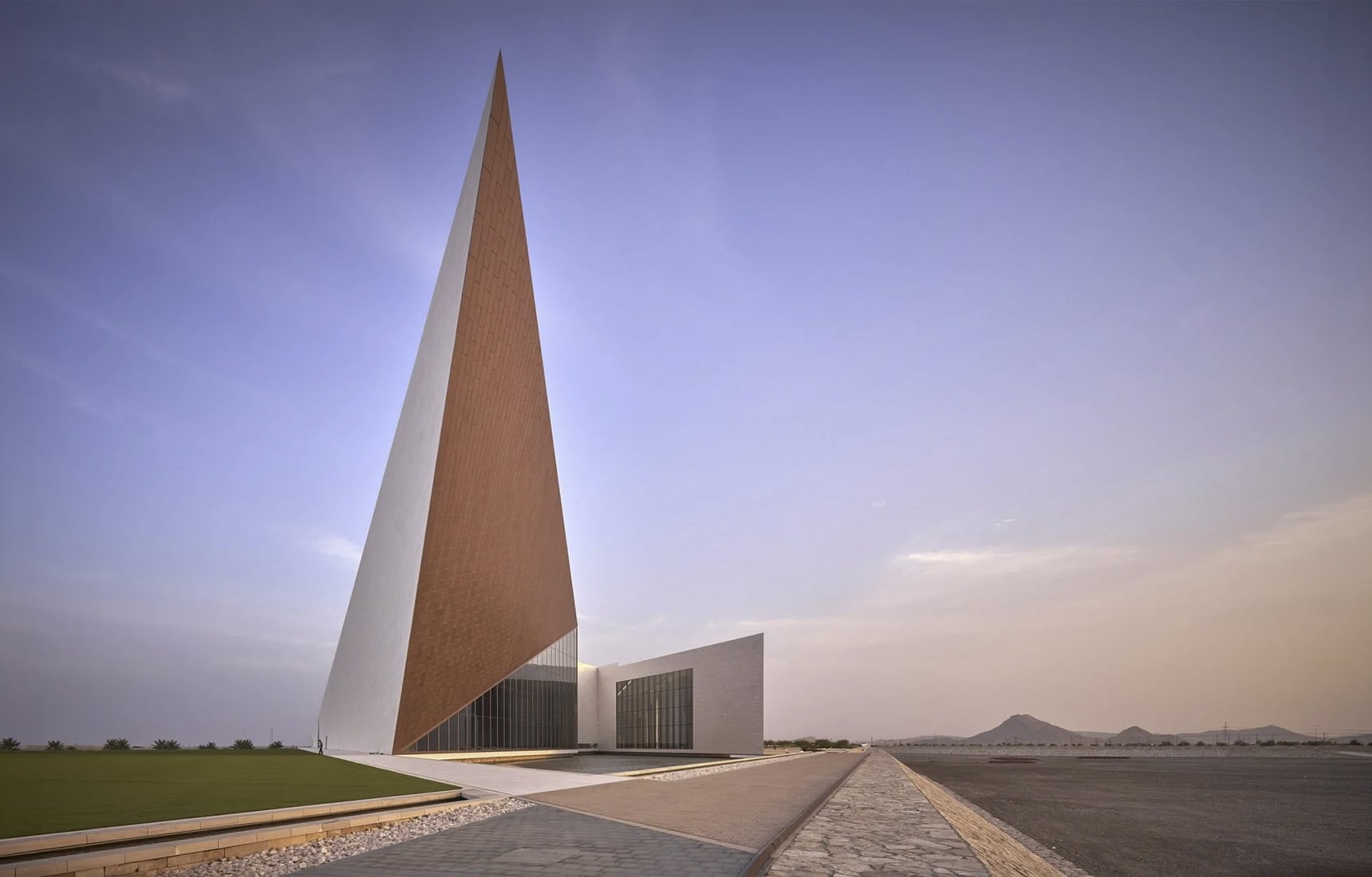
Set on the plain at Manah, near the historic city of Nizwa, the museum rises from the earth as a series of angular, crystalline volumes that seem to have been pushed up out of the ground, echoing the peaks and ridges of the Al Hajar Mountains behind them. It is the work of the Australian practice COX Architecture, and it was voted the “World’s Most Beautiful Museum” in 2024, the same year it won the Prix Versailles Special Prize for an Exterior. Those are not small honours, and standing in front of the building you understand them at once.
But the Oman Across Ages Museum is more than a beautiful object. It is a national story told in stone, the legacy project of a ruler who reshaped his country, and a building whose form, whose setting, and whose contents all speak about the same thing: the passage of time. To see why it works, you have to read all three of those layers together.

A building shaped like the mountains it stands in
Start with the form, because everything follows from it.
COX drew the museum’s geometry directly from the angular, crystalline rock of the Al Hajar range, so that the building reads less like a constructed object dropped onto the plain and more like a natural outcrop of the same landscape. Monumental tilted planes, faceted volumes, heavy stone cladding in the tones of the surrounding terrain: the museum belongs to its site as completely as the rock it echoes.
There is a deeper truth hiding in that choice, and it is worth knowing. The Al Hajar Mountains contain some of the most remarkable exposed geology anywhere on Earth, including vast slices of ancient ocean floor and rock from deep within the planet’s mantle, lifted to the surface and laid open to the sky. Geologists travel from around the world to read the Earth’s history in these mountains. So a museum that borrows the mountains’ crystalline form is not simply making a pretty gesture toward its backdrop. It is echoing a landscape that is itself a record of deep time, which is exactly what the museum inside sets out to tell.

Eight hundred million years, walked from the ground up
The visitor journey is where the concept becomes an experience, and COX has staged it with real drama.
You begin underground, in subterranean spaces that evoke the raw, earthy roots of the earliest settlement, and you climb from there through a sequence of galleries, each shaped to carry the spirit of a different age. The museum covers an astonishing span, roughly 800 million years of Oman’s geological, natural and human story, and the architecture does the narrating as much as the exhibits do. Sweeping volumes open and close, light is handled with precision, and long views appear at the moments that matter. Some galleries rise more than 20 metres, and the design achieves column-free spans of more than 70 metres, so these interiors have the scale of canyons rather than rooms.
The climax is a lovely piece of choreography. Throughout the journey a crystalline gallery stays visible in the distance, glimpsed and promised but never entered, until the very end. This is the Renaissance Gallery, and it opens only as the finale. It stands for modern Oman and for the country’s future, and reaching it after 800 million years of build-up gives the arrival genuine emotional weight. The building makes you earn the present tense.

The vision of Sultan Qaboos
That Renaissance Gallery carries a meaning the architecture alone cannot tell you, and it is the human heart of the whole project.
The museum was commissioned by the Royal Court Affairs of Oman as a legacy project of the late Sultan Qaboos bin Said, the ruler who transformed the country after taking power in 1970. Omanis call the era he began the Renaissance, or Al Nahda, and the museum’s final gallery is named for exactly that. Qaboos laid the foundation stone himself in 2015. He died in 2020, and so it fell to his successor, Sultan Haitham bin Tariq, to inaugurate the finished building in 2023, before it opened fully to the public.
There is a quiet poignancy in that sequence, and it deserves to be said plainly. A ruler conceived a museum to tell his nation’s story across 800 million years, set its first stone, and did not live to walk through it. The building that resulted is, among everything else it does, a memorial to the man who imagined it. A museum about the passage of time became, in its own making, a small demonstration of it.

Engineering, and the intelligence of building cool
None of this would stand without some serious engineering, and here the museum is quietly clever rather than showy.
To achieve those vast, column-free interiors beneath heavy stone cladding, COX used an advanced truss system and a rhomboid steel diagrid, a diagonal lattice that lets the structure carry great spans and great weight at once. A composite roof slab over the diagrid keeps material use down. Because Oman’s interior is fiercely hot, the museum leans on passive cooling: thick thermal mass, mechanical systems buried underground, and air drawn through subterranean labyrinths so that the building is cooled largely by the earth it sits in rather than by brute mechanical force. The engineers also worked with Sultan Qaboos University on a seismic design tuned to the region’s specific geology, giving the building a shock-absorbing system suited to its ground.
All of it reflects a consistent ethos, which is to do more with less: lightness where it can, mass where it counts, and a deep respect for the climate and the land.

Frequently asked questions
What is the Oman Across Ages Museum?
A major cultural and educational museum at Manah, near Nizwa, that tells the story of Oman across roughly 800 million years of geology, nature and human history. It was designed by COX Architecture and opened to the public following its 2023 inauguration.
Who designed it?
The Australian practice COX Architecture, with lighting by Lighting Design Partnership International. It won the Prix Versailles Special Prize for an Exterior in 2024 and was voted the “World’s Most Beautiful Museum” that year.
Why is it significant to Oman?
It was a legacy project of the late Sultan Qaboos bin Said, who laid the foundation stone in 2015. Its final Renaissance Gallery celebrates the modern Omani Renaissance he began in 1970.
What inspired the architecture?
The crystalline, angular geology of the surrounding Al Hajar Mountains, so that the museum appears to rise from the landscape as a natural outcrop.
How is it kept cool?
Through passive design: heavy thermal mass, underground mechanical systems, and air drawn through subterranean labyrinths, which cool the building using the earth rather than energy-hungry machinery.

Final thoughts
The Oman Across Ages Museum stands among the finest buildings in a region rich with them, and what lifts it is coherence. The mountains outside are a record of deep time. The building borrows their crystalline form. The galleries inside tell 800 million years of story. And the whole thing was dreamed by a ruler who wanted his people to know where they came from and where they might go.
Walk up out of those underground rooms, climb through the ages, and arrive at last in the crystalline Renaissance Gallery with the Al Hajar Mountains framed beyond the glass, and the building’s argument lands without a word of explanation. This is architecture doing what it does best: turning time, memory and place into something you can walk through. Oman gave itself a museum worthy of its own long story, and, in the same gesture, a fitting monument to the man who wanted it told.


Leave a Reply