
Collectible Design · London
Reading time: 11 minHaya Jarrar’s first London collection is built on a structural question rather than a theme. Eight works in bronze, oak and stone ask what takes weight and what gives under it, and the clearest answer is a table that stands on a set of carved human legs, raised clear of the floor on a plinth you can see through.
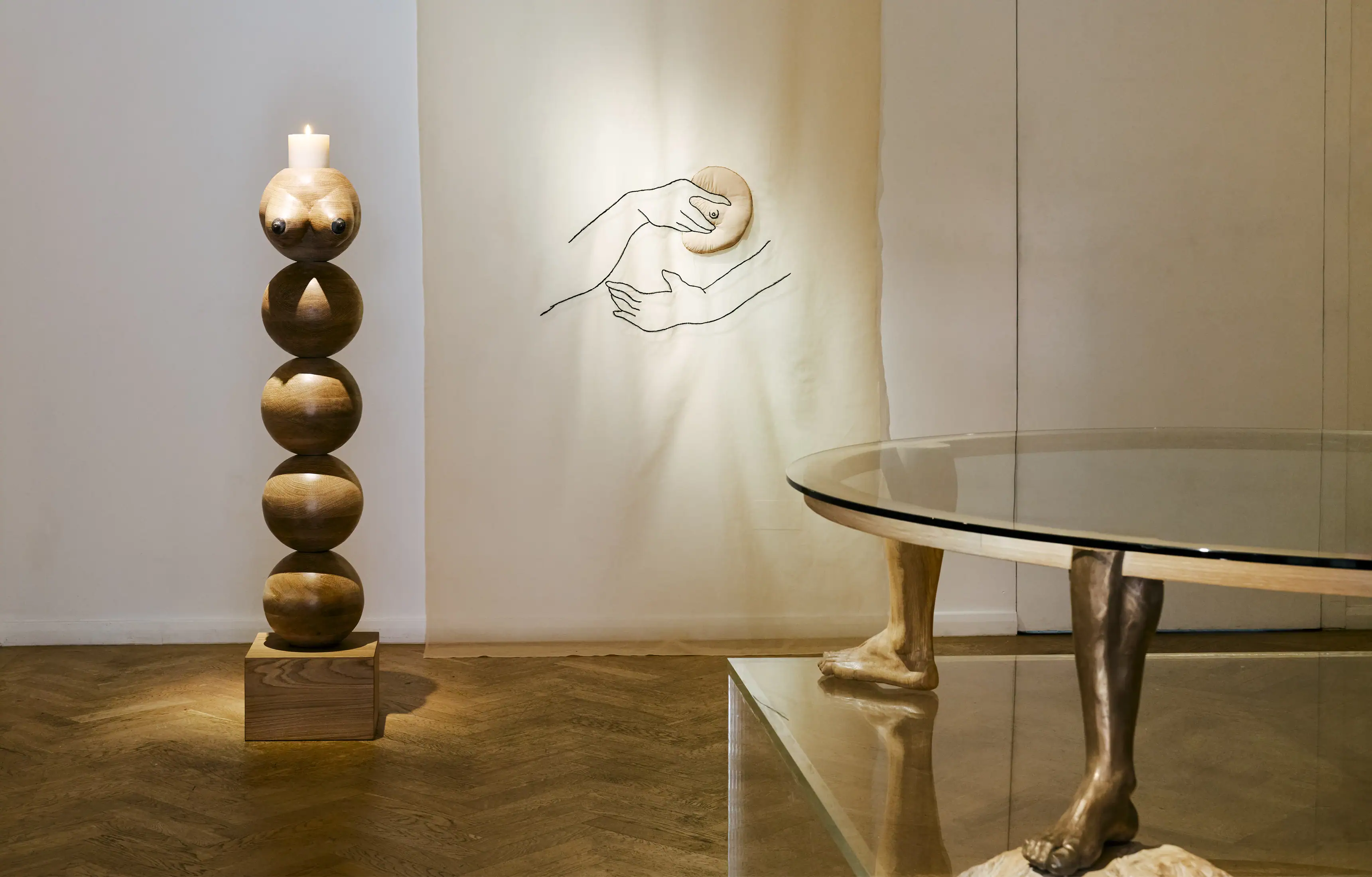
A round glass tabletop rests on legs carved from oak and cast in bronze. They are human legs, ankles, tendons and toes included, and they stand on a clear acrylic plinth that lifts the feet a few centimetres above the parquet. The plinth is the decision worth noticing. It carries no structural load that the floor could not carry. It places the piece the way a sculpture is placed, and because it is transparent, the lift registers before the reason for it does. The polished top of the plinth then reflects each foot, so every leg acquires a twin beneath it, which is exactly what the glass tabletop is doing above.

That doubling is the first clue to how Haya Jarrar has built this collection. She works in pairs. The table is one of eight works she is showing at 14A Hay Hill in Mayfair, open daily and free to enter until 20 September 2026, in the first London outing for Romani Home, the collectible design studio she founded in Dubai in 2024. The show sits within London Design Festival 2026, it is called While I Sat To Make Life, and the pieces were made across her pregnancy and the first months of motherhood.
Jarrar describes the collection through dualities: vulnerability and power, movement and stillness, surrender and grounding. In most hands that would be a mood board. Here it is closer to a specification, because every pair has been given a material to argue it. Bronze and oak take load. Travertine stacks under it. Silk, hung from above and left to pool on the floor, declines to take any load at all and does the most spatial work in the room. The collection is about support, and support is a thing you can build.

The carved leg, and the plinth under it
Get close to the table and the carving holds up. The oak legs are cut with the grain running the length of the shin, so the figure of the timber reads as muscle where the calf swells and as tendon where it narrows into the ankle. The toes are separated and slightly splayed, with the weight forward, the posture of someone standing rather than posing. One leg is cast in bronze instead of carved, and where it meets the plinth it sits on a rough hewn timber base cut into ridges, as though the foot has come to rest on broken ground. Two materials, two finishes, one gesture.

The reference is personal. Jarrar has said the hand-carved oak legs of the Man Chair were modelled directly from her husband’s, echoing the view she had while resting against him during pregnancy, and she frames the piece as a symbol of safety and of a strength that holds without overpowering. That is an unusually literal brief for a furniture leg, and it produces an unusually precise object. A chair leg is asked to do one job, which is to stand there and take the weight of a person. Carving it from the body that did that job is not a metaphor so much as a transcription.
It also solves a problem that sculptural furniture often leaves open. Anthropomorphic legs on a table can read as decoration bolted to a form. These do not, because the proportions are correct and the modelling is anatomical rather than stylised, so the eye reads a body first and a support second, and only then notices that the two are the same thing.

Stacked spheres, and the moment one becomes a body
The candlesticks are the pieces that will travel furthest as images, and they are cleverer than a first glance suggests. Each is a vertical stack of spheres, four or five high, set on a cube plinth cut from the same material. One version is travertine, pale and open-pored, with the pitting left unfilled so the light catches the surface unevenly. The other is oak, turned and polished, with the grain running as a tight spiral around each sphere.

The top sphere is cut flat and socketed to take a pillar candle. On the oak version, that same top sphere is carved into a pair of breasts, with dark inset nipples in a contrasting material. The effect is one of delay. The stack reads as pure geometry, a column of repeated volumes, until the top element resolves into a body and the whole object reorganises itself around that reading. Nothing else changes. The spheres below stay spheres.
There is a functional argument sitting underneath the formal one. A candlestick exists to raise a flame and hold it steady, which makes it an object whose entire purpose is to give light. Putting the source of nourishment at the top of it, directly beneath the flame, means the piece states its subject through its function rather than alongside it. Jarrar has cited Gabriella Crespi as an aesthetic influence, and the debt shows here in the confidence of the stacked geometry and in the willingness to let a simple repeated volume carry an object on its own.

Silk that is hung rather than stretched
The largest intervention in the show is textile. Jarrar drew women’s bodies in single continuous lines, and those drawings were translated into large-scale silk embroideries handmade in Paris. A face resting on a hand. A pair of legs floating. Two hands, one cupping the other. The stitch is heavy black thread on cream ground, and it is worked to keep the wobble and the hesitation of a drawn line rather than smoothing it into a machine curve.
What matters is how they are installed. They are hung from above and left unstretched, so each panel carries its own weight, creases along its length and pools onto the floor at the bottom. No frame, no tension, no flat plane. They are then positioned in front of walls and across openings, which means the softest material in the exhibition is the one doing the architectural work, dividing rooms and filtering light, while the bronze, oak and stone sit within those divisions as objects. That inversion is the sharpest idea in the room.

One panel takes it further. A drawn hand reaches towards a breast that is not drawn at all but padded and three-dimensional, pushing out of the cloth in the same cream silk. The line leaves the plane at precisely the point the drawing is about, and the contrast between the flat stitched hand and the volume it reaches for does more work than either would alone. Matisse and Anna Weyant are both named as references, and the line quality belongs firmly to the first of those, closer to Matisse’s pen drawings of the 1930s and 1940s than to the cut-outs.
The room is scented too, with saffron and coriander over rose, jasmine and magnolia, grounded by amber, musk, cedar and vetiver. Read alongside the organza, the lighting and the transparent displays, it is consistent with the rest of the thinking: the exhibition is built from materials that behave, rather than materials that merely look.

Eight years before the first collection
The studio behind all this is newer than the practice. Jarrar is a Jordanian designer and creative director based in Dubai, and she came to furniture from fashion, where she built the label Romani into a following across the region before turning to objects. She has said that she spent eight years developing a full collection before she felt ready to launch a brand of her own, which recasts the 2024 opening of Romani Home as the moment a long private body of work went public rather than the moment it began.

Romani Home occupies a 3,000 square foot studio in Al Quoz, Dubai’s warehouse district and the centre of its independent gallery scene. Everything is limited edition and handmade. Jarrar works with artisans in India, London and Italy, and gravitates to bronze, oak and stone, materials she describes as holding memory, with the maker’s hand deliberately left legible in the finish. On the evidence of the carving and the casting here, that is a description of a method rather than a claim about one.

The Bourgeois reference, taken seriously
Jarrar names Louise Bourgeois among the artists she draws on, and it is worth following that up, because the reference lands harder in London than it would anywhere else.
Bourgeois spent the last two decades of her life making work in fabric, cut from her own clothing, bed linen, handkerchiefs, tapestry and needlepoint. Those works were the subject of The Woven Child at the Hayward Gallery from 9 February to 15 May 2022, the first exhibition given over entirely to her textile practice. Among the recurring subjects across that body of work is the maternal body, handled without sentiment: The Good Mother of 2003 is a fabric figure with thread running out from the breasts, spooling away from her and onto the floor.

So a studio arriving in London with hung, unstretched fabric works about the nursing body is arriving in the one city that has already given that exact material and that exact subject a full museum survey. The lineage is real and the claim holds. It also sets a useful measure for reading the embroideries, which take the same permission to treat the maternal body as structural rather than tender, and which pool on the floor for much the same reason Bourgeois let her thread run out.

The room, and the district it sits in
The exhibition is credited to curator Anne-Laure Pingreoun, and it sits inside the Mayfair Design District programme, whose theme for 2026 is What Matters Now. Romani Home is listed there alongside Charles Burnand Gallery, MINT Gallery, Sarah Myerscough Gallery, Savoir, HOLLY HUNT and Mandarin Oriental Mayfair, which makes a first London show part of a walkable route rather than a single destination.

It also explains why a Dubai studio’s London debut has landed on Hay Hill rather than in a booth. A domestic first-floor space with herringbone parquet, cornices and daylight from two sides is the correct room for eight pieces made about a house, a body and the months spent inside both. A neutral white cube would have taken the pooling silk and the candlelit travertine and flattened them.
It is a two-way benefit. The district gets a studio nobody in London has shown before, and Jarrar gets a first London audience already in the habit of walking between Mayfair addresses in festival week.

What the eight pieces are arguing
Alongside the table and the candlesticks sits the Fluid Bench, a long curved form in bronze whose surface is left with the movement of the material still visible across it, paired with a small round side table on a single tapered leg. Jarrar frames the bench through breath and water and a body in transition, and describes equilibrium as something found in the ability to move and adapt rather than in stillness. The form supports that: a continuous curve has no single correct approach and no front, so the piece has to be walked around to be understood. Bronze wall sconces and a round mirror carry the same material language up onto the walls, so the metal is present at eye level as well as underfoot.

Put the eight together and the collection reads as a single argument about load. The bench takes weight along a curve. The table takes it through bodies. The candlesticks take it through a stack, the most stable structure available and the one most obviously vulnerable to a knock. The embroideries take none and hold the room together anyway. Jarrar has said that pregnancy changed the way she saw the female body, that a form long celebrated for its beauty revealed a greater purpose, and that the same form capable of inspiring desire is capable of sustaining an entire new human being. The collection makes that case in structure rather than in imagery, which is why it works as furniture and not only as sculpture.

Frequently asked questions
When and where is While I Sat To Make Life on show?
The exhibition is open daily until 20 September 2026 at 14A Hay Hill in Mayfair, London W1J 8NT, from 10am to 6pm. Entry is free and no ticket is required. It forms part of London Design Festival 2026 and the Mayfair Design District programme.
Who is Haya Jarrar?
Haya Jarrar is a Jordanian multidisciplinary designer and creative director based in Dubai. She founded the fashion label Romani before opening the collectible design studio Romani Home in Al Quoz, Dubai, in 2024. She has said she spent eight years developing a collection before launching a brand of her own.
What is in the collection?
Eight limited edition, handmade works in bronze, oak and stone, including the Man Chair, whose hand-carved oak legs were modelled on her husband’s, and the Fluid Bench, a long curved bronze form. Stacked-sphere candlesticks in travertine and carved oak, and a round glass table on carved and cast human legs, complete the group.
What are the wall hangings made of?
They are large-scale silk embroideries handmade in Paris, worked in heavy black thread from Jarrar’s own continuous line drawings of women’s bodies. They are hung unstretched so that each panel creases along its length and pools onto the floor, and one carries a padded three-dimensional breast form that lifts the drawing off the plane.
Is Romani Home part of the Mayfair Design District?
Yes. The exhibition is listed in the Mayfair Design District programme for London Design Festival 2026, whose theme this year is What Matters Now. It is curated by Anne-Laure Pingreoun.

Final thoughts
The easiest way to read a first London show is as an introduction, and this one certainly is. It is more useful read as a statement of method. Every piece in the room has been given a job that its material is genuinely good at, and the reason the collection holds together is that Jarrar has not asked any of them to do a job they are not suited to. The silk is not stretched. The travertine is not polished smooth. The oak is carved along the grain that already looks like muscle.

The plinth under the table is the detail to take away. It is the least visible decision in the exhibition and it sets the terms for everything else: these are objects to be used, presented for a fortnight in the register of sculpture, in a room that behaves like a home. Jarrar calls London her second hometown, and she has chosen an unusually well-judged room in it to say so.
The show runs until 20 September 2026 at 14A Hay Hill, London W1J 8NT, open daily from 10am to 6pm. Entry is free and no ticket is required, and it forms part of the Mayfair Design District programme for London Design Festival.

Project Credits
More from Mayfair Design District
This article is part of continuing coverage of Mayfair Design District, the year-round programme of exhibitions, installations, talks and late nights staged across Mayfair and Marylebone. The 2026 season runs under the theme What Matters Now.
Read every Mayfair Design District story, or begin with Anne-Laure Pingreoun on the season she curates.
Martyn White is an official media partner of Mayfair Design District.



Leave a Reply