
Automotive Design · Nottingham
Reading Time: 8 minutes
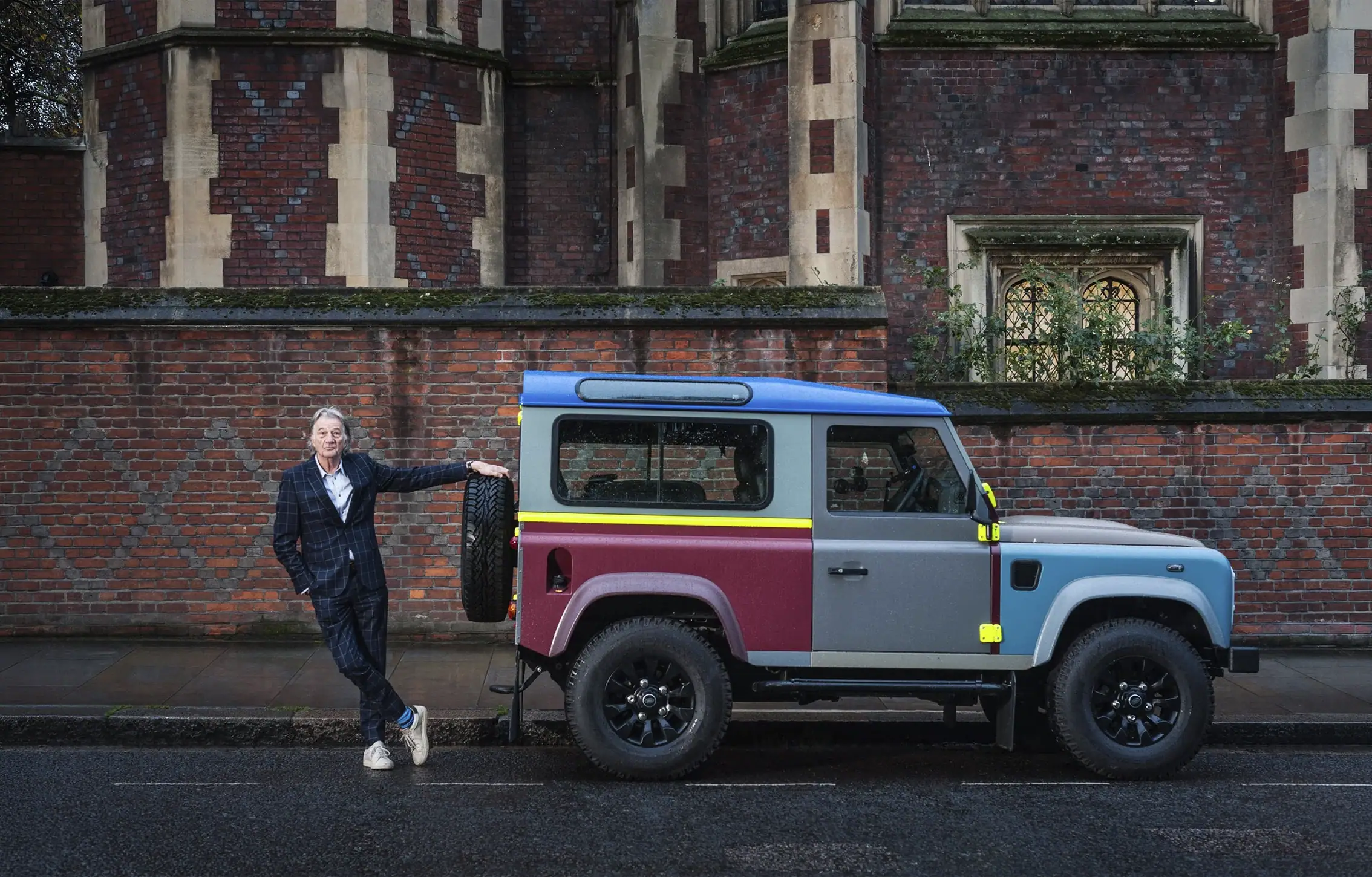
In 2015, as the classic Land Rover Defender neared the end of a 68 year production run, Sir Paul Smith customised one for himself: a Defender 90 finished in 27 colours with a hand-painted bee on the roof. He changed none of its shape. That restraint is the actual story, a tailor applying his own method, respecting a fixed cut and adding colour and detail within it, to a vehicle that had barely changed its own silhouette since 1948.
Introduction
The Defender 90 that Sir Paul Smith built with Land Rover’s Special Vehicle Operations team is finished in 27 individually mixed colours, applied in a patchwork across its body panels, each one sourced from a Pantone reference Smith supplied himself. Inside, black leather trimmed with contrasting blue stitching and Paul Smith Maharam fabric sits beneath a cabin full of details easy to miss on a first look: a photograph of a set of keys printed inside the glove box, a custom Paul Smith fascia in place of the standard dashboard clock, and a small hand-painted bee on the roof, a nod to the countryside heritage the vehicle was built for. It was revealed through a short documentary film released on 18 February 2016, timed to that year’s London Fashion Week and to the closing weeks of classic Defender production at Land Rover’s Solihull plant.
Most of the coverage at the time treated it as a colour story, a designer known for stripes let loose on a famously utilitarian vehicle. That framing misses the more interesting fact sitting underneath it. Smith did not redesign the Defender. He did not touch its silhouette, its proportions or its mechanical layout, all of which had barely changed since the vehicle’s first prototype was built in 1948. What he did instead was apply the exact method that built his career: take a fixed, classic form and work within it, rather than against it.

A vehicle sketched in sand, built from necessity
The Land Rover’s basic shape traces back to a single afternoon in the summer of 1947, when Maurice Wilks, Rover’s chief engineer, sketched a concept into the wet sand at Red Wharf Bay on the Isle of Anglesey while his brother Spencer, Rover’s managing director, watched. The Rover board approved the project that September, and the first production Land Rover was unveiled at the Amsterdam Motor Show on 30 April 1948, priced at £450, with an 80 inch wheelbase and a 50 horsepower petrol engine. Its body panels were pressed from Birmabright, an aluminium alloy chosen not for any design reason but because Britain’s postwar steel rationing had made steel scarce while aluminium, plentiful from wartime aircraft production, was not.
That material choice, made under economic pressure rather than aesthetic preference, produced a shape that stayed recognisably the same through the Series I, II and III models between 1948 and 1983, through the coil sprung Ninety and One Ten introduced in 1983, and through the rebrand to Defender in 1990, chosen specifically to distinguish the working vehicle from the newly launched, more comfort oriented Discovery. By the time Smith’s project began, the basic profile of the vehicle he was customising, boxy, upright, flat panelled, had gone essentially unchanged for close to seventy years. Production ended on 29 January 2016, when the 2,016,933rd and final classic Defender came off the Solihull line, only weeks after Smith’s own film had already put a version of that same shape in front of a fashion audience.

Paul Smith, a tailor whose whole career is classic with a twist
Paul Smith was born in Beeston, Nottinghamshire, in 1946, and left school at 15 to work in a Nottingham clothing warehouse, following his father into the textile trade. A cycling accident at 17 put him in hospital for three months, and it was during that recovery that he began spending time with friends at a local art school, where he first encountered graphic design and fashion. He later trained in tailoring with the Savile Row house Lincroft Kilgour before opening his own shop, Paul Smith Vêtements Pour Homme, on Byard Lane in Nottingham in 1970. It measured 144 square feet, roughly the size of a single large room, and opened only on Fridays and Saturdays while Smith did freelance design work the rest of the week to fund it.
That grounding in tailoring is the reason “classic with a twist” became more than a slogan. Smith’s menswear built its reputation on taking traditional British cut, the suit, the shirt, the sports jacket, and leaving the structure alone while adding colour, pattern and a specific kind of wit inside it: his signature multicoloured stripe, a lining printed with an unexpected image, a single loud button on an otherwise restrained jacket. He was appointed CBE in 1994, knighted in 2000, and made a Companion of Honour in 2020, and by 2025 his label operated more than 130 stores in over 60 countries while he retained majority ownership. Applied to a car rather than a jacket, that same discipline, leave the cut alone, work entirely within it, is exactly what the Defender project became.

What Special Vehicle Operations actually built
The project ran through Land Rover’s Special Vehicle Operations division, overseen by the marque’s chief design officer at the time, Gerry McGovern, whose team exists specifically to carry out individual customer commissions and bespoke builds rather than volume production work. Smith supplied 27 Pantone colour references, earthy and military adjacent tones drawn from the British countryside and from his own tailoring palette, and SVO’s technicians custom mixed and hand applied each one across the vehicle’s panels in a deliberately irregular patchwork, so that no two adjacent panels shared quite the same shade.
The interior carried the same logic in a different register. Black leather with contrasting blue stitching and Paul Smith branded Maharam fabric covered the cabin, while the smaller details did the work that Smith’s fashion collections have always relied on: a joke discovered rather than announced. “My designs are known for their attention to detail, so I didn’t want this Defender to be any different,” Smith said of the project, and described the roof’s hand painted bee as “a tongue in cheek reference to the countryside and the heritage of the car.” None of it altered a single structural line of the vehicle underneath. The customisation lived entirely in colour, material and detail, applied to a shape SVO left exactly as Land Rover had built it.
The design argument: tailoring, not redesigning
Set the two histories side by side and the project stops reading as a fashion designer’s novelty exercise and becomes something more specific. The Defender’s silhouette survived nearly seventy years because it was never treated as decoration to begin with, it was a functional answer to a wartime materials shortage that happened to still work. Smith’s own design language survived just as long by doing the opposite of redesigning a classic form: leaving a traditional cut alone and adding everything interesting inside its boundaries. Applying that method to the Defender rather than to a jacket is not really a stretch for him. It is the same job, performed on a different kind of garment, one built from aluminium panels instead of wool.

The end of one production run, and a second life nine years later
Smith’s Defender arrived at the exact moment the vehicle it was built on stopped being made. The classic Defender’s production run ended nine weeks after Smith’s documentary film was released, closing a 68 year run that had outlasted three name changes and multiple design generations without ever losing its original silhouette. For most one-off collaborations, that would have been the end of the story: a single vehicle, privately owned, appearing in a short film and then disappearing from view.
Instead, the design found a second life. In 2024, nine years after the original build, Land Rover and Paul Smith released a limited edition die-cast model of that specific Defender 90, sold through Smith’s own website in 1:18 and 1:43 scales, complete with steerable front wheels, opening doors and bonnet, and working suspension, reproducing the vehicle’s 27 colour patchwork in miniature down to its interior and undercarriage detailing. A one-off built to mark the end of a production line became, nearly a decade on, a commercial object in its own right, which says more about the strength of Smith’s original design decisions than any amount of contemporary press coverage did at the time.
That second life is also a useful point of contrast with what happened to the Defender name itself. Gerry McGovern, the same chief design officer who oversaw Smith’s project, went on to lead the team behind the completely new Defender that launched in 2020, an entirely reimagined vehicle built on a modern monocoque platform rather than the old body-on-frame chassis, with a silhouette that echoes the original only in outline. Where Smith’s project worked entirely within the classic Defender’s unchanged shape, the vehicle’s next generation abandoned that shape altogether. Both were legitimate design responses to the same 68 year old object; they simply chose opposite constraints, one keeping the form and changing the surface, the other keeping the spirit and changing the form.

Frequently asked questions
What is the Paul Smith Defender?
A one-off Land Rover Defender 90, customised by Sir Paul Smith with Land Rover’s Special Vehicle Operations team, finished in 27 individually mixed colours with a hand-painted bee on the roof and a custom Paul Smith interior. It was revealed in February 2016.
Who designed it?
Sir Paul Smith supplied the colour palette and design details, working with Land Rover’s Special Vehicle Operations division under chief design officer Gerry McGovern.
What colours were used?
27 individually Pantone-matched, custom-mixed colours applied in a patchwork pattern across the exterior panels, drawn from earthy and military-adjacent tones associated with the British countryside.
Did the project change the Defender’s shape or engineering?
No. The customisation was entirely cosmetic, colour, materials and interior detail, applied to the standard Defender 90 body and mechanical layout, which had remained largely unchanged since the vehicle’s original 1948 design.
Is the original Defender still around?
Yes, as a privately owned one-off. In 2024, Land Rover and Paul Smith released a limited edition die-cast model of the same vehicle in 1:18 and 1:43 scales, sold through Paul Smith’s own website.
When did classic Defender production end?
On 29 January 2016, when the 2,016,933rd and final classic Defender came off Land Rover’s Solihull production line, weeks after Smith’s project was revealed.
Final thoughts
It would have been easy to read the Paul Smith Defender as a fashion designer indulging himself with a famous car, twenty-seven colours and a bee for the cameras. What actually happened is narrower and more interesting than that. Smith left a nearly seventy year old shape exactly as he found it and did the one thing his entire career has trained him to do: add personality inside a fixed structure rather than change the structure itself. Nine years later, that restraint is the reason the design was worth reproducing as a collector’s object rather than simply forgotten once the film stopped circulating.
Leave a Reply