
Design Travel · Peru
Reading Time: 8 minutes
The carriages on the Belmond Andean Explorer were built in Australia in 1999 for a luxury train that closed within four years. The company that part-funded that failure bought the carriages, stored them for over a decade, renamed itself Belmond, and shipped them to Peru for a second attempt. This is the story of what changed the second time.
Introduction
The Belmond Andean Explorer is a luxury sleeper train running through the Peruvian Andes between Cusco, Puno on Lake Titicaca, and Arequipa, which launched in May 2017 as South America’s first overnight luxury train. It carries up to 48 guests across 16 carriages, with cabins, two dining cars, a piano bar car, an open-air observation deck and an onboard spa. The interiors are by Muza Lab, the studio founded by Inge Moore and Nathan Hutchins. The train is operated by PeruRail, a joint venture between Belmond and the Peruvian rail entrepreneur Lorenzo Sousa Debarbieri.
Most coverage of the Andean Explorer treats it as a new train built for a spectacular route. It is not new. Every one of its carriages has already run a full commercial life on the other side of the world, under a different name, for a different owner who turned out to be the same company. What Muza Lab was actually asked to design was a second chance for rolling stock that had already failed once.

The carriages already had one life, and it failed
The Andean Explorer’s carriages were built at the Queensland Rail workshops in Townsville, Australia, at a cost of around 35 million Australian dollars, for a train called the Great South Pacific Express. Announced in December 1996 as a partnership between Queensland Rail and Orient-Express Hotels, it entered service in April 1999, running between Kuranda, near Cairns, and Sydney, with occasional routes to Melbourne, Canberra, the Blue Mountains and the Hunter Valley. Fares ran to several thousand Australian dollars, and the train carried up to 100 passengers in Pullman, State and Commissioner suites.
It closed in June 2003, having run up losses of around 12 million Australian dollars across four years of operation. The carriages were sold in 2005 to Orient-Express Hotels, the same company that had helped fund the original venture, and went into storage at the Workshops Rail Museum in Ipswich, Queensland. They sat there for more than a decade.

The same company bought the wreckage, then renamed itself
This is the detail most coverage of the Andean Explorer skips entirely, and it changes what the train actually is. Orient-Express Hotels rebranded itself as Belmond in 2014, a decision the company framed publicly as separating its hotel and travel portfolio from the historic Orient-Express train name, which it had by then licensed out. Two years later, in February 2016, the mothballed Great South Pacific Express carriages were moved from the Ipswich rail museum to the Port of Brisbane and shipped to Peru. The train entered service as the Belmond Andean Explorer in May 2017, engineered onto Peru’s metre gauge network.
Read in sequence, this is not a story about a hotel brand discovering some picturesque old rolling stock to repurpose. It is a story about one company’s own failed 1999 investment sitting in storage under its own ownership for over a decade, surviving a corporate rebrand, and finally getting a second commercial attempt on a different continent. Muza Lab’s brief was not simply to decorate a train. It was to solve, physically, whatever had gone wrong for a nearly identical train the first time round.

Muza Lab designed a second chance, not a blank page
Inge Moore and Nathan Hutchins founded Muza Lab in 2016, after thirteen years working together in architecture and interiors practices beforehand. Moore has described the design intent for the Andean Explorer directly: to create “somewhere to ponder and dream, a space where the beauty of the land can infuse the soul.” That is a brief written for a train whose entire commercial case rests on the view outside the window, which is a very different proposition from the original Australian route.
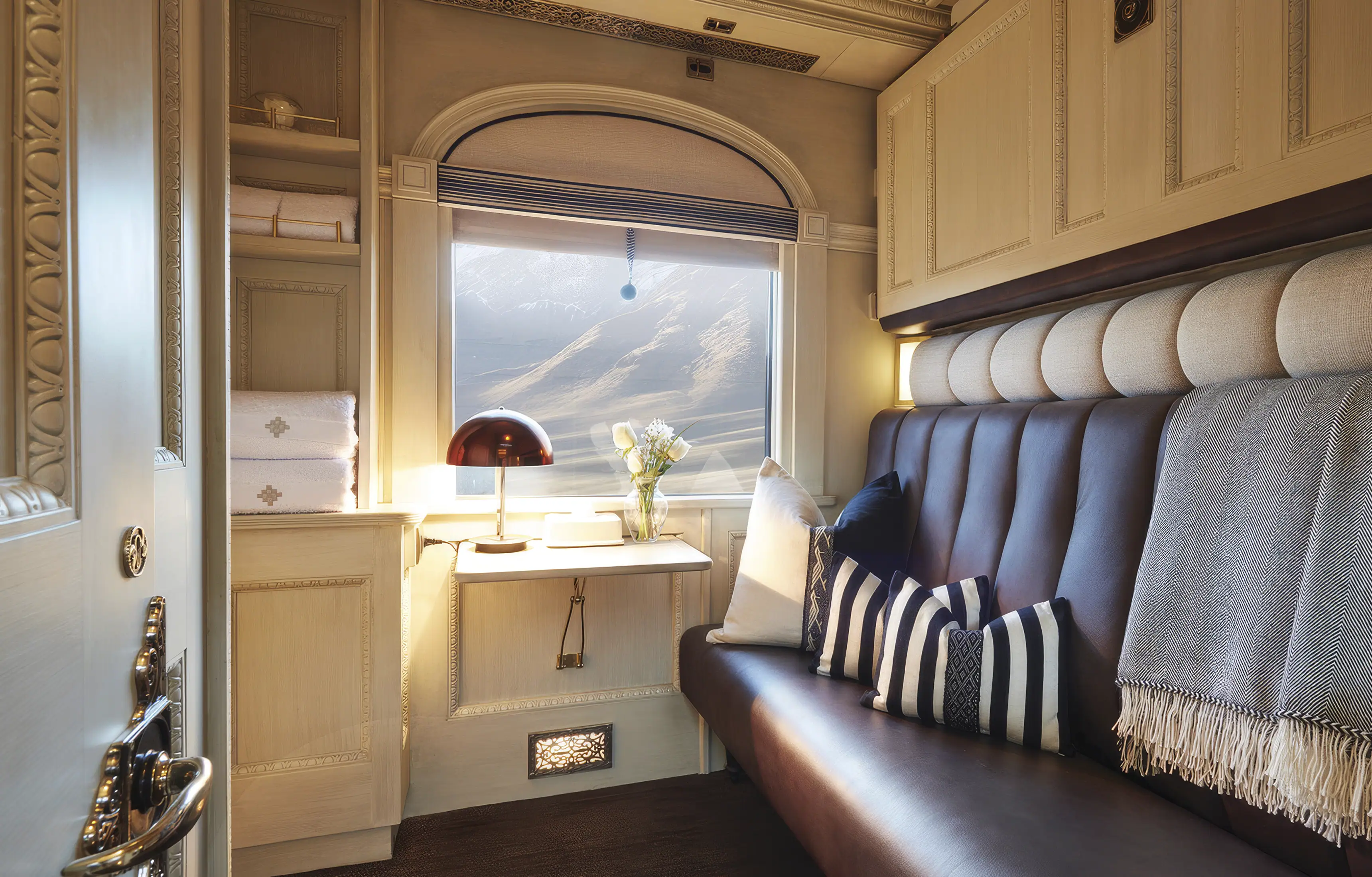
The material palette varies by carriage rather than repeating a single scheme throughout. Sleeper cabins are finished in parchment tones on timber wall panelling, with linen roman blinds, neutral carpets and woven Peruvian textiles worked into cushions and throws. Each cabin is named after Peruvian flora or fauna rather than numbered, and room keys are forged in brass as the Chakana Cross, the stepped Andean cross motif found across Peruvian textile and ceramic tradition. The piano bar car takes a cooler register, grey tweed upholstery with cornflower blue and golden yellow accents, while the observation car runs to a deep teal palette with ceramic table lamps and scrolled balcony rails on its open-air deck. The dining cars move from taupe and cream for casual service to cognac leather chairs and white macramé screens for the formal evening seating, a deliberate register shift across a single day’s service rather than one fixed look.

Why the route succeeds where the original one struggled
Peru gives Muza Lab’s brief something the Australian route never had: geography with a genuinely singular selling point rather than a long transcontinental haul. The Andean Explorer climbs from Cusco to 4,800 metres on the Altiplano, calls at Lake Titicaca with excursions to its floating islands, and continues to Arequipa, a UNESCO World Heritage city, stopping at the Sumbay Caves en route, with an optional extension to Colca Canyon. The Great South Pacific Express, by contrast, covered enormous distances of ordinary Australian coastline and countryside between its headline stops, a harder sell at luxury-train pricing over multiple nights.
The altitude is not incidental set dressing either. At close to 4,800 metres, the Andean Explorer operates at an elevation few trains anywhere reach, and the onboard Picaflor Spa, one of the train’s more genuinely unusual features, offers an Altitude Acclimatising massage alongside treatments built around local ingredients and techniques, including an obsidian stone massage. A spa car built specifically to help passengers manage elevation sickness is a direct design response to the one aspect of this route that the Australian original never had to solve.

Peru was not a gamble. It was already the safer bet
There is a further coincidence in the dates that makes the eventual move to Peru look less like inspiration and more like a company returning to something it already knew worked. 1999, the year the Great South Pacific Express launched in Australia, is the same year Orient-Express Hotels entered a 50:50 joint venture with the Peruvian entrepreneur Lorenzo Sousa Debarbieri to operate rail services in Peru, launching the Hiram Bingham train between Cusco and Machu Picchu. Sousa, an economist and former Citibank Lima banker who had already opened the Hotel Monasterio in Cusco in 1995, had spent the 1990s establishing Peru’s own luxury tourism infrastructure before Orient-Express Hotels arrived as his rail partner.
Both ventures launched the same year, backed by the same company. One, running through Australia’s east coast, closed within four years at a loss. The other, running to Machu Picchu, is still operating more than a quarter of a century later. When the Australian carriages finally needed a second life in 2016, they were not sent to an unproven market. They were sent to join the operator’s own oldest and most reliably successful rail partnership, under the PeruRail joint venture that Sousa and Belmond still run together today. The Andean Explorer’s route was, in that sense, chosen from a position the company already understood rather than discovered fresh.
What the design argument actually is
Strip away the individual palettes and the underlying decision is consistent: Muza Lab treated each carriage as a distinct register rather than repeating one mood across sixteen cars, because a multi-day journey through several dramatically different landscapes, mountain plains, an island-studded lake, a colonial city, needs the interior to change register as the country outside the window does. That is a genuinely different design problem from the original Australian train, which ran through more visually uniform terrain for longer stretches. The rolling stock did not change between 2003 and 2017. The country it was asked to move through did, and the interior scheme changes with it, carriage by carriage, in a way the brief for a single long transcontinental run never demanded.

Frequently asked questions
What route does the Belmond Andean Explorer run?
It travels through the Peruvian Andes between Cusco, Puno on Lake Titicaca, and Arequipa, climbing to around 4,800 metres, with stops including the Sumbay Caves and an optional extension to Colca Canyon.
Who designed the interiors?
Muza Lab, the studio founded by Inge Moore and Nathan Hutchins in 2016, designed the interiors, which launched with the train in May 2017.
Where did the train’s carriages originally come from?
They were built in Australia in 1999 for the Great South Pacific Express, a luxury train that ran between Cairns and Sydney until it closed in 2003. Orient-Express Hotels, which later renamed itself Belmond, bought the carriages in 2005 and stored them for over a decade before shipping them to Peru in 2016.
How many guests and carriages does the train have?
The Andean Explorer carries up to 48 guests across 16 carriages, including sleeper cabins, two dining cars, a piano bar car, an open-air observation deck and a spa car.
Is there really a spa on the train?
Yes. The Picaflor Spa offers treatments including an Altitude Acclimatising massage, designed specifically to help passengers manage the journey’s high elevation, alongside treatments using local ingredients such as obsidian stone.
Who operates the Belmond Andean Explorer?
PeruRail, a joint venture between Belmond and the Peruvian rail entrepreneur Lorenzo Sousa Debarbieri.

Final thoughts
The Belmond Andean Explorer is usually described as a new train inspired by an old aesthetic. It is closer to the opposite: genuinely old rolling stock, sourced from a specific commercial failure that the parent company underwrote and then owned outright for over a decade, sent to a route with a stronger design premise than the one it started on. Muza Lab’s actual achievement was matching an interior scheme to a landscape that changes dramatically across a few days of travel, cabin by cabin, rather than simply refreshing a fleet.
The train that struggled to justify its fares along the Australian coast in 2003 is, unchanged in its bones, currently one of the more sought-after tickets in South American travel. The carriages did not need reinventing. They needed a route that matched what they were always capable of being.


Leave a Reply