
ART & CULTURE · LONDON
Reading time: 7 minDecorex 2025 ran from 12 to 15 October at Olympia, London, its forty-seventh edition. A show this size is easy to summarise by its numbers, more than 280 brands, thousands of visitors, and much harder to summarise by what actually made the strongest stands worth stopping at. In nearly every case this year, it was a real history: a family workshop, a jewellery-house past, a factory that has run for half a century, standing behind the finish on the piece in front of you.
Decorex 2025 ran from 12 to 15 October at Olympia, London, bringing together more than 280 brands across indoor, outdoor and workspace furniture, lighting, textiles and craft. It was the forty-seventh edition of a fair that started in 1978 and is now owned and run by Informa Markets, drawing more than 12,500 designers, architects and specifiers over four days.
Coverage of a fair this size defaults easily to a straightforward list, because a show floor with hundreds of stands genuinely resists any other kind of summary. That is a reasonable way to catalogue Decorex 2025. What is more interesting, walking the same floor, is how many of the strongest stands were not simply showing well-made objects but standing on a real, checkable history: a family firm now three generations deep, a factory that has been running in the same city for over fifty years, a furniture house that began as a jewellery workshop and still designs like one. Seven of them are worth setting out properly.


Haberdashery
What Decorex is, and where it happens
Decorex was established in 1978 as a trade event for the interior design industry and has been held at Olympia, the exhibition hall on Hammersmith Road that opened in 1886, for most of its history. It is now owned by Informa Markets, the events division of the multinational Informa PLC, and it positions itself around three stated aims: showcasing high-quality materials, offering talks and insight to the design community, and connecting designers, architects and specifiers with brands. It runs each October and sits, in most years, close to the busiest stretch of London’s autumn design calendar, the same weeks that carry Frieze London and Frieze Masters and, in alternating years, PAD London. The fair’s defining venue move came in 2019, when it relocated to Olympia from Syon Park, a formative year covered in full in Decorex 2019: Inside the Fair’s First Edition at Olympia.
Being a trade fair rather than a public exhibition changes what a stand is for. Nobody walking a Decorex aisle is expected to buy on the spot; the audience is designers and specifiers deciding what to put into a client’s project months or years down the line. That changes what makes a stand actually work: not spectacle for its own sake, but enough real, demonstrable substance behind a piece that a specifier can credibly explain it to a client afterwards. The seven stands below all cleared that bar in 2025.


Officine Gullo
Lighting: three studios, three very different scales of production
Bert Frank, the London lighting studio founded in 2015 by Robbie Llewellyn and Adam Yeats, showed a stand developed with the interior designer Brian Woulfe of Designed by Woulfe, built around brass, satin nickel and matte-finished fixtures, all designed and hand-finished in England. The studio’s stock in trade is a small, disciplined material palette applied consistently across very different fixture types, which is why a Bert Frank stand tends to read as a single considered room rather than a catalogue of separate products.
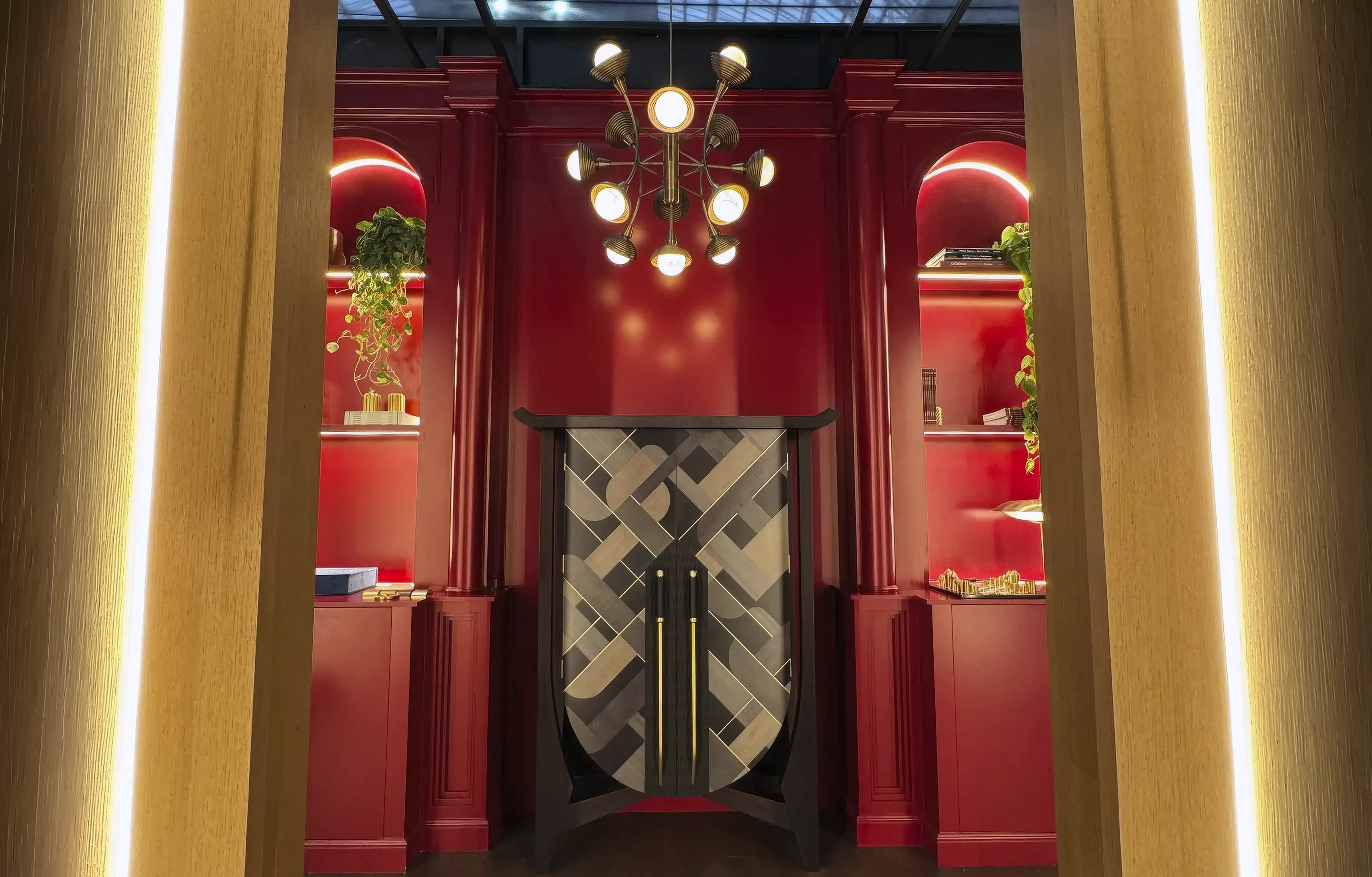
Haberdashery, founded by the former film industry collaborators Ben Rigby and Mac Cox alongside the engineer Daniel Siden, brought two new light sculptures to Decorex 2025, Spring Meadow and Summer Meadow, built from hand-blown glass elements suspended on near-invisible cables and designed to be reconfigured rather than fixed in a single arrangement. Both pieces extend a body of work that already includes large-scale lighting installations for the Shard, Selfridges and Principal Tower, and the studio’s film-industry background shows directly in how the pieces are built: staged and lit as much as engineered, with the suspension system doing as much design work as the glass itself.


Bert Frank
J. Adams & Co, designed in London and manufactured at a Birmingham factory that has been in continuous operation for more than fifty years, took a different approach again, building an entire immersive installation, The House of J. Adams & Co, around the influence of light on material, atmosphere and daily ritual, rather than presenting fixtures on a conventional stand. The installation carried the UK debut of the brand’s Spring/Summer 2025 collection alongside three separate collaborations: a bespoke capsule paint palette developed with YesColours, a custom rug from the Belgian maker BOMAT, and a limited-edition Luna fixture made with Nature Squared. Every piece in the Birmingham factory is still hand-assembled and hand-wired, a production model the brand frames through the Japanese concept of wabi-sabi, treating the small variations that come from human-made work as a mark of authenticity rather than a defect to be engineered out.
Set side by side, the three studios cover a genuine spread of what “lighting design” means in practice: a small London studio working almost entirely by hand, a former film crew building sculptural installations at architectural scale, and a fifty-year-old Midlands factory keeping traditional metalworking alive inside a contemporary product line.

Longbarn Carpets & Crafts
Furniture with a maker’s own history behind it
Officine Gullo, the Florence kitchen and metalwork house founded by Carmelo Gullo and now run by his three sons, Pietro, Andrea and Matteo, showed brass, copper and thick-gauge steel kitchen ranges built by hand in the same city where the family revived a nearly forgotten strand of nineteenth-century Florentine metalworking. The stand’s real argument was continuity rather than novelty: a kitchen built using the same hand-forming and finishing techniques Florentine artisan metalworkers used for decorative ironwork, adapted for professional-grade cooking technology rather than preserved as a museum piece.
FRATO, the Porto furniture house founded in 2010, traces its own design language back to an origin as a high-end jewellery workshop, a background the brand says still shows directly in the attention paid to joints, seams and surface finishing on its furniture, the same close, small-scale tolerance a jeweller works to, applied at furniture scale. Rich woods, brushed metals and marble accents recur across the collection, but the jewellery-house instinct is the more useful thing to know walking past the stand: it explains why the finishing reads as considerably more precise than the scale of the pieces would suggest it needs to be.
The two houses make an instructive pair precisely because they arrive at the same result, furniture that rewards close inspection rather than only a glance across a room, from opposite directions. Officine Gullo scaled a decorative metalworking tradition up to functioning kitchen equipment; FRATO scaled a jeweller’s tolerances up to furniture. Neither treats “craftsmanship” as a marketing word applied after the fact. Both built a design process around a specific prior trade and kept it once the product category changed.


J. Adams & Co
Textiles and curated interiors
Longbarn, the Dutch carpet and textile house working from a production facility in Lichtenvoorde in the eastern Netherlands, exhibited at Decorex for the first time in 2025, showing rugs made exclusively from natural fibres, pure mohair, combed and felted wool, mercerised cotton and eucalyptus, each chosen for how it takes dye and wears over years of use rather than for cost.
Birdie Fortescue, the British designer and antiques dealer who trained at Colefax & Fowler before opening her own Norfolk studio in 2014, showed the textiles, rugs and curated furnishings that have built her reputation for pairing English country-house heritage with pattern drawn from years of travel through Asia, Africa and Europe. Her stand worked less as a single collection than as a curated room, mixing her own textile designs with sourced antiques and objects in a way that reflects how she actually works for clients, assembling a scheme rather than specifying a single product range.
The pairing of Longbarn and Birdie Fortescue at the same fair makes a useful point about how differently “textiles” can be presented. Longbarn’s stand argued from raw material outward: fibre choice, weave and wear were the whole story, with almost nothing else asked to do the persuading. Birdie Fortescue’s argued from a finished room backward, letting a fully dressed setting explain a design sensibility that a swatch on its own could not communicate. A specifier walking both stands in the same afternoon got two working demonstrations of how to sell the same broad category of product for two entirely different reasons.


Birdie Fortescue
Final thoughts
Read stand by stand, none of this is unusual for a design fair; every exhibitor at Decorex has a history of some kind. Read together, though, the strongest stands at the 2025 edition shared something specific: each brand could account, in detail, for the workshop, the family or the material tradition standing behind what it was selling, rather than leaning on finish and styling alone. That is a higher bar than “well made,” and it is the one worth watching for at whichever Decorex comes next.
None of these seven brands needed a themed installation or a headline commission to make that case. A stand, a set of finished pieces and a genuine answer to “who actually makes this, and how” turned out to be enough. That is a useful thing to know walking into any future edition of the fair: the strongest stand on the floor is rarely the most elaborately staged one, it is the one whose maker can answer every question a specifier actually asks.


FRATO
What is Decorex?
Decorex is an annual interior design trade fair held at Olympia, London, bringing together luxury furniture, lighting, textile and craft brands with designers, architects and specifiers. It was established in 1978 and is owned by Informa Markets.
When did Decorex 2025 take place?
Decorex 2025 ran from 12 to 15 October 2025 at Olympia, Hammersmith Road, London W14 8UX.
How many brands exhibited at Decorex 2025?
More than 280 brands exhibited across indoor, outdoor and workspace furniture, lighting, textiles and decorative finishes.
Which brands were among the standout exhibitors at Decorex 2025?
Highlights included the lighting studios Bert Frank, Haberdashery and J. Adams & Co; the furniture houses Officine Gullo and FRATO; and the textile and interiors specialists Longbarn and Birdie Fortescue.
Where is Decorex held, and is it held every year?
Decorex is held annually at Olympia, London, each October, and this site covers each edition separately as it happens.
Is Decorex open to the public?
Decorex is a trade event aimed at designers, architects and specifiers rather than a general public consumer show; access is typically by trade registration.


Leave a Reply