
DESIGN TRAVEL · LONDON
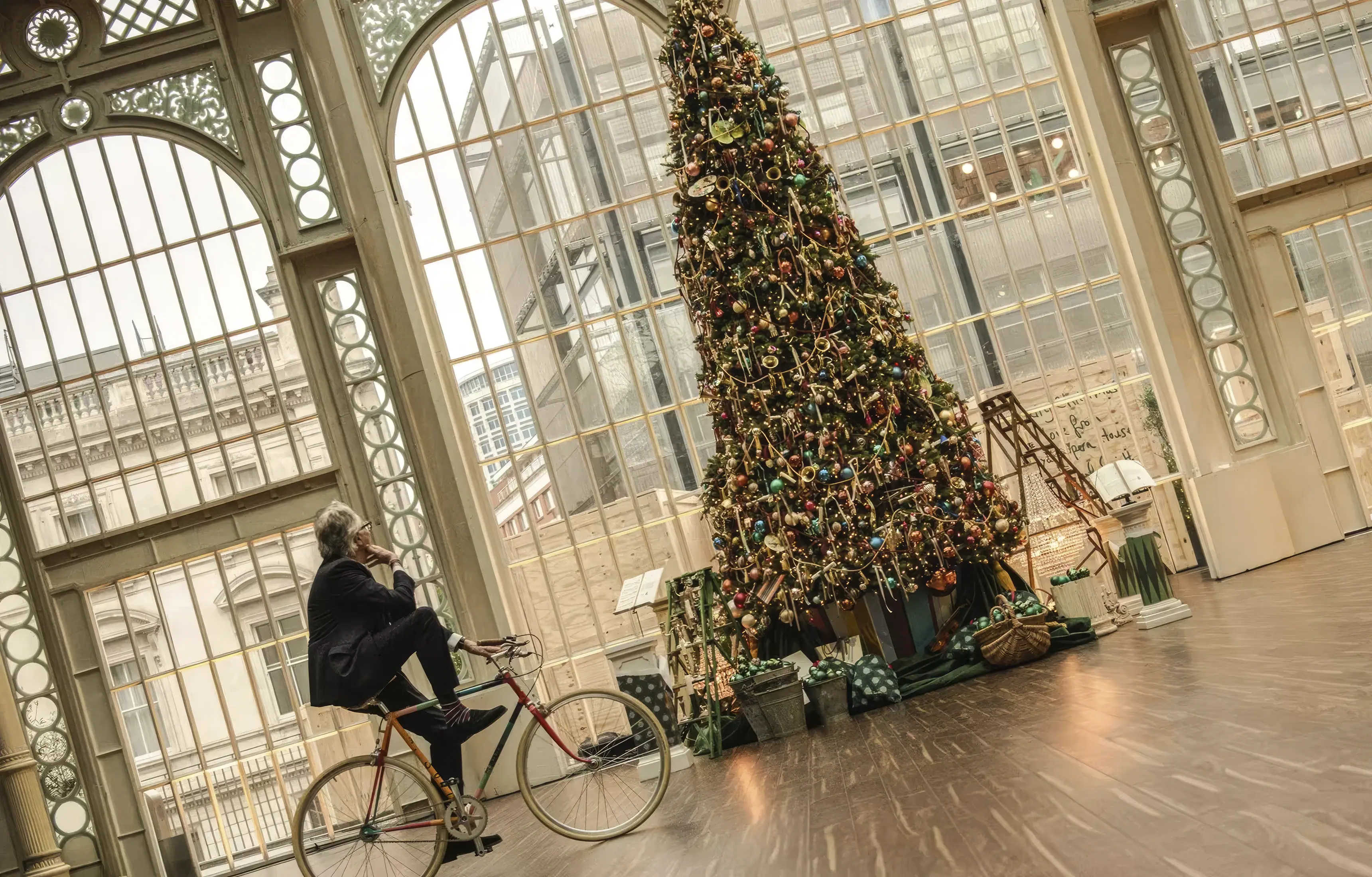
Reading time: 10 minSir Paul Smith has taken his run of designer Christmas trees out of the hotel lobby and into a working opera house for the first time, filling the Royal Opera House’s Paul Hamlyn Hall with ropes, tassels and props borrowed from its own backstage stores. The tree stands in a building that was once London’s flower market hall, on the same ground that gave Smith’s own Floral Street shop its name forty-five years earlier.
Sir Paul Smith unveiled his Christmas tree inside the Royal Opera House on Thursday 6 November 2025, the first time the Covent Garden institution has handed its festive decoration to a guest designer. The tree stands in the Paul Hamlyn Hall, the glazed conservatory space at the building’s Bow Street and Russell Street corner, and is free to visit daily from noon throughout the season.
It is a small commission by the scale of Smith’s usual work, and a large one by the scale of what it represents. The Royal Ballet and Opera, the organisation’s name since it rebranded in April 2024, has been explicit that the partnership is a commercial move as much as a festive one: a way of drawing footfall and revenue into a building that has historically depended on box office income and philanthropy. Smith, in turn, has brought a design language built on stripes, colour and a self-declared eye for the overlooked detail into a building whose backstage machinery he has been visiting, by his own account, for years.
The result is a tree built almost entirely from the Royal Opera House’s own material: archived props, costume off-cuts, rehearsal-room step ladders, and the vocabulary of a theatre getting ready to open its curtain. It is also, less obviously, a tree standing in a building whose own name traces back to the trade that put Smith’s shop on the map in the first place.

What the tree is actually made of
The centrepiece stands roughly eighteen feet tall in the middle of the Paul Hamlyn Hall, built around Smith’s Signature Stripe motif in ropes, tassels and green velvet rather than the tinsel and glass baubles of a conventional Christmas tree. Hung across it are objects drawn from the Royal Opera House’s own props department: fans, musical instruments and candelabra that have appeared in past productions, alongside antique baubles mixed in with new ones carrying Smith’s stripe. Miniature figures of skiers and ice skaters sit among baskets of decorations, and step ladders, of the kind used by stage crews rather than by householders, are left standing against the tree rather than tidied away.
A second element runs along Davies Terrace, the balcony that overlooks the hall: a run of smaller Christmas trees emerging from wooden storage crates, each crate lined in fabric cut from Smith’s Signature Stripe. Handwritten messages, in Smith’s own hand, are placed through the display. The effect is closer to a stage set caught mid-strike than a shop-window Christmas scene, which is precisely the point Smith has said he was working towards: a tree built from what he saw on a visit to the props department, rather than one bought in.
The theme he has given the whole installation is wrapping and unwrapping, the theatrical act of concealing something and then revealing it, which doubles as a description of what a Christmas tree does and what a stage curtain does. It is a neat piece of design thinking: rather than importing his own aesthetic wholesale into someone else’s building, Smith has built the tree out of a process the Royal Opera House already owns.
Smith has been specific about where that process came from. “I have had many memorable moments at the Royal Opera House, but most special was my recent visit to the props department,” he has said, describing the visit as the source of the tree’s concept and framing the whole commission as a way of celebrating what he calls the craft behind the curtain. It is a working method he has applied to previous collaborations too. “As with all my collaborative projects, I wanted to make sure that there are shared values between both partners,” he has said of the partnership, a line that reads as a description of his approach generally rather than this project specifically: Smith’s collaborations, from Anglepoise to Leica to the Royal Opera House, tend to start from what the other party already does well rather than from a look he wants to impose on them.

Who designed it, and what else he has made
Paul Smith opened his first shop in 1970, a twelve-foot-square room at 6 Byard Lane in Nottingham, open only on Fridays and Saturdays while he freelanced elsewhere to cover the rent. He showed his first menswear collection in Paris in 1976 and opened his best-known London address, the Floral Street shop in Covent Garden, in 1979. He was appointed Royal Designer for Industry in 1991, made a CBE in 1994, knighted in the 2000 Birthday Honours, and appointed to the Order of the Companions of Honour in 2020. The business now runs around 130 stores in more than 60 countries, still built on the “classic with a twist” principle Smith has repeated for five decades: traditional tailoring and traditional forms, disrupted by colour, stripe or an unexpected detail.
That principle has taken him well beyond clothing. He has designed a limited-run Mini in 1997, a Triumph Bonneville in 2005, a customised Land Rover Defender, textiles for Maharam since 2003, cycling kit for Rapha, shoes with John Lobb, camera finishes for Leica, and cover designs for Penguin Classics and David Bowie. His London flagship at No. 9 Albemarle Street, designed with 6a architects, wraps a Georgian Mayfair building in a cast-iron facade taken from his own doodles. The Royal Opera House commission sits in that same pattern: a designer who treats every surface, from a shoe last to a shopfront, as a chance to apply the same handful of ideas to a new material.
His most recent precedent for a project like this was Claridge’s, where he designed the hotel’s Christmas tree in November 2024, the sixteenth year of Claridge’s tradition of inviting a different name to reinterpret its lobby tree. That tree was built around a birdhouse, more than a hundred of them, with mechanical roofs engineered by the artist Nik Ramage and creatures by the design studio Studiomama arranged around its base. For 2025, Claridge’s tree passed to Daniel Lee for Burberry, and Smith’s Christmas commission moved instead to the Royal Opera House. It is his first Christmas collaboration with a performing arts institution rather than a hotel, and the Royal Opera House’s first with a guest designer of any kind. Smith is not the only London designer being asked to rethink a festive commission this way: Lee Broom, invited to design a Christmas tree for the Mandarin Oriental Mayfair’s stair void, designed a permanent light installation called Hail instead, and the brief has stayed that way ever since.

The connection between Floral Street and the Floral Hall
The building housing Smith’s tree carries a history that runs directly alongside his own. The Paul Hamlyn Hall was built in 1858 to 1860 as the Floral Hall, designed by the architect Edward Middleton Barry as Covent Garden’s flower market, a supplementary hall built in cast iron and glass by the ironworkers Grissell of the Regent’s Canal Ironworks, with Lucas Brothers as the main contractors. It traded as a market by day and hosted concerts by night, and a trade journal at the time called it the first structure of its kind attempted in glass and iron alone, according to the building’s Historic England listing.
A fire in 1956 destroyed its original glass dome and barrel roof, which were replaced with a plainer pitched structure rather than restored. The whole building was then dismantled between 1996 and 2000 as part of the Royal Opera House’s £214 million redevelopment under Dixon Jones and BDP: its Bow Street portico, columns and ironwork were restored and reassembled on site, a section was relocated to Borough Market, and a replica of the original barrel-vaulted roof was rebuilt in its place. It reopened as part of the wider Royal Opera House and was renamed in 2007 for the philanthropist Paul Hamlyn.
Covent Garden’s own flower, fruit and vegetable market operated in the piazza outside until it moved to Nine Elms in 1974, five years before Smith opened his shop on Floral Street, itself named for the same market trade the Floral Hall was built to house. It means Smith’s tree, celebrating stripes and stagecraft, now stands inside the one surviving architectural fragment of the market that gave his own street its name, on a site he has occupied continuously since 1979. Neither Smith’s own account of the commission nor the Royal Ballet and Opera’s announcement draws this connection explicitly. It is there in the two names, Floral Street and Floral Hall, sitting less than two hundred metres apart.

Why the Royal Opera House wanted a guest designer
The Royal Ballet and Opera, as the organisation running the building has been known since its April 2024 rebrand, has been open about the commercial thinking behind the collaboration. Sophie Wybrew-Bond, its Chief Commercial Officer, described the partnership as intended to “create a standout annual moment that drives footfall” and to help the organisation “unlock fresh commercial potential beyond box office and philanthropy” by working with “a globally recognised brand like Paul Smith.” She has also called it a way of “sharing our love of creativity by opening up the Royal Opera House in a fresh and festive way.”
That framing matters because it marks a genuine change of approach for an institution that has historically kept a distance between its stages and its retail identity. The 2024 rebrand was itself pitched around diversifying revenue beyond ticket sales and donations, and a free, photogenic Christmas installation, designed by a fashion label with its own shop a few streets away, is a direct expression of that strategy rather than an incidental piece of festive decoration. Smith, for his part, has framed the collaboration around proximity rather than commerce: his design studio sits on Kean Street and his flagship shop on Floral Street, both within Covent Garden’s boundaries, and he has spoken about visits to the props department and relationships with dancers and staff built up over years of being, in his words, a Covent Garden neighbour.

How to see it
The tree and the Davies Terrace display are open to the public without a ticket, inside the Paul Hamlyn Hall, which is accessible from the Royal Opera House’s Bow Street entrance daily from noon through the festive period. The hall also operates as a working café and bar during opening hours, so the tree can be seen without booking a performance. The Royal Ballet and Opera has described a wider programme of seasonal activities running alongside the installation, though it has not published a detailed schedule.
For a visitor who knows only the finished result, the tree reads as a fashion label’s take on a Christmas centrepiece. For a visitor who has read the props list, the antique baubles sitting next to newly made stripe, the ladders left where a stagehand would leave them, it reads instead as a fairly precise description of what happens backstage at an opera house in the weeks before curtain up, dressed for a season rather than a production.

Frequently asked questions
What is the Paul Smith Christmas tree at the Royal Opera House?
It is a Christmas installation designed by Sir Paul Smith for the Royal Opera House in Covent Garden, unveiled on 6 November 2025. It is built around Smith’s Signature Stripe motif and props borrowed from the venue’s own costume and set stores.
Where is it inside the Royal Opera House?
The main tree stands in the Paul Hamlyn Hall, the glazed conservatory space accessible from the Bow Street entrance. A related display of smaller trees emerging from storage crates runs along Davies Terrace, the balcony above the hall.
Do I need a ticket to see it?
No. The Paul Hamlyn Hall is open to the public without a ticket, daily from noon throughout the festive season, and functions as a café and bar during those hours.
What is the tree made from?
Ropes, tassels and green velvet in Smith’s Signature Stripe, hung with archived props from past Royal Opera House productions, including fans, instruments and candelabra, along with a mix of antique and newly made striped baubles.
Is this the first time the Royal Opera House has done something like this?
Yes. The Royal Ballet and Opera, which has run the building since its April 2024 rebrand, has described this as its first Christmas takeover by a guest designer.
Has Paul Smith designed a Christmas tree before?
Yes. He designed Claridge’s Christmas tree in November 2024, built around a birdhouse theme, as part of that hotel’s longer-running tradition of inviting a different designer each year. Claridge’s 2025 tree was designed separately by Daniel Lee for Burberry.


Final thoughts
It would be easy to read this as a fashion house lending its name to a Christmas display, the kind of pairing that gets a building photographed for a few weeks and then forgotten. What the detail argues against that reading is the specificity of the material: this tree is built from the Royal Opera House’s own props store rather than a warehouse of imported decorations, and it stands in a hall whose own history, as a nineteenth-century flower market rebuilt piece by piece in the 1990s, runs alongside the history of the street where Smith has traded since 1979.
The commercial logic behind the commission is stated plainly by the institution itself: a rebranded organisation looking for revenue beyond the box office, working with a designer whose studio and shop sit a few minutes’ walk from the stage door. That is not a reason to discount the result. It is the reason the result looks the way it does, built from the building’s own working parts rather than a generic festive kit that could have gone up in any atrium in London.
What the Paul Hamlyn Hall now holds, until the tree comes down in the new year, is a genuinely specific piece of design thinking: a Christmas tree that describes the theatre it stands in, made by a designer whose own address has stood next to that theatre for nearly half a century, inside a hall named for the flower trade that gave his street its name in the first place.


Leave a Reply