Immersive Art · Abu Dhabi
Reading time: 11 minMost immersive venues are rooms with pictures thrown onto them. teamLab Phenomena Abu Dhabi is built the other way round: the rooms are machinery, and the artwork is whatever the machinery produces. I went in having done almost no reading, came out two hours later without a comparison for it, and the part I had been most wary of turned out to be the part I would go back for.
I arrived at teamLab Phenomena Abu Dhabi having done almost no homework, which is not how I usually work and turned out to be exactly the right way to do it. I knew the name, I had a rough idea from photographs of what a teamLab room looks like, and that was the whole of it. I came out two hours later without a useful comparison for what I had just done, and with a much clearer sense that the most interesting thing in the building is the building.
The claim the place makes is an unusual one. In most immersive venues the room is effectively a screen and the work is the image landing on it. Here the rooms are apparatus. Air is moved, water is held at a particular depth, foam is generated, light is pushed through a medium, and the artwork is whatever happens as a result. teamLab call these environmental phenomena, and the consequence is that several of the works could not be shipped anywhere. They are not objects placed in a space. They are events that a space produces.

teamLab Phenomena Abu Dhabi was designed from the inside out
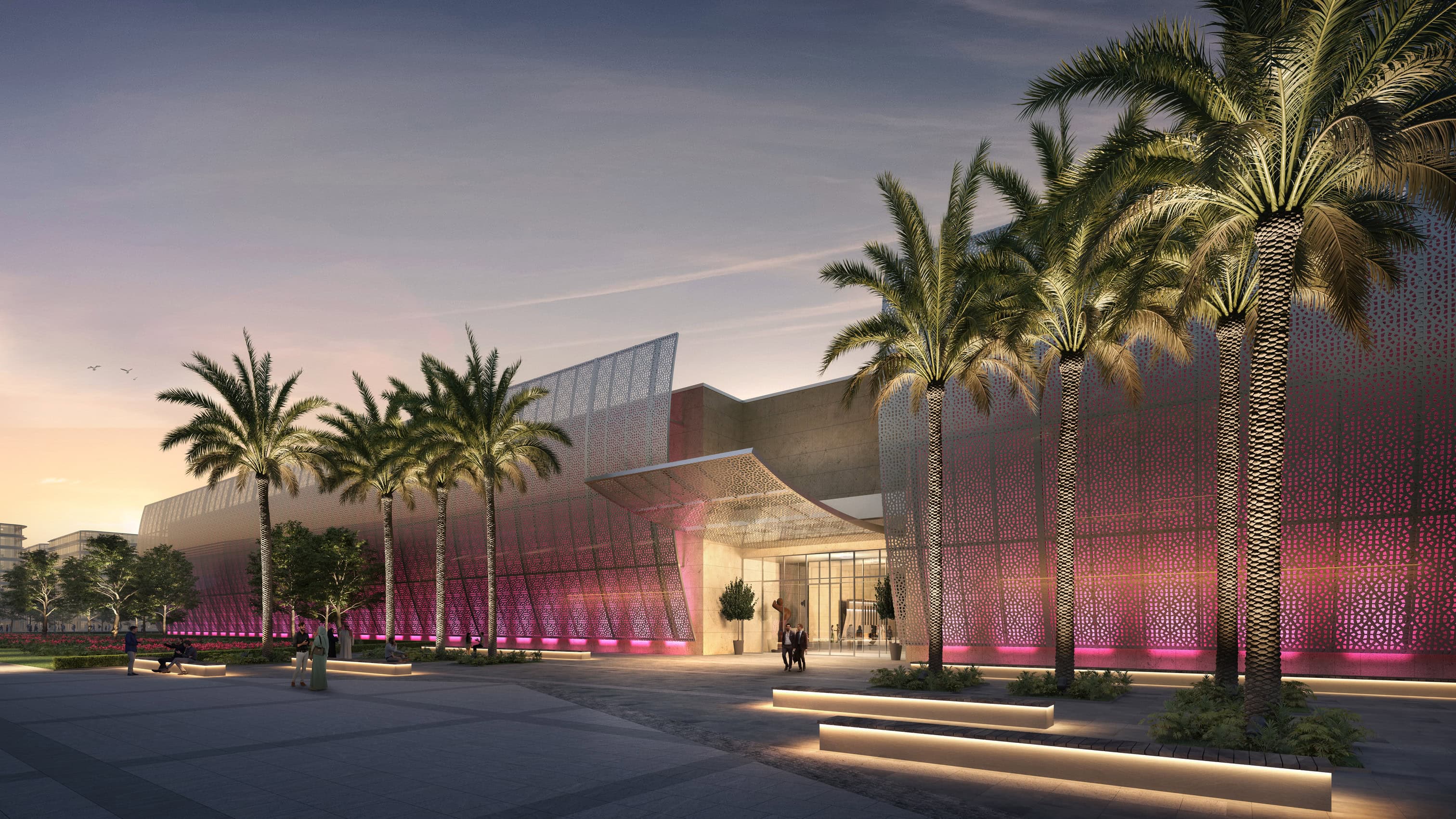
teamLab Architects, led by Shogo Kawata, took the sequence most projects follow and ran it backwards. The phenomena came first. Interior volumes were shaped around what each one needs and around how a person moves through it. Only then was the seaside site on Saadiyat settled on, and only then did MZ Architects, who led the facade, wrap an exterior around volumes that already existed. The outside of the building is a report on the inside.
What that produced is 17,367 square metres of gross floor area on a site of nearly 29,000, built as a reinforced concrete structure behind panelised glass fibre reinforced concrete and glass fibre reinforced plastic. The curves are too complicated to have been drawn by hand and they were not: computational design generated the three dimensional geometry and then produced the construction drawings from it.

Inside, the vast pillars that read as structural are not holding anything up. They are housings for projectors and sensors. In a building where the walls do the load bearing, the columns do the watching, and once you notice that you start seeing the whole interior as equipment dressed as architecture. From outside it is a pale, almost windowless mass with one arched opening, a ceremonial flight of steps up to a raised plaza and a viewing platform on the roof. Windows were never going to work here. Every room is a controlled atmosphere and daylight is a variable you cannot let in.

Several of these works could not be installed anywhere else
Takashi Kudo, teamLab’s communications director, has put the principle plainly: some of the works in this museum can only appear here, and taken out of this context they would not manifest at all. That is a description of how an open system behaves rather than a piece of positioning. A vortex in the sea is not a thing, it is a pattern that holds while water keeps running through it. Stop the flow and there is nothing left to move elsewhere.

At 17,000 square metres of experience across roughly twenty eight installations, this is a bigger undertaking than teamLab Borderless in Tokyo, which runs to around 10,000, and the additional room has not gone on more of the same. It has gone on works that need volume in order to exist at all: a column of foam tall enough to drift, a pool wide enough for waves to cross it, a sphere large enough to climb inside.


The water was the part I was wary of, and it made the visit
I will be honest about the water. I went in wary of it. There is a point where you take your shoes off, roll up whatever you are wearing and step down into a shallow pool, and everything in me wanted to stay on the dry side and watch from there.

Floating Microcosms is the work, and it is the one that turned the visit. The pool holds a crowd of soft ovoids, and they are genuinely free floating rather than tethered, so they drift with the water and with whoever is moving through it. Push one and it tips, rights itself and sounds a note. Its neighbours take up the colour and the tone and pass both on, so within a few seconds a small nudge has crossed the room. There are thirty two colours in the system. The lineage runs back to teamLab’s ball works of 2009, but they have never been loose in water like this before, and that unpredictability is the entire point.


What no photograph had told me is that the water is not a surface effect. It changes how you walk, how loud the room is, how close strangers stand to each other and how fast the work answers you. Watching that room from the edge would have been a different and much smaller thing. If I could do the whole visit again I would, and I would go straight back in.


The foam sculpture is a cell membrane turned inside out
Massless Amorphous Sculpture is made of three things: water, air and ordinary soap. The detail teamLab draw out about it is the one worth carrying home. The wall of a soap bubble is a lipid bilayer, structurally the same membrane that encloses a living cell. What differs is orientation. In a cell the water fearing layer faces inwards; in a bubble it faces out, which is what lets a pouch of membrane hold its shape in air rather than in liquid. The foam you walk into is cell architecture turned inside out.
It also behaves unlike anything else in the building. The mass drifts without rising or sinking. Damage it and it repairs itself, up to a point. And it cannot be pushed. Every other room here rewards you for acting on it: touch the projected water and it parts, lean on an ovoid and the room answers. This one lets you walk into the middle of it and will not be moved by you at all. In a venue built on interaction, the single work that declines to be interacted with is the one I have thought about most since.

What Biocosmos and Morphing Continuum ask your body to do
Biocosmos puts you inside a sphere on a reinforced mesh net that gives under your weight, with projection running the full three hundred and sixty degrees around you. The net is as much the work as the imagery, because it removes the one thing a gallery normally guarantees, which is a floor that stays where you put your foot. Morphing Continuum fills a room with silver spheres carried on air currents that gather them into slow tornadoes, and you can walk into the mass and feel it reorganise around you.

Both do the same job by different means. They make your body a variable inside the piece rather than a position from which to view it. That is the clearest measure of the difference between this and a projection room, where standing still and receiving the work is a perfectly good way to see it.


Tea that exists only for as long as you are drinking it
The tea house is the quiet high point and the most economical idea in the building. In Tea in Spontaneous Order a flower blooms in the bowl in front of you. It comes into being when the tea is poured and it is gone when the tea is finished, so the work has precisely the lifespan of the drink. Overhead, Floating Lamps in Spontaneous Order hang and respond to the room around them. It is the same argument as the foam and the water, made at the scale of a cup.
Sketch Factory runs the idea in the other direction. You draw something, and it comes back to you as an object you can carry out of the building. In a venue where almost nothing survives the moment it happens in, having one room that hands you something permanent is a well judged piece of sequencing.

Where it sits on Saadiyat, and why the neighbours matter
teamLab Phenomena is operated by Miral Experiences in partnership with the Department of Culture and Tourism, and it stands in the Saadiyat Cultural District alongside the Louvre Abu Dhabi and Jean Nouvel’s dome, the Natural History Museum and Frank Gehry’s Guggenheim. Around 1.4 million visitors a year are anticipated, which would put it level with the Louvre’s own attendance.
That neighbourhood changes how the building reads. An experiential venue standing on its own has only itself to answer to. Put one a short walk from a Nouvel dome and a Gehry and it has to hold a conversation with both, and this one does it by being the single building on the island where the visitor forms part of the exhibit. Superblue in Miami made an early version of that case inside a warehouse. This is the version with an architecture practice attached and a cultural district around it, and Abu Dhabi has backed it at full scale rather than as a trial.
A few things I would tell anyone going
Wear something you can roll up, or something you do not mind getting damp, because the water is unavoidable if you want the best of the place and you will want the best of the place. You will be barefoot for a section of it. Give it longer than you think: two hours is a sensible minimum and I could comfortably have used three. Go later in the day if you can, because the building runs into the evening and the works read differently when you are not carrying daylight around in your eyes.

The other thing worth saying is about the people working there, who were phenomenal. Every room is staffed, and not in the manner of invigilators keeping a distance. They walk you in, tell you what a room is about to do to you before it does it, and know the works properly. A good deal of what made the visit was them, and in a building this unfamiliar that is a deliberate piece of design rather than good luck.

Frequently asked questions
What is teamLab Phenomena Abu Dhabi?
A permanent venue for immersive art in the Saadiyat Cultural District, opened on 18 April 2025 and operated by Miral Experiences in partnership with the Department of Culture and Tourism. It covers around 17,000 square metres and holds roughly twenty eight installations. teamLab Architects designed it, with MZ Architects leading the facade.
Do you get wet at teamLab Phenomena?
In part of it, yes. Floating Microcosms is entered barefoot through shallow water, and it is one of the strongest works in the building. Wear something you can roll up or that you do not mind getting damp, and plan to go in rather than watch from the edge.
How long should you allow for a visit?
Two hours is a sensible minimum and three is comfortable if you want to sit with the tea house and go back to a room. The venue opens at 10am and runs into the evening with last entry two hours before closing, so confirm the current times before travelling.
What is the difference between teamLab Phenomena and teamLab Borderless?
Borderless in Tokyo works largely through projection. Phenomena is built on what teamLab call environmental phenomena, where the artwork is produced by physical conditions inside the room such as water, airflow and foam. Several works depend on the specific room they sit in and could not be installed anywhere else.
What else is in the Saadiyat Cultural District?
Louvre Abu Dhabi, the Natural History Museum Abu Dhabi, Zayed National Museum and Guggenheim Abu Dhabi all sit within the same district, which makes teamLab Phenomena straightforward to pair with a museum on the same day.
Final thoughts
Magical and otherworldly were the words I kept reaching for on the day, and having since looked into how the place was put together I have not found better ones. What I can add is that the magic is engineered with unusual honesty. Nothing here is pretending to be something else. It is water, air, soap, wind, netting and light, and the building was shaped around what each of those needs in order to happen at all. That is a rarer proposition than a room full of screens, and it is exactly why these works cannot go on tour.
I went in with no expectations and came out with a benchmark for how this kind of art ought to be experienced. If I could do it again tomorrow I would, water and all. The only thing I would change is that I would head for the pool first.
Project Credits
Go further from here
Read next
The first Frieze Abu Dhabi is built around a thirteenth century shrine assembled from reused Roman stone, rebuilt in the atrium out of timber and cloth by Dala Nasser.
Abu Dhabi