
ART & CULTURE · LONDON
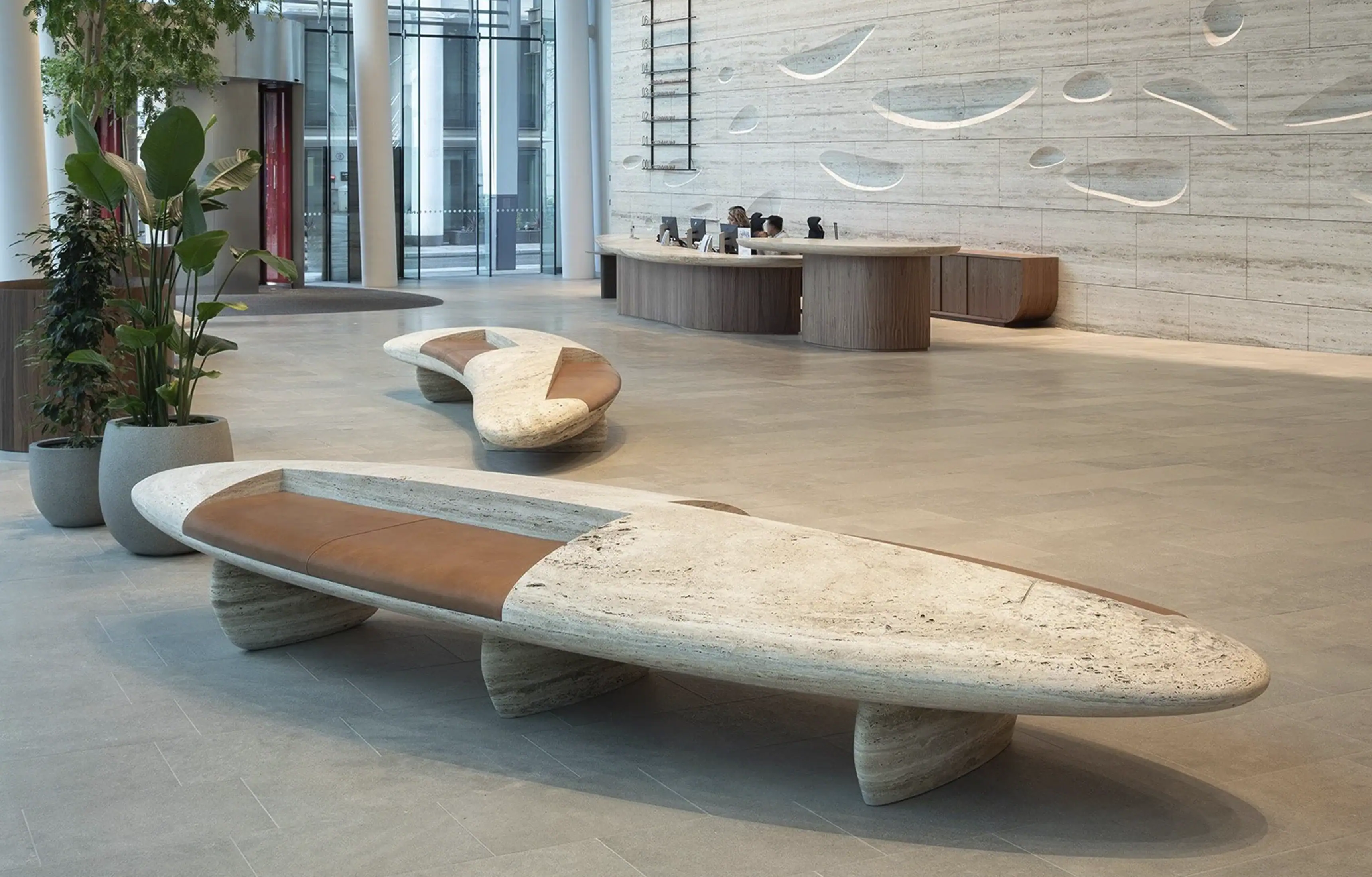
Reading time: 8 minFour sculptural benches now sit in the lobby of 20 Gresham Street in the City of London, each carved from a single five-metre slab of Tuscan travertine and weighing up to two and a half tonnes. The sculptor David Worthington designed them, a marble workshop in Pietrasanta carved them, and Bill Amberg Studio finished them with leather cushions, a two-year collaboration between three crafts that rarely end up in the same room, let alone the same object.
Introduction
Four benches now sit in the entrance hall of 20 Gresham Street, a City of London office building close to Guildhall and St Paul’s Cathedral. Each one is carved from Tuscan travertine, two measuring five metres long, one at four metres, one at three, and each weighing up to two and a half tonnes. They are not, strictly, benches in the sense of something assembled from parts. They are sculpture that happens to be sat on, and the distinction is the whole point of how they came to exist.
The project took two years and drew on three separate crafts that do not often end up working on the same object: David Worthington, the sculptor who designed and carved them; Marble Projects, the Pietrasanta workshop that helped realise them at scale; and Bill Amberg Studio, the London leatherworker whose cushions finish what stone alone was never going to make comfortable. The result reads, from a distance, as a single confident gesture in a lobby. Up close, it is three different disciplines agreeing on where their work stops and the next one starts.


A sculptor who has spent his career making things you sit on
David Worthington is not a stone carver who occasionally makes furniture. Sitting on his work is close to the entire premise. After graduating from Oxford with a degree in Philosophy and Theology in 1984, and later adding master’s degrees in Visual Culture and Computer Arts, Worthington built a practice around what he has described as interactive, kinetic sculpture that the public can sit on, work built from red Iranian travertine, Spanish marble, glass-reinforced plastic, stainless steel and LEDs, depending on what a given commission needs. He has served on the council of the Royal British Society of Sculptors, was elected the organisation’s Vice President, held a sculptor-in-residence post at Glyndebourne, and has curated exhibitions at Woburn Abbey and Chelsea Physic Garden alongside his own commissioned work across the UK and the United States.
That background matters more than a standard artist biography usually does here, because the 20 Gresham Street commission is not a sculptor being asked to make something functional for the first time. It is a sculptor whose signature idea, that a sculptural object can carry a body’s weight without stopping being sculpture, being handed a lobby and a stone budget large enough to prove the idea at genuine architectural scale.


Meeting at Frieze, then reading a wall
Worthington met Kevin Francis Gray, the founder of the Pietrasanta-based fabrication studio Marble Projects, at the Frieze art fair, a connection that turned into the working partnership behind the benches. The brief they were given by the building’s team started with an existing feature already in the entrance hall: a travertine wall carved with oval scallops, cut to catch light and shadow across its surface. Rather than designing the benches as a separate, competing gesture, Worthington built them to answer the wall directly, extending its scalloped, water-worn language from a vertical surface onto four horizontal forms, until the whole space reads less like a lobby with some furniture in it and more like the floor of a riverbed the architecture happens to be built around.
That is a specific, checkable design decision rather than a mood description. A generic stone bench would have treated the existing wall as background. Worthington’s benches instead behave as though they were quarried from the same conceptual block as the wall relief that was already there, which is why the finished lobby reads as a single idea rather than an original feature plus a later addition.
Marble Projects is not simply a fabrication contractor brought in to execute someone else’s drawings. Gray is a sculptor in his own right, represented by galleries including Pace, whose own practice works extensively in marble carved in Pietrasanta, the Tuscan town that has supplied and worked stone since the Renaissance and remains one of the few places in the world with the concentration of skilled carvers a project at this scale needs. Bringing in a studio led by a working sculptor, rather than a purely commercial stoneyard, is part of why the benches read as sculpture that happens to be structural rather than furniture with a decorative finish. Worthington and Gray have spoken together about the collaboration in detail, including how the brief evolved once the existing travertine wall became the project’s reference point.

Four benches, one slab, one quarry
The travertine itself came from the S.I.T.I. quarry in Rapolano Terme, in southern Tuscany, an area that has supplied the material for centuries. A rare five-metre slab was sourced specifically for this commission, large enough that all four benches, despite their different lengths, were cut from the same single piece of stone. That is a meaningful sourcing decision as much as a practical one: benches cut from one slab share the same veining, colour and mineral history in a way that four separately sourced pieces of travertine, however well matched, never quite would.
Getting from a slab to four finished forms took Worthington’s own pencil drawings, translated into a three-dimensional model by the CAD designer Jack Draper, before Marble Projects carved the roughed-out shapes using robotic cutting technology. Worthington has been careful to correct the assumption that follows naturally from that description: “Although I say the sculpture has been made by a robot, that’s not really true.” Every piece was hand-finished on site once the robotic carving had done the heavy removal of stone, the difference between a rough form and a bench with a surface a person will actually want to sit on.
Where the leather comes in
Stone alone does not make a comfortable bench, and Worthington did not treat that as a problem to solve with upholstery bought off a shelf. He brought in Bill Amberg Studio, the London leatherwork practice Bill Amberg founded in 1984, to craft cushions in Tuscan leather that sit into the carved forms rather than simply resting on top of them. Worthington has said he chose Amberg specifically for “fantastic sculptural quality” in his approach to leather, which is a telling reason for a sculptor to give: not warmth, not durability, but the sense that the leather itself needed to hold up as a sculptural decision rather than function as soft furnishing bolted onto someone else’s artwork.
It is the third piece this site has covered on Bill Amberg Studio, after a leather cabinet built for a twinned 33-year-old Macallan release and the studio’s first lighting range, the Loom Collection, and it sits comfortably alongside both without repeating either. The Macallan cabinet is engineering dressed as leatherwork, a lid mechanism that reveals a story about twinned whisky casks. The Loom Collection is leather doing the job of a light fitting’s housing. Here, leather is doing the job stone genuinely cannot: giving a two-and-a-half-tonne block of travertine a surface a person will actually sit down on without hesitation. Three different jobs, one studio, and a founder whose career began with a bespoke leather floor in 1984, which makes leather-as-structural-material something closer to a running argument than a coincidence.


A retrofit built around an existing feature rather than against it
The commission sits inside a wider refurbishment of 20 Gresham Street, led by John Robertson Architects, aimed at turning the building’s entrance hall into a genuine social space rather than a corridor between the street and the lifts. That context matters for reading the benches correctly: they were not commissioned as standalone art for an empty lobby, but as the piece that resolves an existing architectural feature, the scalloped travertine wall, into something the building’s occupants and visitors can actually use rather than just look at. A wall relief only works as art. A bench that extends the same material and the same visual language works as both art and infrastructure, which is a harder brief to satisfy and a more interesting one to have pulled off.
Worthington has since begun offering the stone forms that came out of this commission as a standalone furniture line, available to commission or purchase beyond the original project, and is exhibiting the work at Marmo+Mac in Verona in September 2026. A bespoke lobby commission becoming the basis for a retail product is a familiar enough pattern in furniture design generally. It is a less familiar one for a sculptor whose primary identity has, until now, been built around one-off public and private commissions rather than a repeatable range, and it suggests the 20 Gresham Street benches were treated internally, by Worthington at least, as a proof of concept as much as a finished job.
That reading is consistent with the rest of his practice. Worthington has spent recent years working on a separate body of work applying colour to marble and stone, prompted by the historical fact that ancient sculpture, now seen as pure white stone in museums and textbooks, was originally painted, often in colours a contemporary eye would call garish. The travertine benches sit at the opposite end of that spectrum, entirely unpainted, letting the stone’s own veining and the quarry’s natural colour carry the surface. Two very different projects from the same sculptor, one adding colour back into stone as a deliberate provocation, the other trusting travertine to do all the work unaided, both testing how far a material people mostly associate with museums and monuments can be pushed into something closer to daily use.

Frequently asked questions
Where are the travertine boulder benches?
In the entrance hall of 20 Gresham Street, a City of London office building near Guildhall and St Paul’s Cathedral, as part of a wider retrofit led by John Robertson Architects.
Who designed the benches?
The sculptor David Worthington, working with the Pietrasanta marble fabrication studio Marble Projects, founded by Kevin Francis Gray, whom Worthington met at the Frieze art fair.
What is Bill Amberg’s role in the project?
Bill Amberg Studio crafted leather cushions in Tuscan leather that sit into the carved stone forms, chosen by Worthington for what he described as their fantastic sculptural quality rather than simply for comfort or upholstery.
What material are the benches made from?
Tuscan travertine, sourced from the S.I.T.I. quarry in Rapolano Terme in southern Tuscany. All four benches, despite their different lengths, were cut from a single five-metre slab.
How big are the benches?
Four benches in total: two measuring five metres in length, one at four metres and one at three metres, each weighing up to two and a half tonnes.
How were the benches made?
Worthington’s pencil drawings were converted into a three-dimensional model by CAD designer Jack Draper, then roughed out by Marble Projects using robotic carving technology, before every piece was hand-finished on site.
Final thoughts
It would be easy to describe this as a sculptor commissioning a stone bench and adding a cushion, and technically none of that would be wrong, but it undersells how deliberately each decision was made. The travertine answers a wall that was already there rather than competing with it. The four benches share one slab rather than four approximate matches. The robotic carving does the heavy work so a human hand can do the part that actually matters to how the surface feels. And the leather exists because a sculptor who has spent a career making things people sit on refused to let the one material that makes stone comfortable be an afterthought bought in at the end. Two and a half tonnes of travertine and a Tuscan leather cushion sound, on paper, like they have nothing to say to each other. In the entrance hall of 20 Gresham Street, they have been made to agree.


Leave a Reply