
Architecture · Dubai
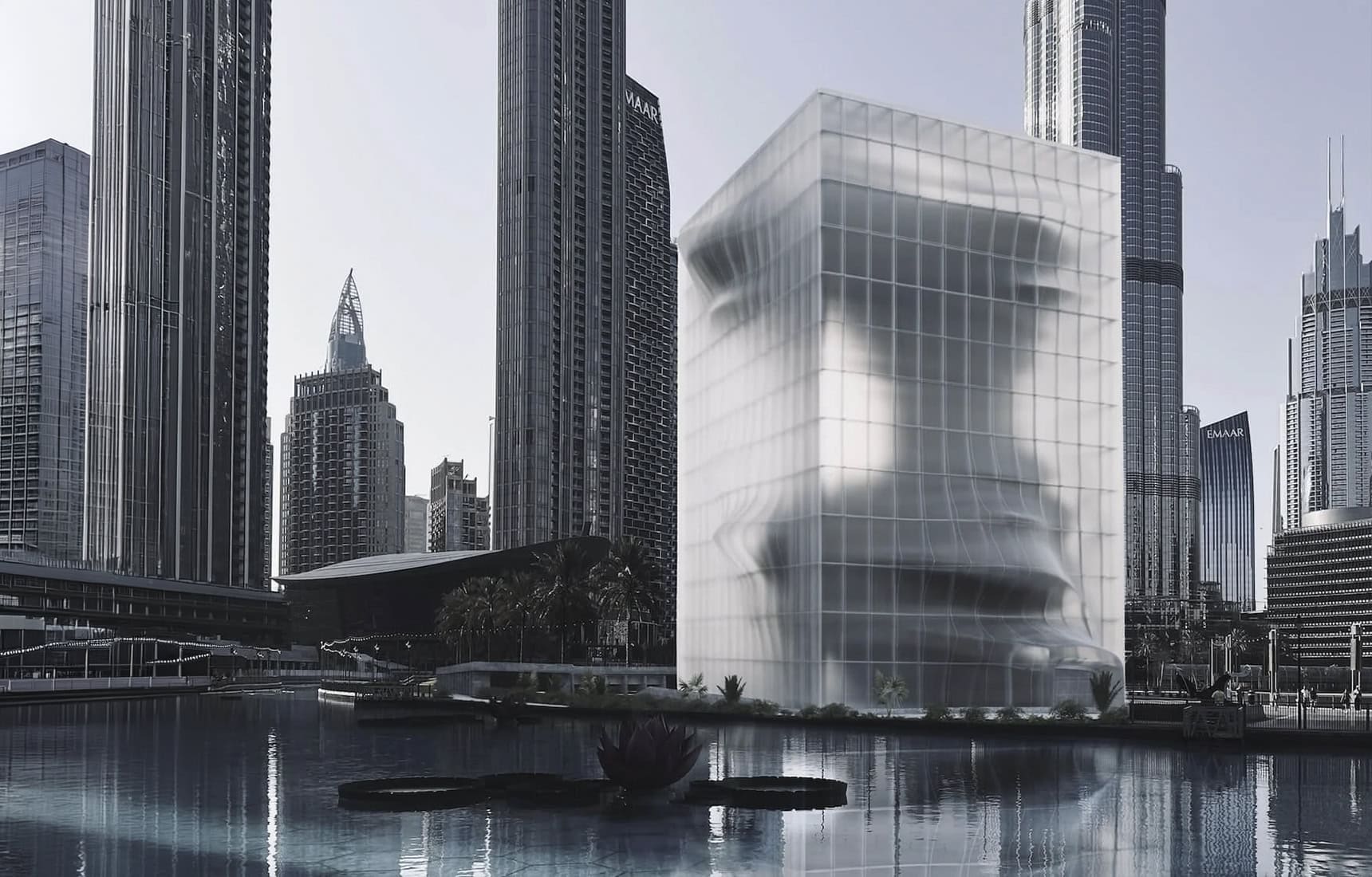
Reading time: 6 minImagine a museum by the Burj Khalifa that is completely transparent on the outside, so the whole city can watch the art being made. Now imagine that inside its glass skin there is a canyon of raw earth. That is the Dubai Art Museum, a striking concept by Kalbod Design Studio, and its clever idea is one of the oldest in the desert.
Before anything else, a point of honesty that makes this project more interesting rather than less: the Dubai Art Museum is a concept, not a construction site. It is a vision, unveiled in 2023 by Kalbod Design Studio, the Tehran practice led by Mohamad Rahimizadeh, working with Amirali Garousian. No cranes have gone up near the Burj Khalifa. What Kalbod has produced is a proposal, a piece of thinking about what a museum in this city could be.
That is worth saying clearly, because speculative architecture like this earns its keep in ideas rather than in concrete, and this particular concept contains a genuinely good one. Beneath the visualisations and the language of “cultural light,” the Dubai Art Museum is built around a single, elegant move that answers one of the great questions of building with glass in the Gulf. The proposal is a 60-metre building of only 2,000 square metres, small and sculptural, and its whole argument lives in its skin.

The challenge of glass in the desert
To see why the concept is clever, you have to start with the problem it sets out to solve.
Dubai loves a glass building, and glass in a desert climate sets architects a demanding technical brief. A fully transparent building in this heat takes in a great deal of sun, and keeping it comfortable calls for real ingenuity. The established answers are tinting, shading and efficient cooling, all of which work well. Kalbod set itself a further ambition on top of those: to keep the glass completely clear, so the building reads as an open window rather than a tinted one.
Kalbod’s concept pursues that further ambition, and its answer is the part worth paying attention to.

The double skin: glass on the outside, earth within
The Dubai Art Museum is conceived as a double skin, and the two layers could hardly be more different from one another.
The outer layer is a transparent facade, an almost fully glazed membrane that lets the city see straight into the life of the museum. The idea is generosity and connection: passers-by glimpse artists at work and galleries in use, so the building offers itself to the street rather than hiding behind a wall. At the entrance the glazing becomes a semi-transparent membrane, giving a teasing preview of the interior as visitors arrive along walkways that lead in from Burj Park.
The inner layer is where the intelligence sits. Wrapped inside the glass is a sculptural mass of rammed earth, shaped into forms that evoke natural canyons and caves. This is not decoration. Rammed earth is one of the oldest building materials on the planet and one of the best suited to a hot, dry climate, because its sheer mass holds a stable, cool temperature while the sun beats on everything around it. It is thermal mass at its most ancient and most honest. So the transparent skin gives you the openness and the spectacle, and the earth core gives you the shade, the calm and the coolness that the glass alone could never provide.
That is the whole concept in one sentence. The newest idea in architecture, total transparency, wrapped around the oldest, a cool cave of packed earth. The building solves the glass box’s fundamental problem by hiding a piece of the desert’s own wisdom inside it.

Part of a bigger conversation
This is not an isolated flourish. It belongs to the most intelligent current running through new architecture in the Gulf.
Again and again, the best recent buildings in this region arrive at the same conclusion: that the old, local answers to heat and light were the right ones, and the job of contemporary design is to translate them rather than throw them away. Oppenheim carved Desert Rock into a mountain to be cooled by the rock itself. RCR wrapped Muraba Veil in a steel mashrabiya. Courtyard houses turn inward to a shaded core. Kalbod’s Dubai Art Museum reaches for the same instinct and takes it to a logical, almost provocative extreme, placing a literal earthen canyon at the heart of a glass building. Whether or not it is ever built, the concept makes the argument vividly, and that is exactly what good speculative architecture is for.

Descending through the galleries
The experience Kalbod imagines follows the logic of the form, and it borrows from two very different sources.
Visitors would rise first to the top floor, then make their way slowly downward along a central ramp, moving through the galleries as they descend. The reference points are the traditional souk, with its winding, discovery-led passages, and the modern spiralling museum in the manner of the Guggenheim. The result is a continuous downward journey rather than a series of separate rooms, so the architecture keeps a constant dialogue going between the space and the art within it. Descending into the cool, cave-like earthen core, floor by floor, would feel a little like walking down into a wadi out of the heat, which is a lovely thing for a museum in this city to make you feel.
Kalbod frames all of this through what it calls the Subject-Object philosophy, the idea that the artists and visitors, the Subject, matter as much as the artworks, the Object, and that the building itself is part of the exhibition rather than a neutral container for it. It is a precise way of saying something simple and true. Here, the architecture is meant to be experienced as intently as the art.

Frequently asked questions
Is the Dubai Art Museum a real, built museum?
No. It is a concept unveiled in 2023 by Kalbod Design Studio. It is a design proposal rather than a commissioned or constructed building.
Who designed it?
Kalbod Design Studio, a Tehran-based practice led by principal architect Mohamad Rahimizadeh, in collaboration with Amirali Garousian.
What is the “double skin”?
An outer transparent glass facade that reveals the activity inside, wrapped around an inner sculptural layer of rammed earth shaped like canyons and caves. The glass gives openness, the earth gives passive cooling.
Why rammed earth?
It is one of the oldest and most climate-suited materials in the desert. Its mass holds a stable, cool temperature, so it addresses the heat that a purely glass building could not manage on its own.
How would visitors move through it?
They would ascend to the top floor and descend along a central ramp through the galleries, inspired by traditional souks and spiralling modern museums.

Final thoughts
Concepts like this one earn their keep through the ideas they carry, and this one carries a fine idea. The Dubai Art Museum is a proposal, and its value is in the idea it makes so clearly: that one of the finest answers to building beautifully in this climate is a return to the oldest material in the region, used with real conviction.
A transparent museum that opens itself to the city, holding a canyon of cool earth at its heart, by the foot of the Burj Khalifa, is a genuinely poetic vision. For now it remains a concept on the page. The thought behind it, that the future of desert architecture lies partly in its past, is one of the most quietly persuasive ideas in the region right now, and this concept states it with unusual grace.


Leave a Reply