
ART & CULTURE · MILAN
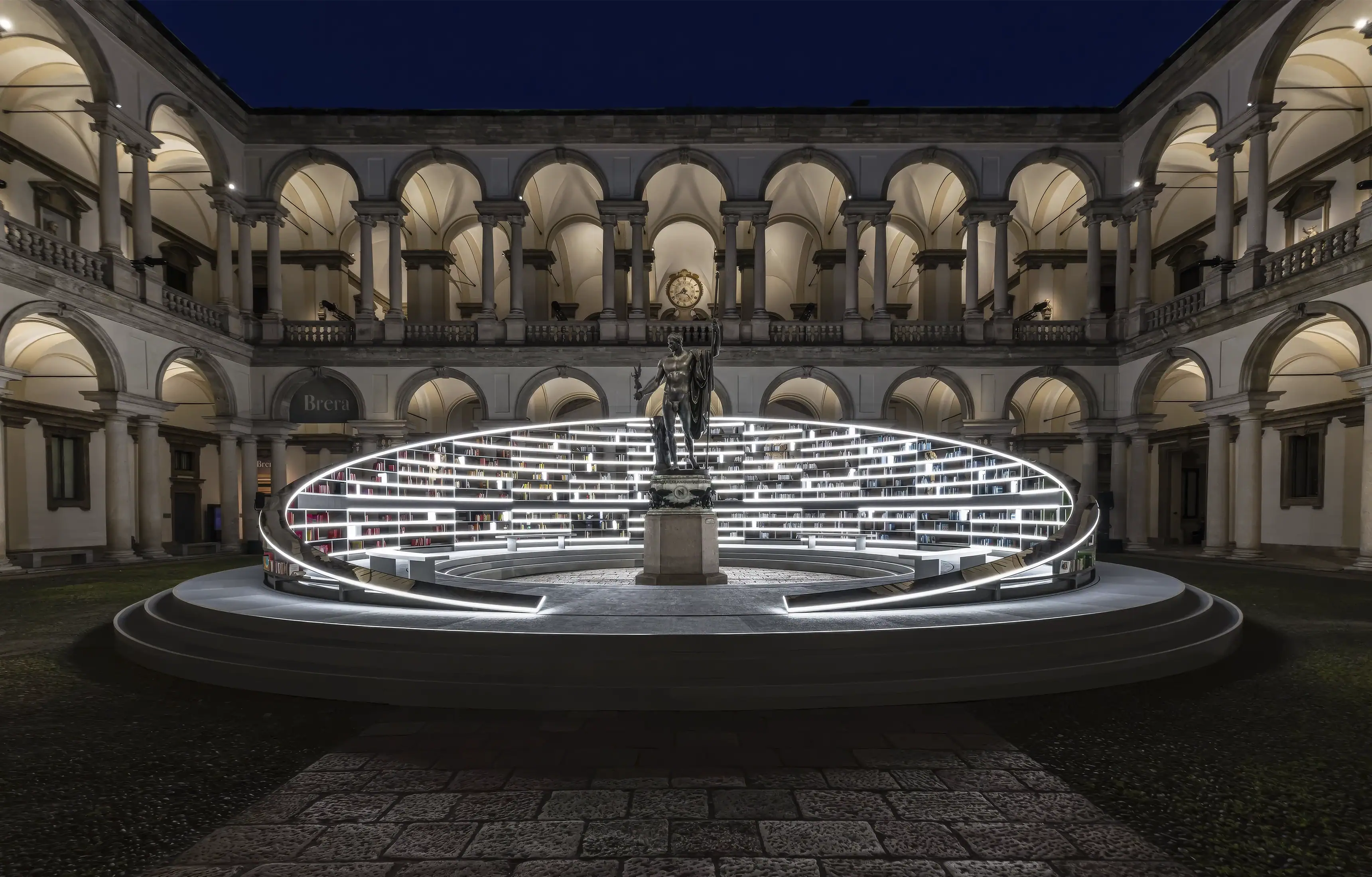
Reading time: 7 minFor two weeks during Milan Design Week 2025, Es Devlin turned the courtyard of Palazzo Brera into a revolving cylinder of books and mirrored light. The installation was built around a scholar whose own name had been mistranslated for two and a half centuries, and whose statue Devlin found by accident.
Es Devlin has spent the past two decades making the invisible legible. She has drawn crowds into a mirrored cube outside Somerset House, folded a choir into the walls of the UK Pavilion at Expo 2020 Dubai, and built the stage sets that turn a pop concert into an argument about scale and memory. For Salone del Mobile 2025, she was given one of the most loaded courtyards in Milan and asked to respond to the theme set for the whole fair: Thought for Humans. What she built there, Library of Light, ran from 7 to 21 April 2025 in the Cortile d’Onore of the Pinacoteca di Brera, and it did something more specific than illustrate a theme. It corrected an omission that had been standing in that courtyard, unaddressed, since 1859.

What actually stood in the courtyard
Library of Light is a cylindrical structure 18 metres in diameter, built from mirrored panels and illuminated shelving, that rotates slowly through the day. By day, its angled mirrored canopy catches sunlight that the courtyard’s high walls would otherwise block from reaching certain corners, and redirects it onto columns, porticoes and statues that rarely see direct sun. By night, the same structure reverses the effect: it becomes a lit drum, projecting shadow and light back out across the surrounding architecture, functioning, in Devlin’s own description of the piece, as a beacon rather than a container.
The shelving holds 3,200 volumes in total, an amount closer to a small public library than an installation prop. Of those, more than 2,000 were curated and donated specifically by Feltrinelli, the Milan publishing house, selected around the fair’s Thought for Humans brief rather than pulled at random from a warehouse. The distinction matters for anyone trying to describe the piece accurately: the 3,200 figure is the structure’s total shelf capacity, and the 2,000-plus figure is Feltrinelli’s specific contribution to filling it, drawn from its own catalogue and curated with the theme in mind. The two numbers describe different things, and reporting on the piece has occasionally blurred them into one.
Visitors were not kept at a distance from the books. They could browse the shelves, and were invited to contribute their own volumes to what Salone del Mobile and Pinacoteca di Brera describe as a living archive, with contributed titles eventually passing into Milan’s public library system rather than staying inside the sculpture. Each evening at 8pm, the installation read aloud: passages projected and voiced across the structure’s displays, turning a static object into something closer to a performance with a fixed curtain time.

The courtyard Devlin was actually working in
Palazzo Brera is not a neutral backdrop. The building began as a fourteenth-century monastery run by the Umiliati order, passed to the Jesuits, who ran a school on the site, and was substantially rebuilt from the early 1600s by the architect Francesco Maria Richini into the austere structure that still stands today. When the Jesuit order was suppressed in 1773, the complex became state property under the Habsburg empress Maria Theresa, who used it to house, under one roof, the Fine Arts Academy, the Lombardy Institute of Sciences and Letters, the Biblioteca Braidense, the Astronomical Observatory and the Botanical Garden. The neoclassical architect Giuseppe Piermarini later reworked the library, the formal entrance on Via Brera, and the courtyard itself, the Cortile d’Onore, where Devlin’s structure rotated for two weeks.
That courtyard already had a fixed resident: a bronze statue of Napoleon, cast by Antonio Canova and installed there in 1859, depicting the emperor as a semi-nude classical hero. It is one of the most recognisable pieces of public sculpture in Milan, and it has stood at the centre of the Cortile d’Onore for well over a century and a half, commemorating one man’s version of imperial permanence. Devlin’s temporary structure rotated around the edges of that same space, and the contrast is not incidental. One is a fixed monument to a ruler. The other was a moving monument to reading, and it was built, in large part, around someone the courtyard had never got around to naming.

The mathematician Devlin found by accident
While researching the site, Devlin came across a second statue in the Cortile: Maria Gaetana Agnesi, the eighteenth-century Milanese mathematician and philosopher. Devlin has said she was previously unfamiliar with Agnesi’s work, and that discovering the statue changed the direction of the whole piece. “This work seeks to bring her presence from the periphery to the centre,” Devlin has said of the decision to build Agnesi into Library of Light rather than simply illustrate the fair’s theme in the abstract.
Agnesi is a genuinely significant figure who has spent most of the intervening centuries under-credited for it. Born in Milan in 1718 into a wealthy silk-merchant family, she was a documented child prodigy fluent in multiple languages by her teens, and went on to write Instituzioni analitiche ad uso della gioventù italiana in 1748, a two-volume textbook covering algebra and calculus that became one of the most comprehensive mathematical texts of its era. In 1750, Pope Benedict XIV appointed her to a chair in mathematics at the University of Bologna, making her the first woman formally offered a university mathematics post anywhere in the world, an honorary position she accepted more as recognition than as a teaching post she actively occupied. She later turned away from mathematics almost entirely, devoting the second half of her life to charitable and religious work, running a hospice for the elderly poor in Milan, and dying in 1799 having given away most of what she had.
There is a specific irony in how Agnesi is remembered today, and it is the detail that gives Library of Light its sharpest edge. A cubic curve she analysed in her textbook, versiera d’Agnesi, was mistranslated into English by the Cambridge mathematician John Colson, who appears to have confused the Italian versiera with avversiera, a word closer to “she-devil.” The curve has been known in English-language mathematics ever since as the Witch of Agnesi, a name with no connection to the mathematics it describes and no connection to the woman who described it. A translator’s error attached a slur to her legacy that has outlived her actual scholarship by nearly three hundred years. Devlin’s decision to have her own voice, alongside Benedict Cumberbatch’s, read directly from Agnesi’s writing inside the installation is not a decorative flourish. It puts Agnesi’s own words back in circulation in the same courtyard where her statue has stood, largely unremarked, since long before Napoleon’s bronze arrived.

The sound inside the structure
Library of Light was built to be heard as much as seen. Devlin worked with the British duo Polyphonia on an original score built around a violin line drawing on Beethoven’s Violin Concerto in D major, Op. 61, composed in 1806. Over that score, Benedict Cumberbatch voices readings from Carlo Rovelli’s The Order of Time, the physicist’s book on the nature of time and memory, while Devlin herself reads passages from Agnesi. The choice of Rovelli is not arbitrary either: a physicist writing about how time is experienced, layered against a structure that literally rotates and against the words of a mathematician who studied resonance and light behaviour, gives the piece a coherent intellectual spine rather than a collage of impressive names. Devlin has described her own relationship to libraries in terms that fit the same logic, saying she has always experienced them as “silently intensely vibrant places where minds and imaginations soar while clutched like kites by their seated bodies.”
A structure built for a fair, made to outlast it
The books were never intended to disappear with the installation. Visitors’ own contributed volumes were designed to enter Milan’s public library system once Library of Light came down, meaning the piece’s afterlife is measurable in actual books on actual shelves elsewhere in the city, rather than in photographs alone. That is a more concrete legacy than most temporary design-week installations attempt, and it fits a fair whose stated theme was Thought for Humans rather than a formal or material provocation. Devlin has built her career on structures that dissolve quickly and photograph well. Library of Light was built to leave something behind that outlives the fair by years, distributed across a city’s library shelves rather than concentrated in one courtyard.

Final thoughts
Library of Light works as spectacle from across the courtyard, and it works differently once a visitor is close enough to read a spine or catch a projected line of text. The mirrored canopy and the rotation give it the immediate impact a design week installation needs to be photographed and shared. The choice to build the whole thing around Maria Gaetana Agnesi, a scholar the courtyard had quietly housed for years without naming properly, is what gives it an argument rather than just an image. Devlin found an omission standing in plain sight and corrected it in the same space, using light, sound and 3,200 books to do it.
What was Es Devlin’s Library of Light?
A rotating, mirrored 18-metre sculpture built by the British artist and stage designer Es Devlin in the Cortile d’Onore of Milan’s Pinacoteca di Brera for Salone del Mobile 2025, combining illuminated shelving, sound and light effects around the fair’s Thought for Humans theme.
How many books were in the installation?
The structure held 3,200 volumes in total. More than 2,000 of these were specifically curated and donated by the Milan publishing house Feltrinelli, selected around the fair’s theme.
When did Library of Light run?
It ran from 7 to 21 April 2025, alongside Salone del Mobile and Milan Design Week.
Who was involved in the soundscape?
The British duo Polyphonia composed an original score drawing on Beethoven’s Violin Concerto in D major, Op. 61. Actor Benedict Cumberbatch voiced readings from Carlo Rovelli’s The Order of Time, and Es Devlin herself read passages from the writing of Maria Gaetana Agnesi.
Who was Maria Gaetana Agnesi?
An eighteenth-century Milanese mathematician, the author of a major 1748 calculus and algebra textbook, and in 1750 the first woman formally offered a university mathematics chair anywhere in the world. Devlin discovered a statue of Agnesi in the same courtyard while researching the installation and built the piece around restoring her visibility.



Leave a Reply