Ways of Seeing is a book about the room around a picture: the wall, the frame, the caption and the person standing in front of it. Read at Alserkal Avenue, its sharpest lesson arrives in a mirror, because Hisham Sharif’s mirrors turn the other way from the ones John Berger describes.
John Berger‘s Ways of Seeing is a short book about a large question: what happens to a picture when it is moved, reproduced, captioned or hung beside something else. It began as a four-part television series on BBC Two in January 1972 and was published as a book the same year. The edition linked here is the Penguin Modern Classics paperback, published in September 2008 and running to 176 pages.
It is built from seven numbered essays. Four combine text and images. Three contain images only, with no commentary at all, and the reader is left to make the argument by looking. The book says the essays can be read in any order, which makes it unusually easy to carry into a gallery and open at whichever page the room suggests.
That is why it is on the Read the Room shelf. Berger is rarely writing about a painting on its own. He is writing about the painting, the wall, the frame, the caption and the person standing in front of it. It is a book about the room around the picture.
A painter, a critic and a television series
Berger was born in Stoke Newington, London, in 1926. He trained at the Chelsea School of Art and the Central School of Art and Design, exhibited as a painter in London in the late 1940s, taught drawing, and then became a critic, writing essays and reviews for the New Statesman. That sequence matters to the book. He looks at pictures with a painter’s attention to how they were made, and writes about them with a critic’s attention to what they are for.
The series was produced by Mike Dibb and ran across four Saturday evenings in January 1972: one episode on the camera and painting, one on women in art, one on painting and possessions, one on fine art and commerce. The book is credited as a collective work, made by Berger with Sven Blomberg, Chris Fox, Michael Dibb and the graphic designer Richard Hollis. Hollis’s part is central. A book that asks readers to argue with pictures needs a layout in which the pictures can do the arguing, and the wordless essays only work because the sequence has been designed with that much care.
The same year, Berger won the Booker Prize for his novel G. He left Britain in the early 1960s and lived and worked in France for the rest of his life, much of it in the village of Quincy in Haute-Savoie. He died in January 2017, aged 90.
Seven essays, and three of them have no words
The first essay opens with the line most readers remember: “Seeing comes before words,” as Berger puts it. From there he draws on Walter Benjamin‘s essay on mechanical reproduction to make a practical point. Once a painting can be photographed and printed, it no longer lives only in the place it was made for. It arrives on a postcard, a poster or a screen, beside other images, under other words, and its meaning moves with it.
He makes that concrete. He shows a reproduction of a landscape, then the same image with a caption beneath it, and asks the reader to notice how the caption changes what is seen. He turns to Frans Hals‘s group portraits of the regents and regentesses of the Old Men’s Almshouse in Haarlem, painted in 1664, and reads the sitters as people looking back at a painter, rather than as a lesson in brushwork.
The third essay is the one that changed how a generation looked at European painting. It is about the nude, and about who a picture of a woman was painted for. Berger notices the mirror that so many painters placed in a nude’s hand, and argues that it turns the woman towards the spectator, making her a sight first and a person second. The fifth essay turns to oil painting and property, reading Thomas Gainsborough‘s Mr and Mrs Andrews as a portrait of a couple and also of the land they owned. The last essay moves to publicity, and to the colour photography that now does much of the work oil paint once did.
Read in sequence, the essays share one habit of mind. Before asking whether a picture is good, Berger asks where it is hanging, who paid for it, who it is looking at and what has been written beside it. Those are questions that can be asked in any gallery, in any city, this week.
What Ways of Seeing shows you in Hisham Sharif’s rooms
The clearest place to try the book is Allusive Veil, Hisham Sharif‘s first solo exhibition in the UAE, at Ayyam Gallery on Alserkal Avenue from 23 September to 30 October 2026. The five paintings are domestic interiors in acrylic, built from layered colour, and in almost every one a mirror, a window or a reflective surface interrupts the room.
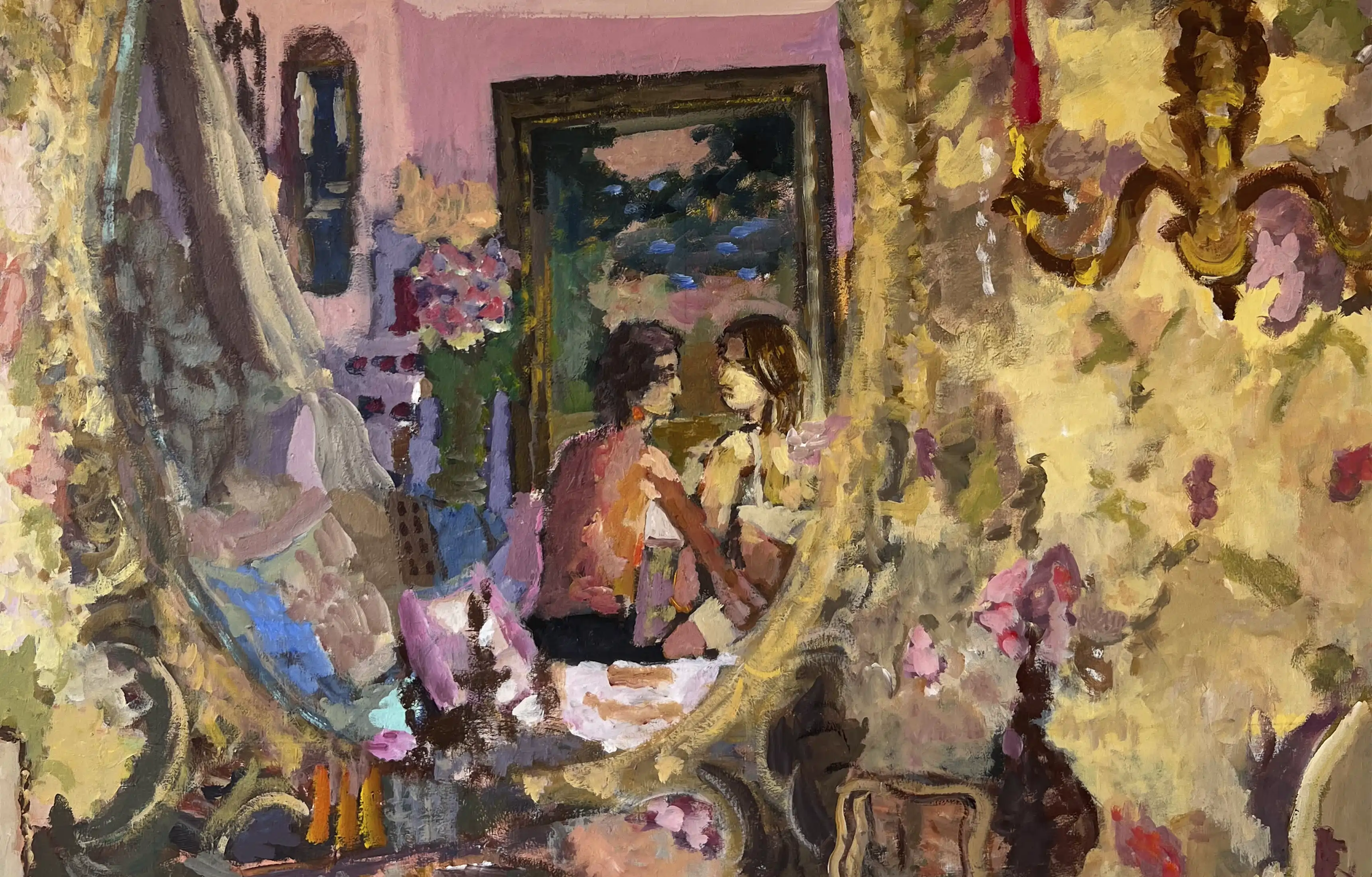
Read Berger’s essay on the nude first and then stand in front of Behind the Mirror, the largest work at 140 centimetres square. An oval mirror shows two figures in a room the viewer cannot otherwise see, set against a densely patterned gold interior. Berger’s mirror turns a figure out towards the spectator. Sharif’s mirror works the other way: it shows the viewer that there is a second room, and keeps the people in it at a distance. Red Room does something similar with furniture, placing a reclining figure behind the posts of a four-poster bed so that the frame of the bed becomes a veil. Across the show the figure is never the loudest thing in the picture. The colour and the pattern carry it.
There is a second thread, and it makes the pairing more than a convenient one. The French painting tradition that Berger examines essay by essay is the one Sharif’s father, AbdulRahim Sharif, studied at the École nationale supérieure des Beaux-Arts in Paris in the 1970s before taking it home to Bahrain, where he became a founding member of the Bahrain Arts Society. Berger asks who a picture is for. Sharif’s paintings, one generation and two countries on, give their own answer by deciding exactly how much of the room the viewer is allowed to see.
The same gallery showed Safwan Dahoul earlier this year, and his work answers the first essay directly. Three of the smallest works in that show were mixed media on wood, each 17 by 13 by 5 centimetres. A photograph of them flattens the five centimetres of depth that the whole argument rests on. Berger’s case is that reproduction carries an image away from its object. Dahoul made objects whose meaning cannot travel without them.
Alserkal Avenue, read as a sequence of walls
Berger’s first essay is about adjacency: an image means something different depending on what hangs beside it. Alserkal Avenue is a district built on adjacency. Galleries took over former marble and car repair warehouses in Al Quoz from 2007 onwards, and a visitor now moves from Ayyam to the next unit and the next, assembling a sequence of their own. Read with Berger in mind, an afternoon there becomes an exercise in noticing how one room colours the next.
It also sharpens the eye for the parts of a gallery that usually go unremarked. Mestaria, a few doors along at Unit 35, runs a framing workshop inside the gallery with more than 300 frame styles. Mount width, profile depth and glazing are all decisions about how a picture meets a wall, and Berger would recognise each one as part of what the picture ends up saying. Outside, the Al Quoz murals on working buildings bring his last essay into the street, where images sit on the facades of food distributors and a children’s museum, read by people on their way somewhere else.
Read it, then walk it
The room to take this book into is Ayyam Gallery at B11, Street 8, Alserkal Avenue, Al Quoz 1, open Monday to Friday from 11am to 7pm and Saturday from 12pm to 6pm while Allusive Veil is on. Read the first and third essays before going. They take under an hour together.
In the gallery, look before reading any wall text, then read it and look again, and notice what the words changed. Stand where the painter seems to have put you and ask who else could be in the room. Look at the frame and the hang as well as the canvas. Then, on the way out, look at the same work on a phone screen and compare. Berger’s argument is easiest to understand at that moment, with the original a few metres away.
Who it is for
Anyone who has walked into a gallery and been unsure where to start will find in it a set of questions that work in every room. Interior designers and collectors who hang art for a living will recognise its attention to frames, walls and neighbours. Students meet it early and keep it, and seasoned gallery-goers tend to reread it every few years and find a different essay doing the work. It is short enough to read in an evening and useful enough to keep in a coat pocket.
Frequently asked questions
What is Ways of Seeing?
A book by John Berger, first published in 1972 and based on the BBC Two television series of the same name broadcast in January 1972. It is made up of seven numbered essays, four with text and images and three with images only.
Who made Ways of Seeing?
The book is credited to John Berger with Sven Blomberg, Chris Fox, Michael Dibb and Richard Hollis. Mike Dibb produced the television series and Richard Hollis designed the book.
Which edition of Ways of Seeing does Read the Room link to?
The Penguin Modern Classics paperback, published in September 2008, 176 pages, ISBN 978-0-14-103579-6.
What is Ways of Seeing about?
How images are seen and what shapes their meaning: reproduction, the female nude and the spectator, oil painting and ownership, and publicity. Berger asks where a picture hangs, who it was made for and what is written beside it.
Who was John Berger?
A British painter, art critic, novelist and essayist, born in London in 1926. He won the Booker Prize in 1972 for his novel G. and lived in France for most of his later life. He died in January 2017.
Which martynwhite.co stories pair with Ways of Seeing?
Hisham Sharif’s Allusive Veil at Ayyam Gallery and the Alserkal Avenue district in Dubai, with further reading on Safwan Dahoul at Ayyam, Mestaria Gallery and the Al Quoz murals.
Final thoughts
Ways of Seeing is often filed as a book about art history. It works better as a set of instructions for standing in a room: notice the wall, the frame, the caption, the neighbour, and the place the painter has left for you.
Hisham Sharif’s mirrors and Safwan Dahoul’s five-centimetre boxes test those instructions well, and Alserkal Avenue gives a whole district to practise on.
Read the essays, then go and see what the room is doing to the picture.
Book Credits
Read next
The first Frieze Abu Dhabi is built around a thirteenth century shrine assembled from reused Roman stone, rebuilt in the atrium out of timber and cloth by Dala Nasser.
Abu Dhabi