Less but Better is Dieter Rams’s own account of how he designs, first published in 1995 and reissued by Gestalten in 2014. Its ten principles are a way of looking as much as a way of making, and they turn the smallest objects in a room, a light switch or the handle on a lamp, into evidence of a design argument.
Less but Better is the book in which Dieter Rams explains his own way of working, in German and English side by side under its original title, Weniger, aber besser. It first appeared in 1995 from Jo Klatt’s Design+Design Verlag in Hamburg. The edition on the Read the Room shelf is the Gestalten reissue of 2014: 154 pages, edited by Jo Klatt with the Dieter und Ingeborg Rams Stiftung.
It is a short book with a long reach. It does not set out to catalogue every Braun product or to tell the full story of the company. It sets out the ideas, the criteria and the methods behind the objects, shows how a changing culture of industrial manufacturing shaped them, and carries the ten principles of good design that Rams has returned to ever since.
It is on the shelf because it trains the eye on the smallest things in a room: the switch by the door, the lamp on the table, the shelf on the wall. After reading it, those objects start to explain themselves.
From a carpenter’s grandson to Braun’s head of design
Rams was born in Wiesbaden in 1932, and the strongest early influence on him was his grandfather, a carpenter. He studied interior design at the Wiesbaden School of Arts and Crafts in the early 1950s and trained as an architect. In 1955 he joined Braun, the electrical products company, to modernise its interiors, and within six years he was its head of design, a role he held for 34 years before retiring from the company in 1997.
From 1957 he was also developing a storage system, and he asked Erwin Braun whether he could design furniture for another company. That company became Vitsœ, founded in 1959, and in 1960 it launched the 606 Universal Shelving System, which it still makes. The 620 Chair Programme followed. The two strands, appliances made by the million and furniture made to last a lifetime, run through the book together.
The principles themselves came from a question. In the late 1970s, increasingly aware of the sheer quantity of objects and images around him, Rams asked whether his own design was good design. The ten principles were his answer, and the phrase on the cover was the answer at its shortest.
What Less but Better asks you to look for
Good design, in Rams’s formulation, is innovative; it makes a product useful; it is aesthetic; it makes a product understandable; it is unobtrusive; it is honest; it is long-lasting; it is thorough down to the last detail; it is environmentally friendly; and it is as little design as possible.
The value of the list for a reader is that almost every line can be tested with an object in your hand. Can you tell how it works without being told? Does the structure show? Will it still look right in ten years? Does every part do a job? Rams’s own gloss on the fourth principle is the most useful sentence to carry into a room: good design, he writes, “can make the product talk.”
The fifth principle is the one that matters most inside a home. Rams describes objects that fulfil a purpose as tools, neutral and restrained, so that the room is left to express the people who live in it. Read that way, a Rams shelf or radio is designed to recede, and the success of the object is measured by how well the room around it belongs to someone else.
Rams is careful to present the principles as a position that keeps evolving rather than a fixed rulebook, and that openness is what makes them travel. They were written by someone designing radios, razors and shelving, and they apply just as well to a brass switch made in a Leicestershire mill or a lamp made for a Danish seaside hotel.
The light switch, read as a Rams object
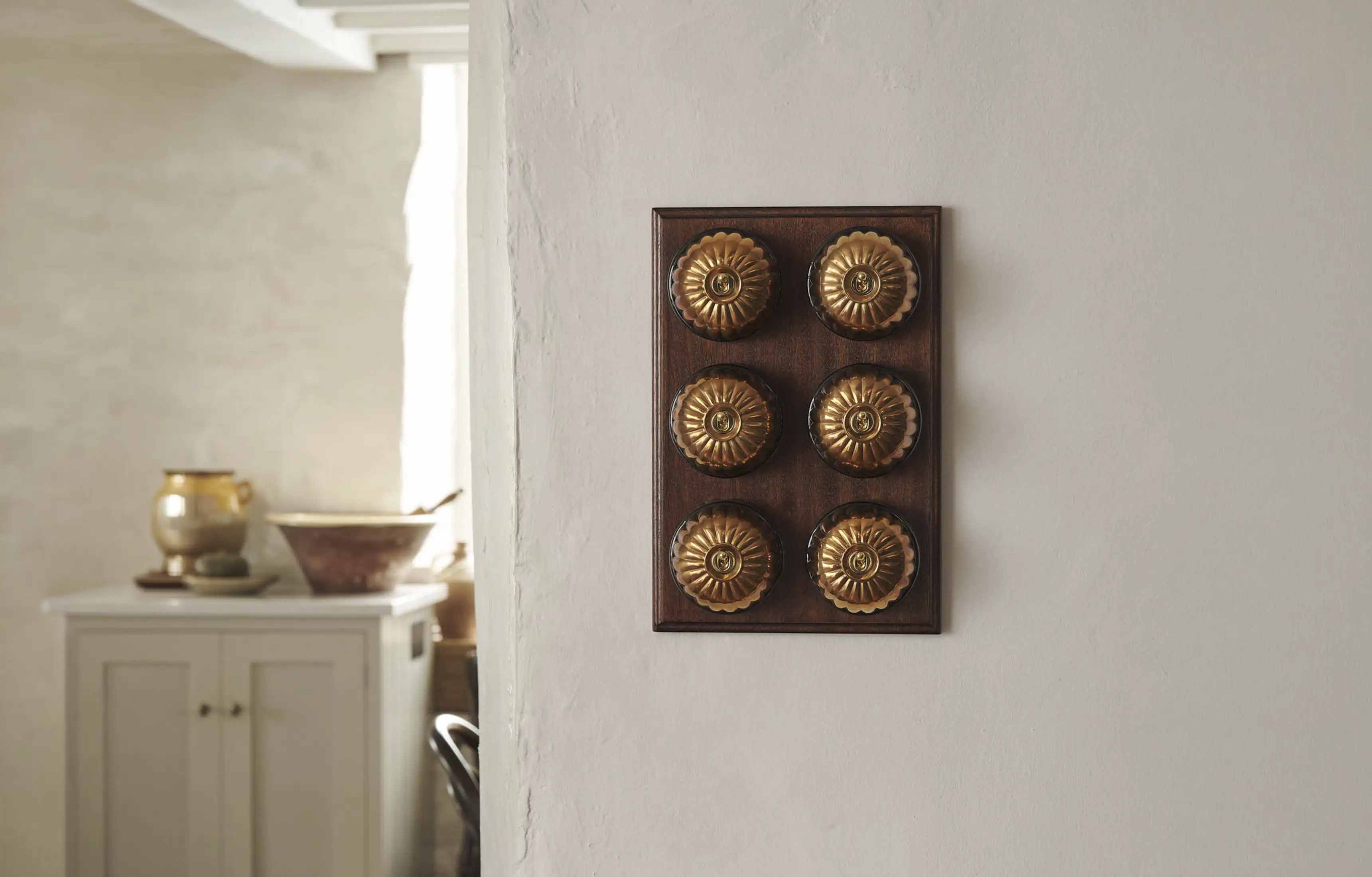
deVOL‘s Heritage Light Switches, the Dolly and the Jelly, are pressed brass and glazed ceramic, made to order by metalsmiths at Cotes Mill in Leicestershire. Read through Rams, the first thing they show is the fourth principle at its purest. A toggle switch states its condition by its position. From across the room you can see whether the light is on, because the mechanism and the interface are the same thing.
The sixth and seventh principles follow. The switches are brass and ceramic because the originals of the 1880s and 1890s were brass and ceramic, rather than a modern body dressed to look old, and the Heirloom, Aged and Oxidised finishes are designed to develop with handling. Rams describes products that fulfil a purpose as tools, and a switch touched dozens of times a day is the most tool-like object in any house.
There is a neat counterpoint on the site. At Hôtel Borsari in Martigny, John Cretton furnished the rooms with Vitsœ shelving, Rams’s 620 seating and 1962 Braun audio, and fitted Bakelite switches made by the Swiss company Feller. deVOL’s range returns to brass, the material Bakelite took over from after 1909. Put the two side by side and the book’s point becomes clear: the principles concern how an object behaves, and both materials can carry them.
A handle that is also the structure
GUBI‘s Hornbæk Portable Lamp was designed for the CORI Hornbæk Hotel, a 1935 seaside hotel on Denmark’s northern coast. Its two folded canvas shades sit on a hand-glazed ceramic base, and an antique brass ring gathers the shades at the top. The ring does two jobs at once: it holds the canvas in place and it is the handle. Inside, a stainless-steel frame carries the load and lets the lamp ship flat, with the canvas guided along internal rails rather than fixed with visible hardware.
That is the tenth principle in a single component. One part, two functions, nothing added. It is also the fourth: a ring on top of a cordless lamp tells you, before anyone explains it, that the light is meant to be picked up and carried. And GUBI’s whole business of bringing designs back into production is the seventh principle at company scale, since a design that does not date can simply be made again.
The same reading works on Jaime Hayon’s Ikebana vase for Fritz Hansen, where the perforated disc that holds each stem sits in the mouth of the glass and is the first thing you see. The mechanism is the face of the object.
Read it, then walk it
In London, take the book to Vitsœ‘s shop on Marylebone Lane, where the 606 system, launched in 1960, is planned and sold. Since 2017 Vitsœ has made it in Royal Leamington Spa, in a building designed around the same modular logic as the shelving. Look at how a single upright, a shelf and a fixing make a system that can be added to, taken down and moved house.
deVOL’s flagship at Cotes Mill, a sixteenth-century water mill on the River Soar outside Loughborough, holds the workshops where the switches are made. And for a night inside the book, Hôtel Borsari puts Rams furniture and Braun audio into its rooms. Take the ten principles as a checklist and test them on the switch, the shelf and the chair.
For the long-lasting principle at the scale of a building, Leila Atlassi’s brief for the Strand Hotel in Stockholm asked for something durable rather than a concept to be replaced in three years, and furnished it with pieces in continuous production since 1958.
Who it is for
Product designers will recognise it as a founding text. Interior designers and specifiers will find it a clear framework for choosing the hardware, lighting and storage that a room is lived through, the objects handled every day. Anyone renovating a home will find ten questions worth asking of every switch, tap and shelf before buying it. And because the text runs in German and English together, it is also a fine way to read Rams in his own words.
Frequently asked questions
What is Less but Better by Dieter Rams?
It is Dieter Rams’s own book about his design philosophy and methods, published in German and English as Weniger, aber besser. It first appeared in 1995 and was reissued by Gestalten in 2014.
Who is Dieter Rams?
A German designer born in Wiesbaden in 1932. He joined Braun in 1955, was its head of design for 34 years, and designed furniture for Vitsœ, including the 606 Universal Shelving System of 1960.
What are Dieter Rams’s ten principles of good design?
Good design is innovative, makes a product useful, is aesthetic, makes a product understandable, is unobtrusive, is honest, is long-lasting, is thorough down to the last detail, is environmentally friendly, and is as little design as possible.
Which edition of Less but Better does Read the Room link to?
The Gestalten edition of 2014, 154 pages, edited by Jo Klatt with the Dieter und Ingeborg Rams Stiftung, with German and English text. ISBN 978-3-89955-525-7.
When did Dieter Rams write the ten principles?
In the late 1970s, when he asked himself whether his own design was good design.
Where can you see Dieter Rams furniture in London?
At Vitsœ’s shop on Marylebone Lane, which plans and sells the 606 Universal Shelving System and the 620 Chair Programme.
Final thoughts
It would be easy to treat Less but Better as a manifesto for minimalism. It is more useful as a set of questions that can be put to any object, at any price, in any material.
Put them to a brass switch, a canvas lamp or a steel shelf and each one answers clearly. The book’s gift is that it makes the answers visible.
Read the book, then go and stand by the light switch.
Book Credits
Read next
Lee Broom's Chant Chambers turned his Shoreditch showroom into a corridor of light for London Design Festival, and a chandelier into a building system.
London