
ART & CULTURE · MIAMI
Reading time: 10 minA flag built from seventeen thousand hand-cast bullets. A floor that answers back when it is walked on. A muralist who started on the abandoned railway lines outside Santander. SCOPE Miami Beach has spent nearly two decades giving street and urban contemporary art the kind of room a beachfront pavilion allows, and its 2019 edition, running through Miami Art Week, made the clearest possible case for why that room matters.
Every December, Miami Beach turns over its sand, its hotel lobbies and its warehouse district to art. Art Basel Miami Beach takes the convention centre. Design Miami takes a tent beside it. And a few blocks north, on the stretch of Ocean Drive between Eighth and Tenth Streets, SCOPE Miami Beach takes the beach itself, building a temporary pavilion where South Beach’s sand gives way to a programme built around galleries most of the blue-chip fairs would not show.
SCOPE Miami Beach 2019 ran from 3 to 8 December, its pavilion pitched directly on the sand with open views back over the water. Inside, 134 galleries and project spaces filled the show under the banner of what SCOPE calls The New Contemporary, its own shorthand for art that grew out of graffiti, street painting, fibre craft and participatory installation rather than out of the academy. The names on the wall labels told that story on their own: Anthony Lister, HOTTEA, Quintessenz, Okuda San Miguel, Rizomi, Gallery Tableau and the sculptor Kevin Champeny, shown through Steidel Contemporary, each working in a register that has more in common with a wall in Wynwood than with a white-cube gallery in Chelsea.
The fair around them has a specific reason for existing, and it explains why this particular group of artists ended up in the same tent.
A fair built for what the academy skips
SCOPE was founded in 2002 by the gallerist Alexis Hubshman, who set out to build a fair for galleries that the established circuit routinely overlooked: first-time exhibitors, artists working outside conventional gallery representation, and practices, like street art and fibre art, that most blue-chip fairs were still treating as a novelty rather than a category. The fair runs its own Breeder Program specifically to give first-time and emerging galleries a route onto the floor, and it has staged editions in New York during Armory Week, in Basel, and in London during Frieze Week, alongside its long-running Miami Beach edition during Miami Art Week.
That founding brief, a fair for what the mainstream circuit was slow to take seriously, is the reason SCOPE Miami Beach reads so differently from the fairs around it. Where Art Basel Miami Beach’s aisles are built around secondary-market blue-chip names, SCOPE’s pavilion is built around artists whose formative years were spent on walls, fences and trains rather than in a studio critique. By 2019 that distinction had become the fair’s clearest asset rather than a compromise: the artists who had once needed a fair willing to take a chance on them now defined an entire wing of Miami Art Week in their own right.

Two inflatables anchor the beach
Anthony Lister’s contribution took the fair’s beachfront setting literally. The Brisbane-born artist installed two large inflatable sculptures directly on the sand outside the pavilion, their surfaces worked over in the same expressive, layered painting he applies to canvas: loose figuration, drips and reworked passages that read as much like a studio wall mid-process as a finished painting.
Lister trained at the Queensland College of Art, graduating in 2001, and found an early mentor in the New Zealand painter Max Gimblett during a formative period in New York. His grandmother, who introduced him to galleries and to painters including Brett Whiteley, gave him his grounding in classical technique long before graffiti did. What makes his work distinctive is the collision of the two: expressionist, pop-inflected figures built with the same discipline of composition and colour that a portrait painter would use, then pushed through mediums, spray paint and charcoal, that belong to the street rather than the academy. Placing that collision on two inflatable forms, in the open air, on the sand outside SCOPE’s pavilion, took a practice built for gallery walls and put it somewhere it had to hold its own against the ocean.

Yarn, not paint
Inside the pavilion, HOTTEA’s contribution ran in the opposite direction: colour without weight, suspended rather than inflated. Eric Rieger, working as HOTTEA, hung dense fields of brightly coloured yarn from the pavilion’s structure, gradients of colour built thread by thread until they read from a distance like a solid, almost architectural form.

Rizomi
Rieger’s route to yarn is one of the more specific and least reported facts about his practice. He began as a graffiti painter in Minneapolis, and it was legal trouble tied to that paint-based work that pushed him towards yarn as a medium instead, a material that could occupy the same fences and public surfaces without the same legal exposure. He studied graphic design at the Minneapolis College of Art and Design, graduating in 2007, the same year his grandmother, who had taught him to knit, died, a loss that folded directly into the work that followed. What began as yarn bombed onto chain-link fences around the Twin Cities has since been shown at the Minneapolis Institute of Art and installed in London, Berlin, New York and Los Angeles, and HOTTEA was named Minneapolis’s Best Street Artist in 2013 without ever picking up a spray can for the purpose. At SCOPE, that same technique, yarn threaded and knotted into a fixed structure rather than a fence, filled the pavilion with colour that moved with the visitors walking beneath it.

Rizomi
A floor built to be walked through
Quintessenz took the opposite structural surface. Where Lister worked the beach and HOTTEA worked the ceiling, the German duo built an interactive floor piece for visitors to walk across, its geometry drawn directly from the visual language of graffiti and street painting rather than from gallery convention.
Thomas Granseuer and Tomislav Topic met as students at the University of Applied Sciences and Arts in Hildesheim, and built their practice from that combination: a graffiti-formed sense of shape and colour, refined through formal graphic design training. Their large-scale murals, typically painted across the facades of entire buildings, use geometric pattern and saturated colour to change how a viewer reads the architecture underneath it, treating colour, in the duo’s own account of their work, as content in its own right rather than decoration applied afterwards. Bringing that language down from a vertical wall onto a horizontal floor, and making it something the audience had to physically cross rather than simply look at, took a practice built for facades and gave it a genuinely participatory register inside SCOPE’s pavilion.

Gallery Tableau
From Santander’s railway lines to the world’s walls
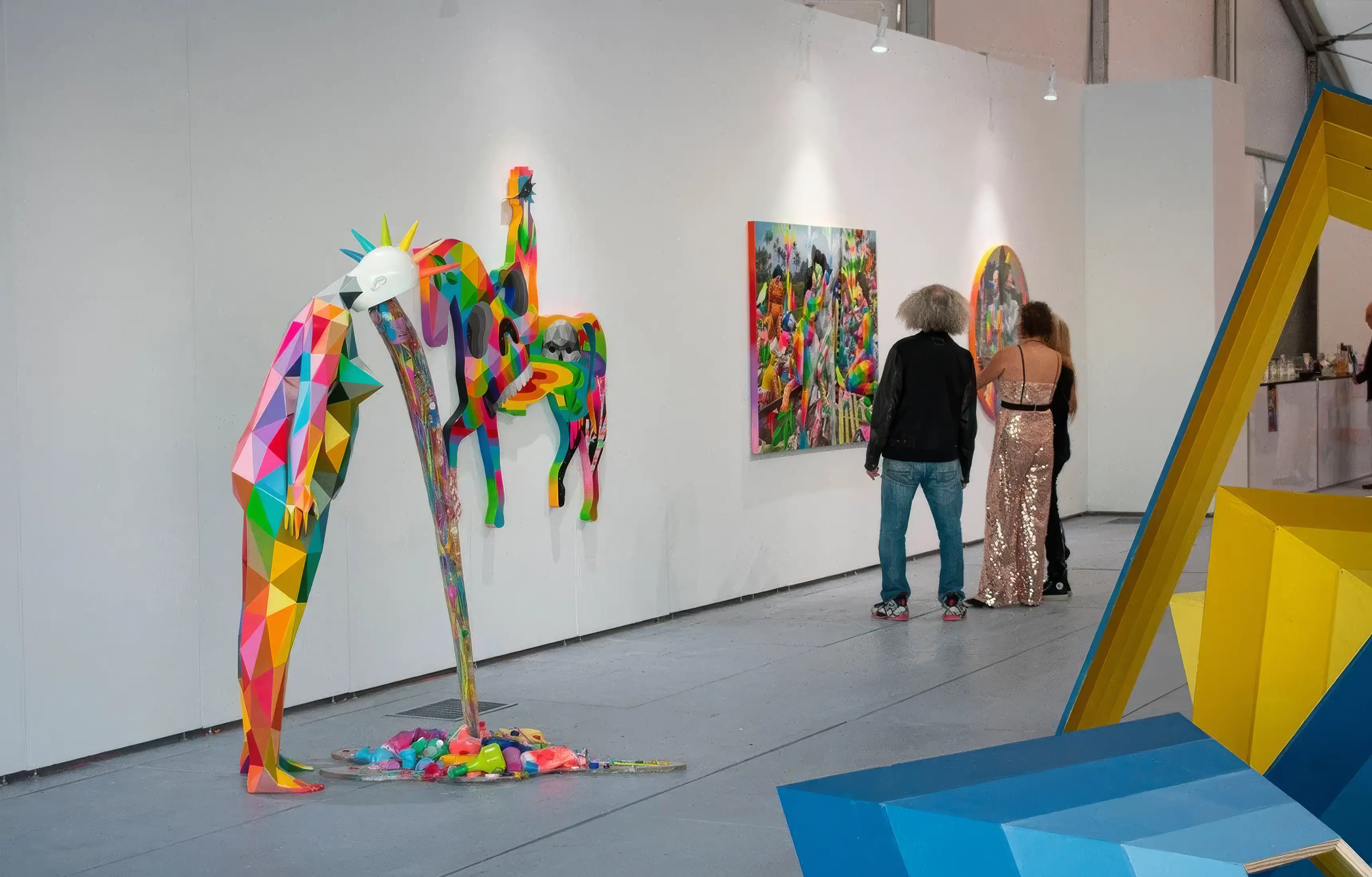
Okuda San Miguel’s contribution to SCOPE 2019 included both life-size figures and mural work, instantly recognisable for the style that has made him one of the most widely commissioned street artists working today: fractured, prismatic geometry laid over animals, skulls, religious iconography and human figures, rendered in a palette bright enough to read from a block away.

Gallery Tableau
Born Óscar San Miguel Erice in Santander in 1980, Okuda began painting recognisable graffiti around 1997, working on railway tracks and abandoned factories in his home city before he had any formal training. He went on to complete a Bachelor of Fine Arts at Complutense University in Madrid in 2007, and moved into large-scale sculpture around 2009, but the geometric, multicoloured vocabulary he developed on those Santander railway lines has carried through everything since. It is the same visual grammar behind his best-known works: the Kaos Temple, a deconsecrated church in Llanera, Asturias, that he covered inside and out in 2015; 11 Mirages to Freedom, a mural completed in Marrakech in 2016; a mural covering a twenty-three-storey student residence in Toronto in 2018; and the Air Land Sea sculpture series installed at Boston Seaport the same year. SCOPE’s pavilion gave that same instantly legible style a beachfront audience, life-size and immediate rather than viewed from twenty-three storeys up.

Steidel Contemporary
Thousands of small things, one large image
Kevin Champeny works from the opposite end of the scale question. Shown through Steidel Contemporary, the American sculptor builds his large-format pieces from thousands of individually hand-sculpted and hand-cast urethane components, assembled one by one until they resolve, at a distance, into a single coherent image.

Steidel Contemporary
Loaded, his best-known piece at SCOPE, is an American flag built from 17,000 individually hand-cast bullets, its stars and stripes formed entirely from a material more commonly associated with firearms than with fabric. It is a technique Champeny has applied across a wider body of work under similarly plain, descriptive titles: Blue Heaven, a piece built from 4,500 hand-cast skulls in his Fifty Shades series, and A Little Faded, made from 816 hand-cast roses across thirty-four shades of pink. Seen together, the pieces share a method rather than a subject: an image that only fully resolves once the viewer registers just how many individually made components went into it, and how long that must have taken.
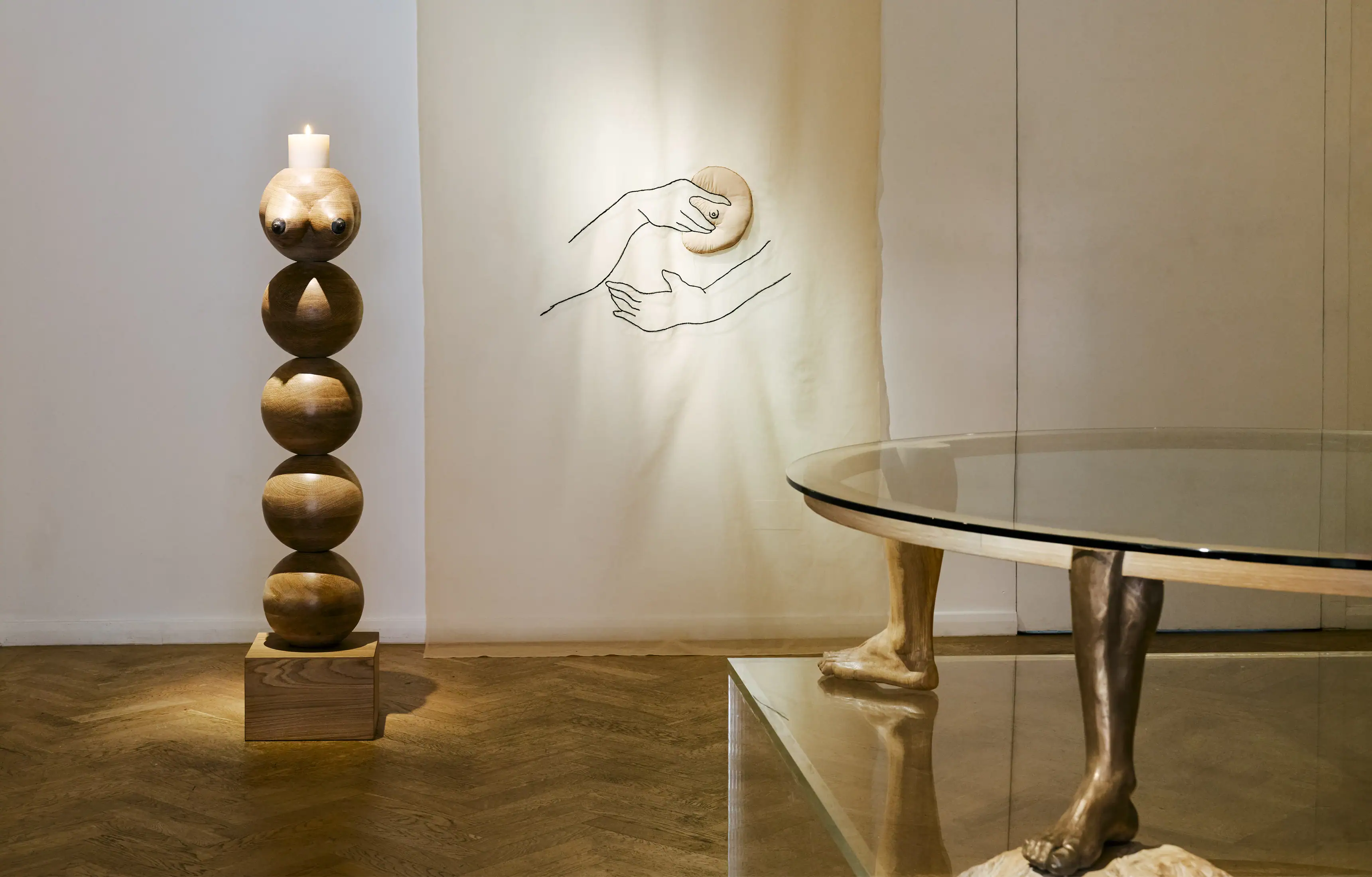
Elsewhere in the pavilion, the same appetite for scale and material specificity showed up in different registers. Rizomi presented sculptural work built around death, drugs and the life cycle, hundreds of hand-assembled pieces incorporating preserved butterflies, beetles and scorpions into their compositions. Gallery Tableau’s booth worked in optical illusion, with bowls that appeared to extend physically out from the surface of a canvas and glass pieces built to bend and refract light rather than simply hold it. Between them, the two booths gave SCOPE’s floor a second axis, next to street art’s flat colour and graphic line, of work built on craft, material specificity and a slower kind of looking.

Steidel Contemporary
The route from the street to the pavilion
Look across SCOPE Miami Beach 2019’s headline names and a pattern appears that none of them state outright but that the fair’s own history explains. HOTTEA moved from paint to yarn because paint got him in legal trouble. Okuda started on abandoned railway lines before he ever set foot in art school. Quintessenz met at a design school but kept graffiti’s grammar of shape and colour as the foundation of their practice. Lister fuses street painting with a classical technique his grandmother taught him. Four different routes, four different materials, and the same underlying trajectory: work that began outside the gallery system, on a surface nobody owned, and found its way onto a fair floor built specifically to receive it.
That is not a coincidence, and it is the clearest explanation of what SCOPE actually is. Alexis Hubshman built the fair in 2002 for galleries and artists the established circuit was slow to take seriously, street art and fibre art chief among them. Seventeen years on, the artists who once needed a fair willing to take that chance were the ones filling its pavilion and setting its programme. SCOPE did not simply exhibit street art in 2019; it exhibited the specific, varied paths by which street art gets made, each one intact and named rather than smoothed into a single house style.

Gallery Tableau
What the pavilion gave its visitors
Beyond the artwork itself, SCOPE’s pavilion functioned as one of the more sociable stops on the Miami Art Week circuit. Its open-plan structure, with a bar and DJ running through the fair’s hours and unobstructed views back over South Beach, meant the art was never separated from the business of standing around and talking about it, which is, for a fair built on the principle of accessibility, exactly the point. A visitor could walk from Lister’s inflatables on the sand, through HOTTEA’s suspended colour and Quintessenz’s interactive floor, past Okuda’s murals and Champeny’s bullet-built flag, and out again into the ocean air within the span of an afternoon, with the fair’s own social space built in at every turn rather than tacked on at the edges.

Rizomi
Final thoughts
It would be easy to describe SCOPE Miami Beach 2019 as a street art fair and leave it there. That undersells what was actually on the sand. The fair’s real subject was the range of routes by which work made outside the gallery system finds its way in: a flag built from bullets, a floor built from graffiti’s own geometry, murals that trace back to a set of abandoned railway lines outside Santander, and a colour field made entirely of yarn. None of those routes look alike, and SCOPE’s pavilion was built, deliberately, to hold all of them at once rather than smoothing them into a single house style.
That is the argument SCOPE has been making since Alexis Hubshman founded it in 2002, and 2019’s edition simply gave it its clearest possible cast of names. A fair built for the overlooked does its best work when the overlooked no longer need the description, and by December 2019, on that stretch of Ocean Drive, they plainly did not.

What was SCOPE Miami Beach 2019?
SCOPE Miami Beach 2019 was the Miami Beach edition of the SCOPE Art Show, a contemporary art fair focused on emerging galleries, street art and urban contemporary practice, held during Miami Art Week.
When and where did SCOPE Miami Beach 2019 take place?
The fair ran from 3 to 8 December 2019, in a temporary pavilion pitched on the sand of South Beach, on Ocean Drive between Eighth and Tenth Streets, Miami Beach.
Who founded SCOPE Art Show, and when?
Gallerist Alexis Hubshman founded SCOPE in 2002, building the fair around emerging and first-time galleries through its Breeder Program.
How does SCOPE differ from Art Basel Miami Beach?
Art Basel Miami Beach focuses on established, blue-chip galleries and secondary-market work. SCOPE was founded specifically to give emerging galleries, first-time exhibitors and practices such as street art and fibre art, historically overlooked by the mainstream fair circuit, a route onto the floor.
Which artists showed at SCOPE Miami Beach 2019?
Headline names included Anthony Lister, HOTTEA (Eric Rieger), the German duo Quintessenz, Okuda San Miguel, Rizomi, Gallery Tableau and sculptor Kevin Champeny, shown through Steidel Contemporary.
What was Kevin Champeny’s “Loaded” made from?
Loaded is an American flag built from 17,000 individually hand-sculpted and hand-cast urethane bullets, part of a wider body of work in which Champeny builds large images from thousands of small hand-cast components.
What material does HOTTEA work in?
HOTTEA, the Minneapolis artist Eric Rieger, works in brightly coloured yarn, a material he turned to after legal trouble tied to his earlier graffiti practice.

Leave a Reply