
ART & CULTURE · LONDON
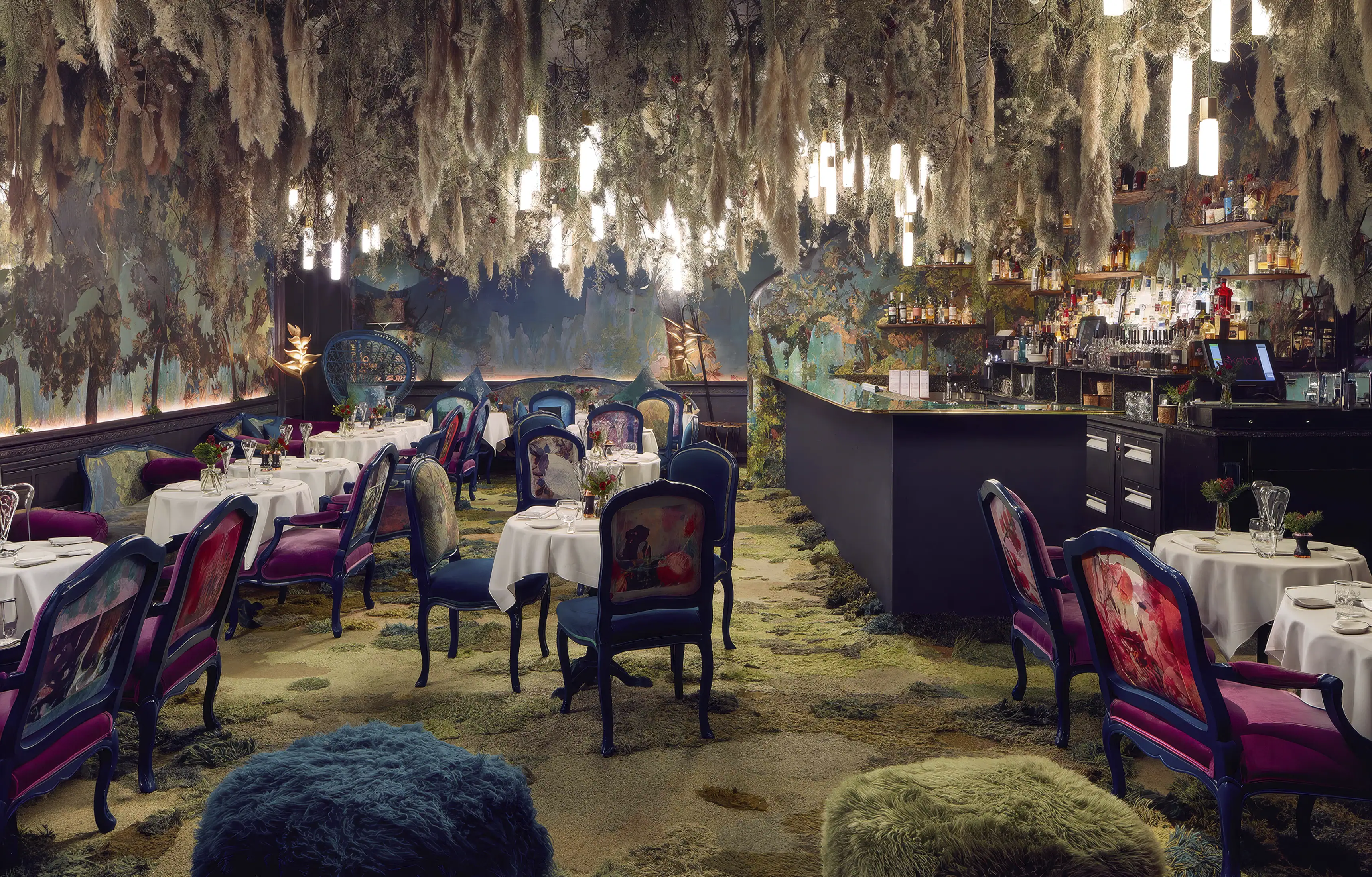
Reading time: 9 minFor six weeks over Christmas 2018, sketch’s Glade restaurant sat beneath a lighting fixture built to translate 60-million-year-old volcanic geology into sand-cast brass. Tala’s Basalt ceiling lights, newly launched and inspired by the hexagonal columns of the Giant’s Causeway, hung over conifer branches and clematis vines arranged by the florist Rebel Rebel, in an installation called Under the Mistletoe. It was one scene inside sketch’s wider Dulce Domum takeover, and it dressed a room that was already, permanently, a forest.
sketch, the Mayfair restaurant and gallery group at 9 Conduit Street, spent Christmas 2018 turning its ground-floor rooms into a set of festive tableaux under the collective title Dulce Domum, Latin for “sweet home.” Inside the Glade, one of the building’s five distinct public rooms, the brief went to two specialists working in entirely different materials: the lighting company Tala, showing its new Basalt ceiling light for the first time in a hospitality setting, and the florist Rebel Rebel, dressing the room in conifer branches, trailing clematis vines and other winter foliage. Together the pairing was billed as Under the Mistletoe, and it ran for the length of the restaurant’s six-week Christmas season.
The interest in this installation is not that a restaurant decorated a room for the holidays. It is what each collaborator brought to the brief. Tala’s Basalt light is not a generic pendant with a seasonal excuse; it is a fixture built around a specific geological process, and Under the Mistletoe was among the first places London could see it hanging over a table rather than sitting in a showroom. Rebel Rebel, founded by two former television professionals turned florists, works from a wild, naturalistic style rather than a formal one, which suited a room that had never been formal to begin with. And the Glade itself, quietly, was not a blank canvas. It was already a forest, built from paper rather than pine, and had been since long before Tala or Rebel Rebel arrived.

What Under the Mistletoe actually was
The installation combined two things: a light source and the material it lit. Tala’s Basalt ceiling fixture, a cluster of angular sand-cast brass pendants finished with mouth-blown, matte borosilicate glass diffusers, was suspended above the Glade’s dining tables. Beneath and around it, Rebel Rebel arranged conifer branches and clematis vines through the room’s existing canopy of decorative branches, working real, cut foliage into a permanent structure that already reads as woodland. The effect, in period coverage, was described as an “enchanted” scene: real winter greenery threaded through the Glade’s tree-like architecture, lit from above by a fixture whose own form echoes rock rather than foliage. Tala’s angular brass pendants and Rebel Rebel’s soft, trailing stems sat deliberately at odds with each other, mineral against organic, which is a more considered pairing than “Christmas lights and greenery” suggests on its own.

Tala’s Basalt light: from the Giant’s Causeway to sand-cast brass
Tala was founded in 2016 by three friends who met at the University of Edinburgh, among them Joshua Ward, who studied for an MSc in Carbon Management before turning to lighting design. The company’s founding argument was that energy-efficient lighting had been treated as a technical compromise rather than a design opportunity, and its early reputation was built on the Voronoi bulb, a spiralling LED filament designed to be the fixture rather than hide inside one. Basalt, launched in 2018, was Tala’s move from bulbs into architectural fixtures, and its origin is specific rather than decorative: the company’s design team visited the Giant’s Causeway on the coast of County Antrim in Northern Ireland, where roughly 40,000 interlocking basalt columns step down into the sea.
Those columns exist because of a genuinely dramatic piece of geology, and it is worth stating plainly, because it is the part of the story a listing for the light itself will not give you. Basalt is a fine-grained volcanic rock that forms as molten lava cools. When a thick lava flow cools slowly and evenly, the rock contracts and cracks in a strikingly regular pattern, most often into five- or six-sided columns, because a hexagonal fracture is the most efficient way for a cooling, contracting mass to relieve stress evenly in all directions. Do it slowly enough, over a large enough flow, and the result is a stepped, geometric coastline that looks engineered rather than natural, which is precisely why the Giant’s Causeway has drawn wonder, and folklore, for centuries. Tala’s designers translated that same logic into a manufacturing process rather than a decorative motif: solid brass is sand-cast into angular, faceted forms and given a mix of polished and dimensional textured surfaces, echoing the way natural fracture leaves some faces smooth and others rough. The pendants are designed to be combined, singly, in threes, or in clusters of nine, so that a single Basalt fixture can be scaled the way a real formation of columns scales, by repetition rather than by making one piece bigger. The glass diffusers are mouth-blown borosilicate, chosen so that no two are quite identical, in the same way that no two columns at the Causeway are quite identical either. Under the Mistletoe put a young company’s most architecturally ambitious fixture to date directly above a dining room, rather than in a photograph on a product page, within months of its launch.

Rebel Rebel: a florist built on New Covent Garden and a Norfolk flower farm
Rebel Rebel was founded in 2000 by Mairead Curtin and Athena Duncan, who left careers in television to set up a floral events company together. What began as a small operation has grown into an established London studio with a shop base in Tufnell Park, working across weddings, corporate events, and film and photography production as well as retail. The pair have described their guiding principle as a version of the florist Constance Spry’s own advice, to be original if you want to and not to be if you don’t want to be, which points to a practice built on instinct rather than a house formula.
That instinct shows in how Rebel Rebel sources material. Flowers and foliage come daily from New Covent Garden Flower Market in Nine Elms, supplemented by seasonal growers and by the studio’s own flower farm in Norfolk, with a sister operation, Rebel Rebel Italia, running a flower farm and summer school in Tuscany. For a winter installation, that sourcing model matters: conifer branches and clematis vines are not exotic imports dressed up for a photograph, they are the kind of seasonal, close-to-source material a studio with its own farm reaches for as a matter of course. Rebel Rebel’s naturalistic, slightly wild style, built up over two decades of events and production work rather than formal florist training alone, is what let the Glade’s Christmas dressing read as a real winter thicket rather than a shop display.

The Glade was already a forest
Here is the detail that most coverage of a single Christmas installation misses, because it requires looking at the room’s design history rather than just its Christmas dressing. The Glade is not a neutral dining room that sketch decorates from scratch every December. It is a permanent installation in its own right, created by the artist Carolyn Quartermaine with the designer Didier Mahieu, built as what has been described as an immersive, fairytale forest using découpage techniques: early twentieth-century botanical illustrations and printed papers, cut and assembled into intricate decorative compositions, with branches stretching across the walls and vintage rattan furniture running through the room. It is, in permanent form, a forest made of paper.
Under the Mistletoe therefore hung real conifer and clematis, lit by a fixture modelled on volcanic rock, inside a room whose walls were already a hand-cut forest of botanical paper. That is not a coincidence of scheduling; it is a deliberate layering. A room built entirely from the idea of a woodland, using découpage rather than living material, spent six weeks in 2018 with an actual, living woodland threaded through it, under a light fixture built from the geology of an actual place in Northern Ireland. Three different registers of “forest,” paper, brass and rock, and cut stems, sat in the same room at the same time, which is a more precise design idea than “Christmas decorations in a woodland-themed restaurant” suggests. It is the kind of connection that only shows up once you know what the room underneath the tinsel actually is.

Dulce Domum: the wider Christmas takeover
Under the Mistletoe was one of six scenes making up sketch’s 2018 Christmas programme, collectively titled Dulce Domum, which ran through the restaurant’s public rooms from 15 November 2018 to 6 January 2019. The Latin phrase translates as “sweet home,” and it also happens to share its title with a chapter of Kenneth Grahame’s The Wind in the Willows, in which Mole, homesick after adventures in the wider world, returns to find his own modest burrow decked out and welcoming. Whether or not that literary chapter was the specific reference behind sketch’s programme title, the resonance is a fitting one for a Christmas season built around bringing warmth, light and greenery indoors, room by room, rather than a single uniform theme repeated everywhere.
That approach, giving each room to a different collaborator working in a different material, is consistent with how sketch has approached Christmas, and its interiors generally, in the years since. The building’s rooms change hands regularly between designers, florists, artists and lighting studios, and a seasonal installation at sketch tends to behave less like decoration laid over a fixed backdrop and more like a short, specific commission handed to specialists who would not otherwise share a brief. Under the Mistletoe, pairing a two-year-old lighting company’s newest fixture with a two-decade-old floristry studio inside a two-decade-old découpage room, is a clear example of that pattern in miniature.

Final thoughts
It would be easy to describe Under the Mistletoe as a lighting brand and a florist decorating a restaurant for the holidays, and leave it there. That much is true, and it would still be worth knowing about: a young, design-led lighting company putting its most architecturally ambitious fixture yet directly above a dining table, and a florist with its own flower farm threading real winter growth through a room built for exactly that kind of material.
What makes it worth a longer look is what was already there before either collaborator arrived. Tala’s Basalt light is not an abstract geometric pendant; it is sand-cast brass built to carry the actual logic of how lava cools into hexagonal stone at a specific place on the Antrim coast. Rebel Rebel’s foliage is not generic greenery; it comes from a supply chain the studio has spent two decades building, down to its own farm. And the Glade is not a neutral room that gets dressed and undressed every December; it is a permanent découpage forest, built by Carolyn Quartermaine and Didier Mahieu, that had real branches and real light hung through it for six weeks in 2018.
That is the argument Under the Mistletoe makes, whether or not anyone writing about it at the time set out to make it: a Christmas installation is only as interesting as the room, the maker and the material it is built from, and in the Glade in 2018, all three had a genuine story behind them.
What was sketch’s “Under the Mistletoe” installation?
It was the name given to sketch London’s Christmas 2018 dressing of the Glade restaurant, combining Tala’s newly launched Basalt ceiling lights with winter foliage, including conifer branches and clematis vines, arranged by the florist Rebel Rebel.
When did Under the Mistletoe run?
It ran for sketch’s 2018 Christmas season, part of the wider Dulce Domum programme across the restaurant’s public rooms from 15 November 2018 to 6 January 2019.
What is Tala’s Basalt light made from and what inspired it?
Basalt is made from sand-cast, hand-finished solid brass paired with mouth-blown matte borosilicate glass diffusers. Tala’s design team based the collection on the hexagonal basalt columns of the Giant’s Causeway in Northern Ireland, translating the geometry created when cooling lava cracks into stone into an angular, modular pendant system.
Who is Rebel Rebel?
Rebel Rebel is a London floristry studio founded in 2000 by Mairead Curtin and Athena Duncan, based in Tufnell Park and sourcing daily from New Covent Garden Flower Market and its own Norfolk flower farm. The studio works across weddings, events, film and photography production.
Who designed the Glade at sketch?
The Glade’s permanent interior was created by the artist Carolyn Quartermaine with the designer Didier Mahieu, built from découpage, botanical illustrations and vintage papers cut and assembled to form a fairytale forest, furnished with vintage rattan pieces.
What does “Dulce Domum” mean?
It is Latin for “sweet home.” The phrase also titles a chapter of Kenneth Grahame’s The Wind in the Willows, in which a homesick character returns to a decorated, welcoming home, a resonance that suits a Christmas programme built around bringing warmth and greenery into sketch’s rooms.


Leave a Reply