
ART & CULTURE · VENICE
Reading time: 9 minUffe Isolotto filled the Danish Pavilion with a family of hyperrealistic centaurs and let the building’s own split personality do half the storytelling. The pavilion has been two structures fused into one since 1960, a grand 1930s exhibition hall grafted onto an extension built to feel like an actual house, and Isolotto staged his transhuman farmhouse story inside exactly that seam. Built from silicone, blown glass, real eelgrass and horse manure, We Walked the Earth became the most discussed single work of the 2022 Venice Biennale, and it never once tells the visitor whether what they are looking at is a birth or an ending.
We Walked the Earth was Denmark’s contribution to Biennale Arte 2022, the 59th International Art Exhibition in Venice, staged in the Danish Pavilion in the Giardini from 23 April to 27 November 2022. It was commissioned by the Danish Arts Foundation, curated by Jacob Lillemose, and made by the artist Uffe Isolotto, who transformed the entire building into the home of a family of centaurs at the precise moment something has gone badly wrong inside it.
The Biennale that year was titled The Milk of Dreams, curated by Cecilia Alemani, and took its name from a book of fantastical creatures by the surrealist artist Leonora Carrington. Isolotto’s pavilion sat comfortably inside that brief without needing much translation: a species that has rebuilt itself, biologically and mechanically, until it can no longer be sure what it is.
What made the installation land, beyond the shock of the imagery itself, was how precisely it was built. Isolotto did not sculpt two centaurs and place them in a white room. He assembled a production team spanning special-effects modelling, taxidermy, glass-blowing, fashion and scenic painting, and used every one of the pavilion’s existing rooms, then rebuilt those rooms as a working farmstead that had tipped into something else. The physical craft is the argument. The rest of this piece is about how it was made, who made it, and the one detail in the pavilion’s own history that explains why Isolotto’s story fits the building as well as it does.
A farmhouse for a family that is no longer entirely human
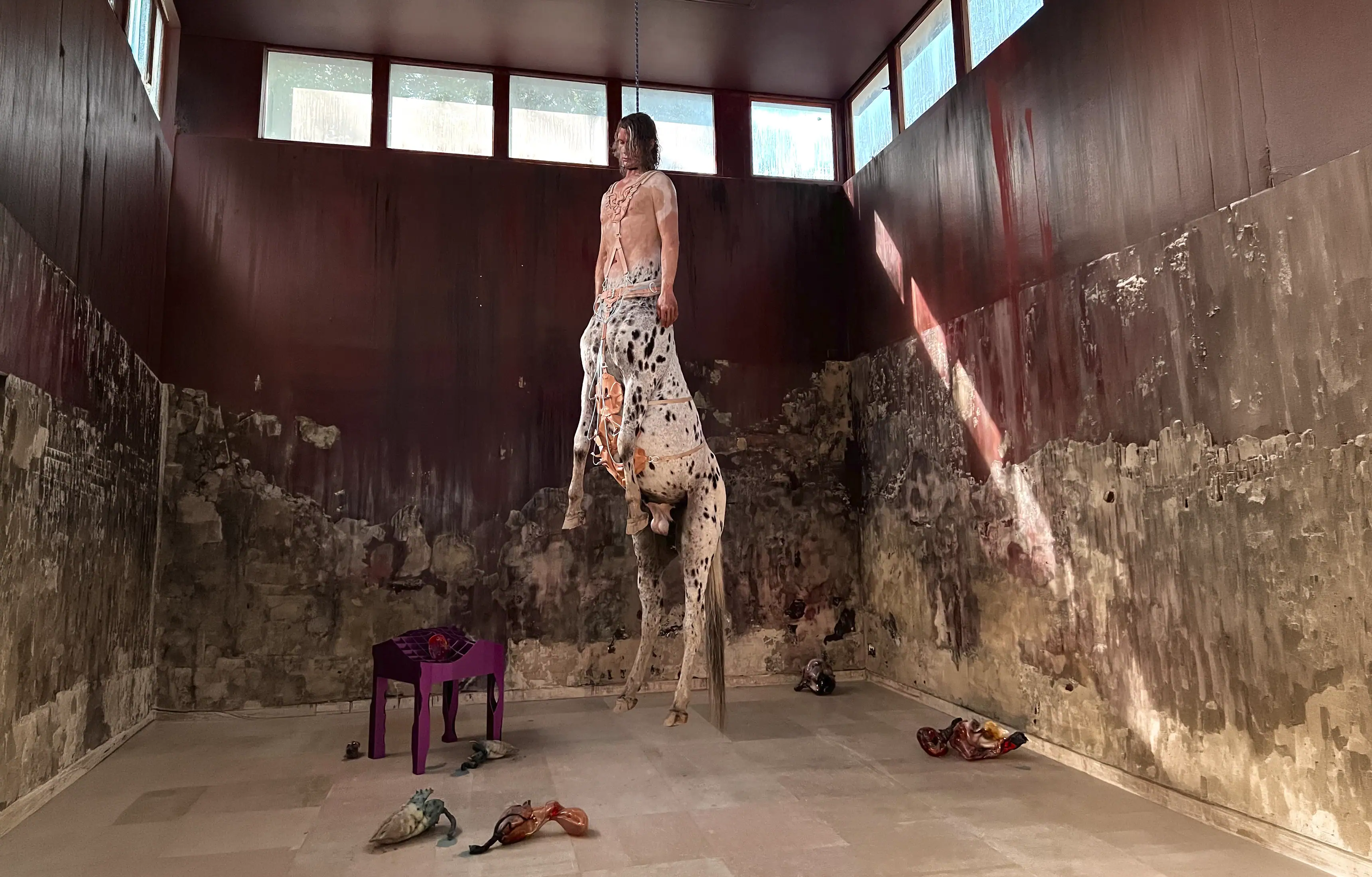
Visitors to the pavilion in 2022 did not walk into a gallery. They walked into a threshold: a heap of horse manure and a small area paved with field stones sat just past the entrance, and eelgrass, the coarse marine grass Danish farmers once dried and packed onto roofs as insulation, was worked through the spaces beyond it. Further in, the rooms held the debris of a working smallholding pushed slightly out of true: tools that resembled traditional Danish farming and fishing implements but had been reshaped for a body that was not quite human, and a mutated ham hanging from a beam. Small sculptures of unfamiliar crops sat around the installation, oozing a bright blue fluid that ran through tubes into the centaurs themselves, standing in at once as nourishment, medication and heating.
The narrative peaked across two rooms. In one, an adult male centaur hangs by a chain from the ceiling, lifeless, above the pool of mutated crops. In the other, an adult female centaur lies on the floor of what reads as a domestic room, in the act of giving birth, the newborn’s small hands already carrying an unfamiliar, faintly human cast. Isolotto has deliberately withheld an explanation for what has happened between the two rooms, and has said as much directly: “something has to die for something to be born.” He has resisted going further than that. The installation is built to hold death and birth, catastrophe and continuation, in the same building at the same time, and to let the visitor decide which reading they are willing to carry out with them.

Uffe Isolotto, the poet who became a sculptor of hybrid bodies
Uffe Isolotto, born in 1976, is a graduate of the Royal Danish Academy of Fine Arts in Copenhagen, where he completed his training in 2007. He came to visual art by way of poetry, and his earliest exhibited work leaned on the digital tools of his generation: Photoshop drawings printed onto foam board formed part of his original art school application, before he moved away from flat graphic work toward the spatial, sculptural and video-based practice that runs through everything he has made since.
Before Venice, Isolotto ran Age of Aquarius, a project space and exhibition programme on the roof of his own building in Copenhagen, developed with his wife, the artist and curator Nanna Starck. It gave him a working laboratory for the ideas that eventually filled the Danish Pavilion: biological, synthetic and digital ecosystems, staged as installation rather than argued as theory. Isolotto has described his method for a project of this scale as directorial rather than solitary, working with what he calls a diverse team including fashion designers, special-effects make-up artists, glass artists, graphic artists and model makers, each contributing a specific craft to a single environment.
That team, credited in full for We Walked the Earth, included 10 Tons for the centaur modelling, Thomas Foldberg Studio for the humanoid elements, Fyns Naturværksted for taxidermy, the fashion designer Anne Sofie Madsen for clothing and accessories, Soft Baroque, Maria Koshenkova and Ida Hy for sculptural and glass elements including blown-glass forms built to read as internal organs, Christine Bechameil and Marie Søegaard Tarpø for scenic painting, and Line-Gry Hørup for graphic design. For the sensory register of the farmstead itself, Isolotto drew on Frilandsmuseet, the open-air museum of historic Danish rural buildings outside Copenhagen, working from its smells, light and atmosphere rather than from photographs of it.

A pavilion that was already living a double life
The detail that makes We Walked the Earth more than a strong sculptural installation is the building it was made for. The Danish Pavilion in the Giardini was designed by the architect Carl Brummer and built between 1930 and 1932, a formal, top-lit exhibition hall in the classic Giardini mould. In 1958, the architect Peter Koch was commissioned to restore and extend it, completing the work in 1960 with an addition that departs deliberately from Brummer’s grander register. Where the original hall reads as civic and ceremonial, Koch’s extension is domestic in scale and feeling, closer to a private house than a national exhibition space.
Isolotto has spoken about the pavilion in exactly those terms, describing it as “a grandiose building from the 1930s with a 1960s extension that is rather reminiscent of a typical detached family home,” and setting out to use that architectural doubleness rather than smooth it over. It is a genuinely useful thing to know before reading the rest of the installation, because it means the pavilion was not a neutral container Isolotto dressed as a farmhouse. It already had the shape of two eras welded together, one formal and one domestic, and he built a story about a family caught between two states of being directly into a building already caught between two states of itself. The architecture and the artwork are, for once, making the same argument from opposite directions.
There is a second thread worth pulling, from Isolotto’s own working history rather than the building’s. For years he worked out of a Copenhagen studio previously used for three decades by the Danish sculptor Anne Marie Carl-Nielsen, who grew up on a farm, began sculpting animals as a child, and is best known for an equestrian statue of King Christian IX. It is not a detail either the pavilion’s own materials or the wider Biennale press coverage draws attention to, and Isolotto has not framed We Walked the Earth as a direct response to it. But the coincidence is exact: a farm childhood, an early instinct for animal form, and a monumental horse-and-rider sculpture, sitting in the working history of the same studio Isolotto later occupied, years before he filled a national pavilion with farm buildings and horse-bodied figures of his own.

What curator Jacob Lillemose asked the pavilion to do
Jacob Lillemose holds a doctorate in art history from the University of Copenhagen and has built a curatorial career around bringing contemporary art into direct contact with technology, science and other fields it does not usually sit alongside, including through X AND BEYOND, the exhibition framework he founded. That focus is precisely what he brought to the Danish Pavilion brief: rather than curate a survey of Isolotto’s work, he backed a single, total environment and used his own framing to sharpen the question the installation asks rather than answer it.
Lillemose set the pavilion’s premise as directly as an exhibition text usually allows. A family of three, centaurs, in a strange hybrid time period that folds the historical past of Danish farm life into the sci-fi future of a trans-human world. Visitors enter their home and move through the rooms holding their belongings, food and working tools, encountering a story that is deliberately withheld rather than explained. The pavilion asks whether the family’s situation is tragic or hopeful, or both, and whether the answer says more about them or about the visitor reading it. It is, in Lillemose’s own framing, a question about where a species under pressure looks for its next move: back toward who it was, or forward into what it might become.
The craft that makes the ambiguity work
None of this would have carried the weight it did in Venice without the specificity of the making. The centaurs themselves were built to hyperrealistic standard in silicone and resin over aluminium armatures, the kind of full-body model-making more usually associated with film special effects than a national pavilion, developed with 10 Tons and Thomas Foldberg Studio to survive close, sustained scrutiny from visitors standing inches away. Taxidermy work, real field stones, real horse manure and real eelgrass sat alongside the fabricated bodies rather than being simulated, which is part of why the installation reads as a place rather than a display. Isolotto has been clear that the ambiguity is a considered choice rather than a gap in the storytelling: “even though the centaurs might not be real, we feel the centaurs’ struggle,” he has said, and the craft is precisely what makes that feeling possible. A less exact set of bodies would have read as costume. This read as consequence.

Final thoughts
It would be easy to describe We Walked the Earth as a shock installation, a pair of striking creature sculptures built to make Venice stop and photograph something. That undersells everything that actually happened in the Danish Pavilion in 2022. The centaurs are the headline image, but the installation’s real achievement is architectural and narrative discipline: an artist who used a farmstead’s worth of specific, real materials, a production team built like a film crew, and a curatorial brief built entirely around restraint, to fill an entire national pavilion with one continuous, unresolved story.
The building helped. Carl Brummer’s formal 1930s hall and Peter Koch’s domestic 1960s extension gave Isolotto a structure that was already asking the question his artwork asks, a place built in two registers, one grand and one intimate, that had to be reconciled into a single pavilion. He built a family caught between two states of being into a building already caught between two states of itself, and let the architecture and the sculpture argue the same point from either side.
What the installation gave its visitors, ultimately, was permission to sit with a question rather than resolve it. Is a species that has remade itself past recognition looking backward for shelter or forward for escape? We Walked the Earth never says. It builds the farmhouse, hangs the chain, sets the birth in motion, and leaves the rest of the sentence to the person standing in the room.
What is We Walked the Earth?
We Walked the Earth is the installation artist Uffe Isolotto made for the Danish Pavilion at the 2022 Venice Biennale, transforming the whole building into the farmhouse home of a family of hyperrealistic centaurs.
Who made We Walked the Earth?
It was made by the Danish artist Uffe Isolotto, curated by Jacob Lillemose and commissioned by the Danish Arts Foundation, with a production team spanning special-effects modelling, taxidermy, glass-blowing, fashion and scenic painting.
Where is the Danish Pavilion and who designed it?
The Danish Pavilion stands in the Giardini in Venice. It was designed by the architect Carl Brummer and built between 1930 and 1932, then restored and extended by the architect Peter Koch between 1958 and 1960.
What materials did Isolotto use for the centaurs?
The centaur figures were built in silicone and resin over aluminium armatures, alongside real field stones, eelgrass, horse manure and taxidermy elements, with blown-glass sculptures standing in for internal organs.
What actually happens in the installation?
An adult male centaur hangs lifeless from a chain in one room while an adult female centaur gives birth on the floor of another, with mutated farm tools and crops running through the rooms between them. Isolotto has deliberately left the connection between the two scenes unexplained.
Can I still see We Walked the Earth?
No. The installation was staged for the duration of Biennale Arte 2022 and closed with the Biennale on 27 November 2022. It was built specifically for that edition of the Danish Pavilion and was not intended to travel.
What was the theme of the 2022 Venice Biennale?
Biennale Arte 2022 was titled The Milk of Dreams, curated by Cecilia Alemani, taking its name from a book by the surrealist artist Leonora Carrington.
Who curated the Danish Pavilion in 2022?
Jacob Lillemose, an independent curator with a doctorate in art history from the University of Copenhagen and the founder of the exhibition framework X AND BEYOND, curated We Walked the Earth for the Danish Arts Foundation.


Leave a Reply