
ART & CULTURE · MIAMI
Reading time: 10 minFive day-glo boulders, up to thirty tons of Nevada limestone apiece, and a steel spine hidden inside to hold them against hurricane winds: Ugo Rondinone’s Miami Mountain has stood at the corner of 21st Street and Collins Avenue since 2016, the first work in his mountain series a museum bought outright rather than borrowed. Its desert sibling, Seven Magic Mountains, keeps having its temporary licence in Nevada renewed. Miami Mountain was built never to need one. In 2019, the Argentine artist Marcela Sinclair took its exact palette and handed it back to the public, rock by rock.
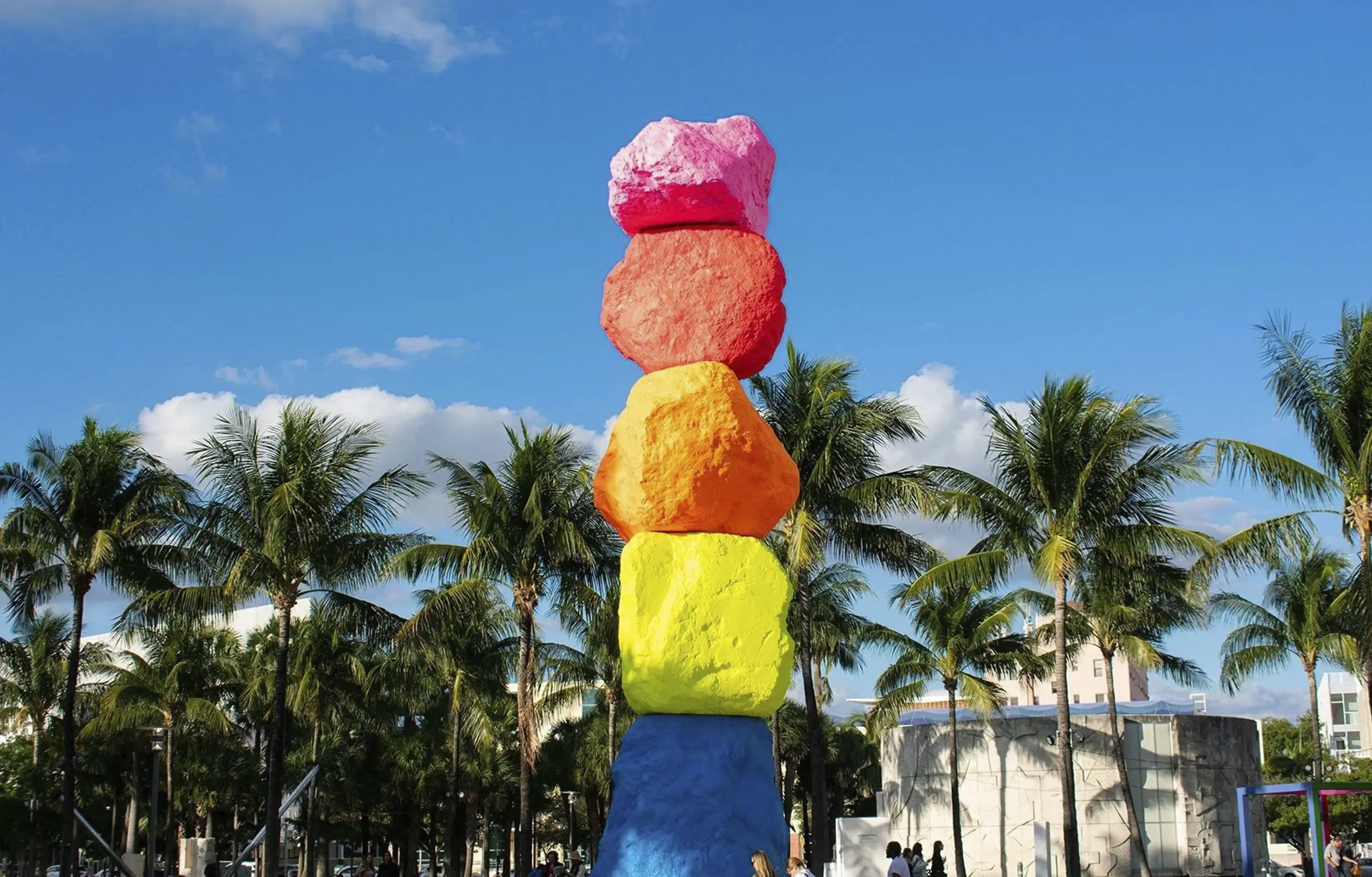
Collins Park sits behind the Bass Museum of Art, a short walk from the Miami Beach boardwalk, and for most of the year it reads as a fairly ordinary green space: palms, gravel paths, a scatter of benches. Then the eye reaches the corner of 21st Street and Collins Avenue, and the ordinary stops. Five boulders, each painted a different fluorescent colour, stand stacked forty one feet into the air, cantilevered over one another as if a light breeze might send the whole thing over.
It will not. The sculpture is Miami Mountain, made by the Swiss artist Ugo Rondinone and unveiled on 30 November 2016, during that year’s Art Basel Miami Beach. The Bass acquired it outright through the John and Johanna Bass Acquisition Fund, making it the first work in Rondinone’s mountain series that any museum has owned rather than simply hosted. Nearly a decade on, it remains the only sculpture of its kind built with permanence, rather than a fair’s calendar, in mind.
That distinction is the argument of this piece. Rondinone’s stacked, painted boulders are best known from Seven Magic Mountains, the installation in the Nevada desert that made his name internationally and that keeps being granted new leases on a life that was never meant to be permanent. Miami Mountain took the same visual language and planted it somewhere with no expiry date at all. Three years after it went up, a second artist, Marcela Sinclair, arrived in the same park with a smaller, participatory answer to it, and in doing so tied Miami Mountain to a wider cultural exchange between Miami and Buenos Aires that most accounts of the sculpture leave out entirely.

Five boulders and a hidden spine
Miami Mountain is built from five limestone boulders, quarried in Nevada, each weighing somewhere between fifteen and thirty tons. They are stacked in the manner of a cairn, the oldest and simplest of human gestures for marking a place, and then painted individually in saturated, fluorescent colour: no two boulders share a hue, and none of them relates to the colour of stone at all. The effect from a distance is closer to a stack of enormous sweets than to rock.
What holds the stack together is not visible from the ground. A steel core runs through the centre of the sculpture, engineered to keep five loosely balanced tons of stone standing through South Florida’s hurricane season, while staying entirely hidden inside the boulders themselves. The illusion the sculpture depends on, of stone simply resting on stone the way it would in a natural rock formation, only works because the engineering that makes it possible is nowhere to be seen. Rondinone has described the effect directly: in Miami Mountain, he has said, you cannot tell whether you are looking at natural material or something closer to Styrofoam. That uncertainty is not a side effect. It is the point.
The stacking itself borrows from a specific geological reference: hoodoos, the tall, irregular rock columns that form in the badlands and canyon country of the American West, most famously at Bryce Canyon, where centuries of frost and rain wear vertical spires out of soft, layered stone. Rondinone’s boulders are cut and placed by hand rather than shaped by weather, but the top-heavy, precarious profile is a deliberate echo of that natural process, translated from something that takes millennia into something installed in a matter of weeks.

From the Nevada desert to a Miami Beach park
Miami Mountain did not arrive in isolation. Six months before it went up in Collins Park, Rondinone had unveiled Seven Magic Mountains, an installation of thirty three boulders arranged into seven towers, thirty to thirty five feet tall, standing in the Ivanpah Valley south of Las Vegas near Jean Dry Lake. That project was produced jointly by the Nevada Museum of Art and the Art Production Fund, backed by Aria Resort and Casino and International Game Technology on a budget of around 3.5 million US dollars, and installed on land secured under a Bureau of Land Management right-of-way permit that itself took roughly a fifth of the project’s budget to negotiate.
Seven Magic Mountains was conceived as a two-year exhibition, due to close at the end of 2018. It did not close. The installation has since been granted a series of extensions and now stands under a right-of-way that runs to May 2027, more than eight years beyond its original closing date, a testament to how firmly it took hold of the Nevada desert’s public imagination.
Miami Mountain took the same visual grammar, a smaller number of boulders in the same fluorescent register, and set it down somewhere that never had a closing date to begin with. Where Seven Magic Mountains asks a visitor to make a pilgrimage into the desert along Interstate 15, arriving at the sculpture as the culmination of a journey, Miami Mountain sits in a city park that people already pass through on the way to somewhere else. Silvia Karman Cubiñá, The Bass’s executive director, has described the contrast precisely: in Nevada, she has said, the encounter is a special art pilgrimage with a spiritual quality; in Miami Beach, it begins as casual surprise and moves toward awe. The two works make the same formal argument in two entirely different registers of arrival.
There is a second reversal built into the material itself. Rondinone’s Human Nature, the nine bluestone figures he installed at Rockefeller Center in 2013, took raw, unpainted stone and set it down in one of the most artificial urban settings in the world, a paved plaza ringed by skyscrapers. Miami Mountain does the opposite. Painted in colours that occur nowhere in geology, it takes stone that would otherwise read as entirely natural and installs it in a genuine park, surrounded by grass and palms, and makes it look synthetic instead. Rondinone has spent much of his career moving material back and forth across that boundary between the natural and the artificial. Miami Mountain is one of the clearest demonstrations of how he does it.

The maker
Ugo Rondinone was born on 30 November 1964 in Brunnen, Switzerland, and studied at the University of Applied Arts Vienna between 1986 and 1990. He moved to New York in the late 1990s and has lived and worked there since, building a practice that runs across painting, sculpture, photography, video and large-scale public installation, frequently returning to the same handful of motifs: mountains, clouds, trees, the sun and moon, the human figure at rest. He represented Switzerland at the Venice Biennale in 2007, and his public sculptures, Human Nature at Rockefeller Center among them, have been seen by tens of millions of passers-by who never set foot inside a gallery.
Miami Mountain sits inside that wider body of work as the piece that made the mountain motif permanent for the first time. Rondinone returned to it again in the winter of 2024 and 2025, at the opposite end of both his career and his palette, with the rainbow body at the Aspen Art Museum, an exhibition built around thirteen luminous wax dancers rather than boulders, but carrying the same interest in transformation, colour and the point where solid matter dissolves into something else. Seen alongside Miami Mountain, it makes the case that Rondinone’s mountains were never really about geology. They were about what happens when something as fixed as stone is made to behave like light.
Marcela Sinclair’s answer, in five cubic metres
In December 2019, during Miami Art Week, the Argentine artist Marcela Sinclair installed Derrame, Spanish for spill, directly around the base of Miami Mountain. Sinclair, born in Buenos Aires in 1968 and a first-prize winner in sculpture from Argentina’s Fondo Nacional de las Artes in 2017, works across drawing, painting, photography and site-specific installation, and has built much of her practice around public space as a place where community gets built and conflict gets exposed rather than avoided.
Derrame took roughly five cubic metres of river rocks, each between two and fourteen centimetres across, and painted them in the exact fluorescent palette Rondinone had used on Miami Mountain’s five boulders, then spread them across the ground around the sculpture’s base. Where Miami Mountain is fixed, permanent and far too heavy for anyone to touch, Derrame was designed to be handled. Visitors were invited to pick the small stones up, restack them, regroup them, and build their own versions of the monument standing above them, at whatever scale their hands allowed.
The effect is a genuine formal argument rather than a gimmick. Sinclair took Rondinone’s palette, the one fixed, unchangeable element of his sculpture, and made it the one thing in her own piece that anybody could rearrange. Miami Mountain proposes a single, permanent cairn. Derrame proposes that everyone who visits gets to build one of their own, and that no two versions need to look the same.

The Buenos Aires connection few accounts mention
Derrame was not an independent response staged alongside Rondinone’s sculpture. It was one of six works in Disruptions, a public art exhibition that Art Basel Cities brought to Collins Park for Miami Art Week 2019, curated by Diana Wechsler and Florencia Battiti and selected through Buenos Aires’s Ministry of Culture. Buenos Aires had been named Art Basel Cities’ first partner city the previous year, and Disruptions was one of the results of that multi-year cultural partnership: six Argentine artists given a single Miami Beach park as a shared, temporary canvas.
Alongside Sinclair, the exhibition included Graciela Hasper’s interactive colour-traced sculptures, Marie Orensanz’s corten steel keyhole piece exploring language, Pablo Reinoso’s dead tree trunk fitted with steel branches, Agustina Woodgate’s fountains carved from local oolite limestone, and Matías Duville’s planted steel pipework. Sinclair’s Derrame was the only one of the six built in direct conversation with a work already standing in the park. Buenos Aires’s contemporary art scene arrived in Collins Park for a single Miami Art Week, made its most direct statement through the sculpture already rooted there, and then, in the case of the smaller rocks at least, left with whoever picked one up.
What Collins Park now holds
Almost a decade after it went up, Miami Mountain has become one of the more reliable orientation points in Miami Beach’s museum district. It sits close enough to the Bass Museum of Art, the Miami City Ballet and the Miami Beach Regional Library that a visitor arriving from any direction is likely to see the boulders before they see the buildings around them, and it does that job without needing a wayfinding sign. The colour does the work instead.
That is, in the end, what a permanent acquisition allows that a temporary installation cannot: the chance to become a fixture of a place’s daily geography rather than a season’s talking point. Seven Magic Mountains draws visitors out into the desert for the length of a permit. Miami Mountain simply waits in the park, for as long as the park exists, for whoever happens to walk past.

Final thoughts
It is tempting to describe Miami Mountain as the smaller, calmer cousin of Seven Magic Mountains, a Miami footnote to a Nevada headline. That undersells what actually happened. Rondinone built the Nevada installation first and let it become a desert pilgrimage; he built the Miami version second and gave it something the desert piece has never had, an acquisition, a deed, a place in a museum’s permanent collection with no clock running against it.
That permanence is what let Marcela Sinclair’s Derrame work as well as it did three years later. A temporary installation responding to another temporary installation would have been a passing gesture, gone with the rest of Miami Art Week’s December calendar. Because Miami Mountain was never going anywhere, Sinclair’s smaller rocks could treat it as a fixed point to orbit, take its exact palette, and hand the one part of the sculpture that could be handled back to whoever happened to be standing in the park that week.
Rondinone has spent thirty years moving the same handful of images, mountains, clouds, dancers, light, in and out of stone, wax, bronze and glass. Miami Mountain is the version that decided to stay still. Everything since, from the desert extensions to the rainbow-coloured dancers in Aspen, has been Rondinone finding new ways to ask what happens when something fixed starts to feel like it might, one day, move.
Miami Mountain
What is Miami Mountain?
Miami Mountain is a permanent public sculpture by the Swiss artist Ugo Rondinone, made from five stacked, fluorescently painted Nevada limestone boulders standing around forty one feet tall.
Where is Miami Mountain located?
It stands in Collins Park, Miami Beach, at the corner of 21st Street and Collins Avenue, immediately adjacent to the Bass Museum of Art.
When was Miami Mountain installed?
It was unveiled on 30 November 2016, during that year’s Art Basel Miami Beach, and was acquired outright by The Bass through the John and Johanna Bass Acquisition Fund.
What is Miami Mountain made of?
Five limestone boulders quarried in Nevada, each weighing between fifteen and thirty tons, painted individually in fluorescent colour and held together by a hidden internal steel spine.
How does Miami Mountain relate to Seven Magic Mountains?
Seven Magic Mountains, installed six months earlier near Las Vegas, uses the same visual language across thirty three boulders arranged in seven towers. Miami Mountain adapted that language into a single, permanent sculpture, while Seven Magic Mountains remains a temporary installation that has had its licence repeatedly extended, most recently to May 2027.
What is Derrame, and who made it?
Derrame, Spanish for spill, is a 2019 installation by the Argentine artist Marcela Sinclair, made from around five cubic metres of small river rocks painted to match Miami Mountain’s colours and left for visitors to rearrange by hand.
Was Derrame an official companion piece?
Yes. It was one of six works by Argentine artists in Disruptions, a Miami Art Week 2019 exhibition curated by Diana Wechsler and Florencia Battiti as part of Art Basel Cities’ partnership with Buenos Aires, and it was the only one of the six built in direct dialogue with an existing sculpture in the park.
Can visitors touch Miami Mountain?
Miami Mountain itself is a fixed, permanent sculpture not intended for touching or climbing. Sinclair’s smaller companion rocks, when installed, were the element of the project designed for public handling.


Leave a Reply