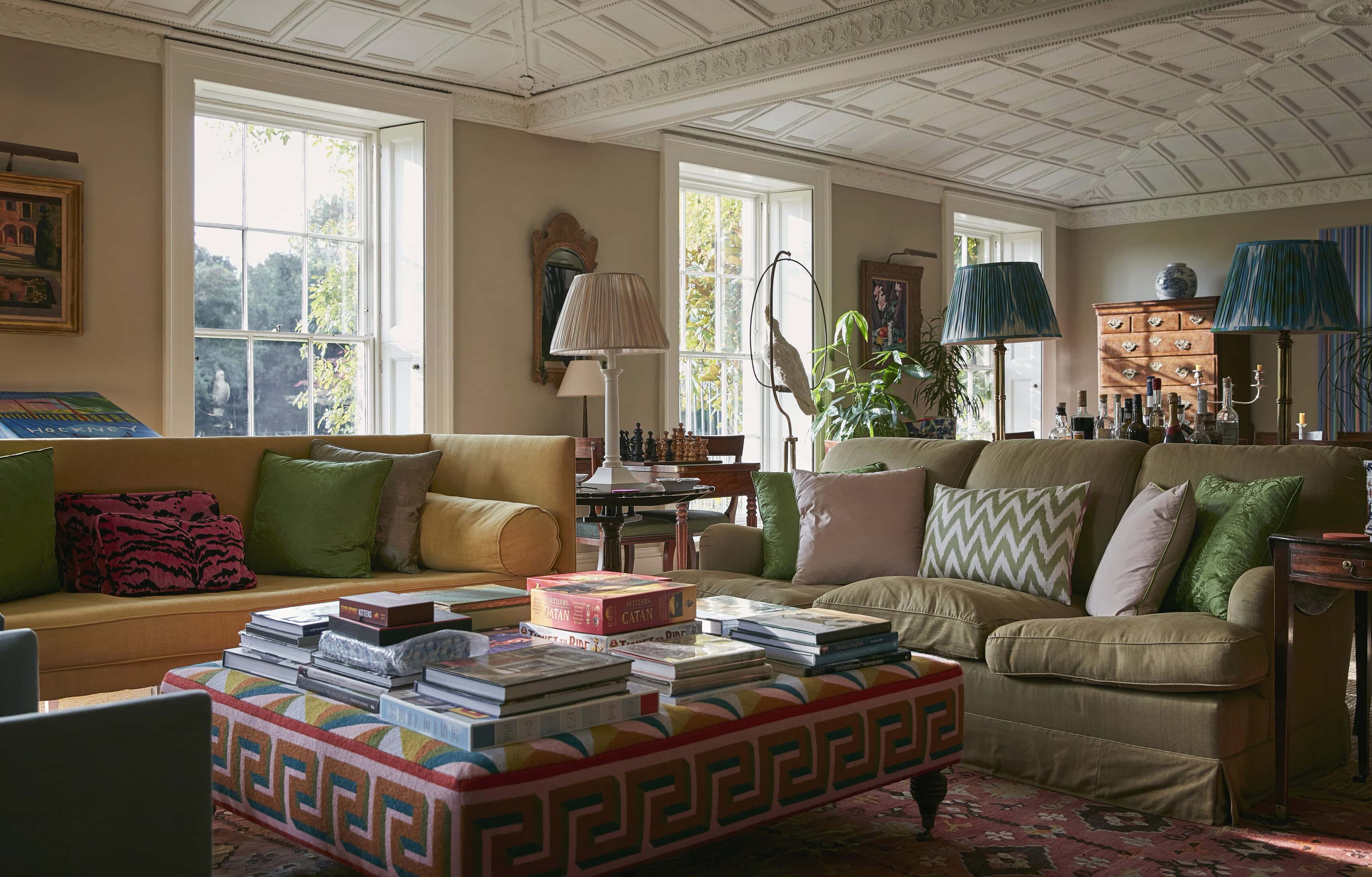
Thirty volumes in, the Andrew Martin Interior Design Review has stopped being an annual and become an archive. Volume 30 runs to 512 pages and more than 1,200 photographs, crowns Ben Pentreath as the thirtieth International Interior Designer of the Year, and is best read as the control sample against every other book on this shelf.
The Andrew Martin Interior Design Review is not a book you read. It is a book you count. Volume 30 runs to 512 pages and more than 1,200 photographs, gathering a hundred designers into one object, and it has been doing exactly that once a year since 1996. Taken on its own it is an annual. Taken as a run it is the longest continuous photographic survey of what the world has considered a good room, and that is the only way to read it properly.

What thirty volumes actually record
Martin Waller started the award and the book together, on the principle that a designer anywhere should be able to be discovered by everyone. The book is the award’s evidence: the Top 100 each year, photographed, captioned and bound.
Stack the spines and something becomes visible that no single volume shows. Nineteen nineties London is in there, and so is the beige decade, the grey decade, the return of pattern, the moment brown furniture came back, the arrival of Chinese practices at scale in the 2010s, and the current appetite for saturated colour and visible craft. None of that was a thesis anybody set out to prove. It is the by-product of asking the same question every year for thirty years and photographing the answers. The Decoration of Houses made the same bet from the other end, arguing in 1897 that proportion would outlast fashion.

That is the real argument for the Review as a reference. Design annuals usually date badly because they are trying to be current. This one has run long enough that dating is the point.
How to read Volume 30
Start at the back. The index of designers tells you where the practices are, and the geography is the first surprise: this is a British book with a membership that long ago stopped being British. Waller was an early and persistent advocate for Chinese interior design, and the relationship with the China Institute of Interior Design has put a generation of practices in front of a Western readership who would not otherwise have seen them.
Then read a spread rather than a page. The format gives most projects a double-page opening and then a run of detail shots, which means you can see the decision and then the execution. Cover the caption with your hand and try to date the room. You will be out by a decade more often than you expect, which is the most useful thing the book does.

Lastly, look at what the hundred have in common in a given year rather than what makes each distinctive. The Review is the fastest way to see a consensus forming.
The thirtieth hundred
Volume 30 places emerging British names including Jo Bee and Charlotte Stuart Interiors alongside Gregory Mellor, Fox Browne, Zeynep Fadillioglu, Chang Ching-Ping and Aline Asmar d’Amman, with Sophie Ashby, Helen Green, Katharine Pooley, Rebecca Hughes, Joanna Wood, Taylor Howes, Muza Lab and Sophie Paterson. The cover carries a project by Gregory Mellor, who took the award in 2023. Aline Asmar d’Amman’s contribution this year is a train interior, which tells you something about how loosely the category of an interior is now drawn.

The thirtieth award goes to Ben Pentreath, the British architect and designer whose Bloomsbury practice draws towns, buildings and interiors in the same office. He will be presented with it at the Victoria and Albert Museum on 22 October 2026. There is a fuller piece on Ben Pentreath, the thirtieth winner and what his studio actually does.

The panel is the editorial position
The Review has no critic. What it has instead is a judging panel drawn almost entirely from outside the design trade. Over thirty years that has included Stanley Tucci, Ronnie Wood, Jo Malone, Anya Hindmarch, Darcey Bussell, Terry O’Neill, Gordon Ramsay, Richard E. Grant, Rob Brydon, Twiggy, Tim Rice, Thandiwe Newton, Sebastian Coe, Kelly Jones, Dominic West and Felicity Blunt.
Put like that it sounds like a guest list. Read the book and it starts to look like a method. A room specified by a designer is judged by designers in almost every other award in the industry, which produces a particular kind of winner: technically impressive, legible to peers, often quite hard to live in. A panel of people who are very good at something else entirely judges on a different axis. They are reading the room as occupants.

That explains a great deal about which projects end up in these pages, and why the run stays readable thirty years later while a lot of trade-judged archives do not.

The industry the book has been recording
There is a figure in the thirtieth anniversary material worth holding on to. Over the same three decades the book has been running, the UK interiors market has roughly doubled in nominal terms, from somewhere around nine and a half billion pounds in 1996 to a Mintel valuation of about nineteen and a half billion today. There are now approximately twenty thousand interior designers working in Britain.
Those numbers are the context for everything in the book. A doubled market across thirty years is, in real terms, something closer to flat, and the shape underneath it has changed completely: a polarised landscape where committed buyers spend heavily on fewer, better things while the volume end has migrated to second-hand and circular platforms. Both halves of that are visible in the Review if you know to look. The projects get more specific, more handmade and more expensive at the top, while the idea of a room assembled entirely from new goods quietly disappears.

Where it sits on the shelf
Everything else on this shelf is a book with an argument. Wharton wants proportion over ornament, Tanizaki wants shadow over light, Venturi and Scott Brown want the ordinary taken seriously, Rams wants less and better, Zumthor wants atmosphere treated as a material. Each of them is trying to change how you look.
The Review does none of that. It is the control sample: a very large, very consistent record of what the trade actually produced, year after year, with nobody editorialising over the top of it. Which makes it the book to read against the others. Take an argument from one of them, then open thirty years of evidence and see whether the profession agreed. Usually it half did, a decade late, and for reasons nobody wrote down.
That is a slower kind of reading than the rest of the shelf asks for, and it is the only one here that gets better the more volumes of it you own.

What the book teaches you to see
Pick any volume and the same lesson is available. A photographed room is an argument about where to stand.
Every project in the Review has been shot from a position its designer chose, usually with the furniture adjusted and the flowers brought in that morning. Reading thirty years of that, you start to notice the staging rather than the room: the sightline that resolves, the one corner that is never shown, the way a hallway is almost always photographed towards the light. Once you can see it in the book, you can see it in a magazine, in a listing photograph, and eventually in a room you are standing in.

That is a more useful skill than any individual scheme in the book, and it is the thing you only get from a long run.
Where to find it
Volume 30 was published internationally by teNeues on 24 September 2026 with Martin Waller as author and co-editor, and arrives in the United States on 17 November 2026. It launches in London during Focus at the Design Centre, Chelsea Harbour, the building that also hosts WOW!house, and is sold through the Andrew Martin showrooms, online and in selected bookshops.

Frequently asked questions
What is the Andrew Martin Interior Design Review?
An annual survey of international interior design published alongside the Andrew Martin International Interior Designer of the Year Award, which Martin Waller founded in 1996. Each edition gathers the year’s Top 100 designers, photographed and captioned. Volume 30, published by teNeues in 2026, runs to 512 pages with more than 1,200 photographs.
Who publishes the Andrew Martin Interior Design Review Volume 30?
teNeues, with Martin Waller as author and co-editor. It is a hardcover of 512 pages, published internationally on 24 September 2026 and in the United States on 17 November 2026.
Who won the Andrew Martin award in Volume 30?
Ben Pentreath, named the 30th Andrew Martin International Interior Designer of the Year. The award is presented at the Victoria and Albert Museum in London on 22 October 2026.
Is the Review worth owning if you are not an interior designer?
It works as a reference rather than a manual. Read as a run it is a record of changing taste, and read as a single volume it is a very large sample of current international practice, which makes it useful for anyone briefing a designer or trying to work out what they actually like.
Which designers are in Volume 30?
The hundred includes Jo Bee, Charlotte Stuart Interiors, Gregory Mellor, Fox Browne, Zeynep Fadillioglu, Chang Ching-Ping, Aline Asmar d’Amman, Sophie Ashby, Helen Green, Katharine Pooley, Rebecca Hughes, Joanna Wood, Taylor Howes, Muza Lab and Sophie Paterson, among others.
Final thoughts
Most design books argue a position. This one does not, and that turns out to be its value.
Thirty volumes of a hundred rooms a year is roughly three thousand projects, photographed to a consistent standard, with no editorial line beyond the judgement of a panel that has included a chef, a ballerina and a Rolling Stone. What survives that process is not a movement. It is a sample.

Read one volume and you get a snapshot of the trade in a single year. Read the shelf and you get something closer to a method: the ability to look at any photographed room and see the choices behind the camera as clearly as the ones in front of it.
Volume 30 is the one to start with, because it is the one that knows it is a thirtieth.
Book Credits
Read next
Ben Pentreath is the 30th Andrew Martin International Interior Designer of the Year. His Bloomsbury studio draws towns, buildings and interiors under one roof, and in 2022 he handed the…
United Kingdom