
ART & CULTURE · MIAMI
Reading time: 10 minThe eighteenth Miami edition of Art Basel gathered 269 galleries from 29 countries at the Miami Beach Convention Center, and it is remembered for a piece of fruit. Look past the banana, though, and the booths around it were making the same argument in slower, quieter ways: that an idea can outlast, outweigh or simply outpace the object built to carry it.
Art Basel Miami Beach opened its eighteenth edition on 4 December 2019 with a VIP preview day, followed by four public days from 5 to 8 December. Close to 80,000 visitors passed through the Miami Beach Convention Center that week, moving between 269 galleries from 29 countries, with organisers reporting attendance up on the year before. It was also the edition that made international news for a banana duct-taped to a wall.

Helly Nahmad Gallery
That story, Maurizio Cattelan’s Comedian at Galerie Perrotin, is worth telling properly, and this piece does. But a fair the size of Art Basel Miami Beach is not one booth. It is a concentrated week of curatorial decisions made independently by galleries from London, Berlin, New York and beyond, and in 2019 several of the strongest of those decisions shared a subject without coordinating on it: time, and what happens to an object, or an idea, as time acts on it. Sheila Hicks was showing woven forms built by hand over weeks. Daniel Arsham was showing sculptures built to look as though geological time had already passed through them. Olafur Eliasson was showing work about the length of a moment as it is perceived. Cattelan’s banana simply ran that same question at the opposite speed, resolving itself in about ninety seconds.
Sheila Hicks at Alison Jacques Gallery
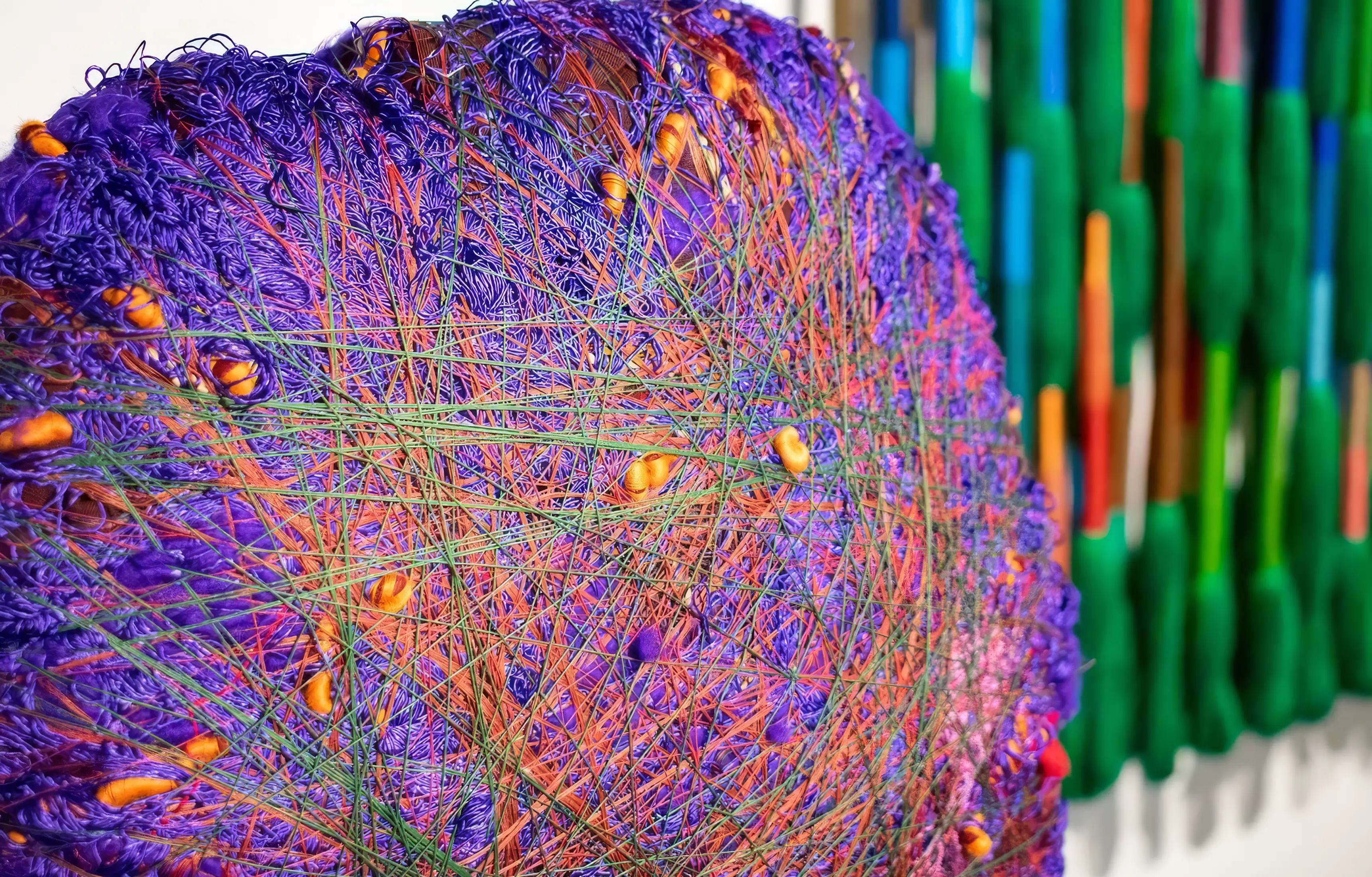
London’s Alison Jacques Gallery brought a group of works by Sheila Hicks, the American fibre artist whose career now runs to seven decades. Hicks studied at Yale School of Art between 1954 and 1959, where her teachers included Josef Albers, the Bauhaus colour theorist whose Interaction of Color was written during those same Yale years. Her thesis, supervised by the archaeologist Junius Bird, was on pre-Incaic Peruvian textiles, and that combination, Albers’s structural colour theory laid over a lifetime’s study of ancient weaving technique, has shaped everything she has made since.

The works at Alison Jacques’s Miami booth were built from bound linen, cotton and wool, twisted and wrapped into forms that sit somewhere between textile and sculpture. Hicks does not treat weaving as a flat, decorative discipline. She builds with fibre the way a sculptor builds with clay or bronze, using the loom, or her own hands, to generate volume, and using colour the way Albers taught her to, as a structural material rather than a surface finish. It is a direct, traceable line from a Bauhaus classroom to a Miami convention centre booth sixty years later, and it is the kind of lineage that makes a fibre-art presentation worth walking past twice.

Alexander Calder and Jean Dubuffet at Helly Nahmad Gallery
Helly Nahmad Gallery’s New York outpost brought a booth built around two very different mid-century figures. Alexander Calder’s sculptural mobiles, suspended constructions of painted metal and wire balanced to move on their own currents of air, turn the gallery wall’s usual stillness into something closer to weather. A Calder mobile is never finished in the way a painting is finished. It keeps composing itself, and no two visitors to the booth saw quite the same arrangement of its parts.

Alongside the mobiles, the gallery showed Jean Dubuffet’s Ciseaux I, a 1966 canvas from the French artist’s mature period. Dubuffet spent the 1960s developing Hourloupe, a visual language of interlocking cellular forms in red, white, blue and black that he applied across painting, sculpture and eventually architecture. Ciseaux I sits inside that project, a single canvas doing, in two dimensions, what Calder’s mobiles were doing in three: building a system that keeps generating new relationships between its own parts rather than settling into one fixed image.

Daniel Arsham and Georges Mathieu at Perrotin
Perrotin’s booth carried the fair’s most direct engagement with the idea of erosion, and it belonged to Daniel Arsham. His Blue Calcified Crystal Venus de Milo is part of a body of work in which Arsham recasts recognisable objects, classical statuary, and increasingly the everyday artefacts of the late twentieth century, as though they had been recovered centuries from now, worn away by mineral growth. The technique starts with an accurate cast, often taken from museum moulds and 3D scans of the original object, built in hydrostone. Arsham then works the surface by hand, opening it up to reveal seams of blue calcite, selenite, quartz and rose quartz beneath, so that the finished piece reads as a fossil of itself: a recognisable form caught mid-transformation into something closer to geology.

Applied to the Venus de Milo, one of the most reproduced images in Western art, the effect is pointed. Arsham is not eroding an object. He is eroding an object everyone already carries a mental copy of, and the crystal growth breaking through its surface asks what happens to an image that familiar once real time, rather than reproduction, is allowed to act on it.
Perrotin’s booth also included a 1962 canvas by Georges Mathieu, the French painter whose rapid, gestural application of paint direct from the tube, often completed in front of an audience, helped define European lyrical abstraction in the years after the war. Mathieu worked at speed and worked once: a canvas either arrived in a single continuous session or it did not exist. Placed a few metres from Arsham’s slow-motion erosion, the pairing gave the booth its own internal argument about tempo, one artist compressing years of geological change into an object, the other compressing an entire painting into an afternoon.
The banana: Maurizio Cattelan’s Comedian
The work that ended up defining the week was smaller than any of those. Comedian, unveiled at Perrotin’s booth, was a single banana, bought from a shop near the convention centre and fixed to the wall with a strip of silver duct tape. Cattelan made it in an edition of three, plus two artist’s proofs, priced at $120,000 each. Two editions sold on the fair’s opening days, one of them to Sarah Andelman, the founder of the Paris concept store Colette, in her first major art purchase. A third was reserved for a museum, with institutions understood to be in discussion.

On Saturday 7 December, the fair’s second public day, the performance artist David Datuna approached the wall at around 1.45pm, peeled the banana from its tape, and ate it in front of the crowd. He filmed the act and posted it, captioned: “I love Maurizio Cattelan artwork and I really love this installation. It’s very delicious.” Security escorted him away, but Galerie Perrotin chose not to press charges. Emmanuel Perrotin, the gallery’s founder, returned from the airport when he heard what had happened, and the booth was restocked from a spare banana kept in reserve for exactly this possibility. Lucien Terras, the gallery’s director of museum relations, gave the line that ended up doing more explaining than any review could have: “He did not destroy the art work. The banana is the idea.”
That distinction is the whole piece. What a collector actually owns is the certificate of authenticity that comes with each edition, along with instructions for sourcing and replacing the fruit whenever it ripens past use, not the banana itself. Eating it did not destroy the artwork, because the object on the wall was always a stand-in for an idea that lives in the paperwork rather than the fruit. Datuna’s performance was, if anything, the fastest possible demonstration of that structure.

neugerriemschneider
It also fit a pattern in Datuna’s own practice that got little attention amid the coverage. The New York-based artist had built a career on works that use one object to stand in for a much larger, harder-to-picture idea, most notably his Viewpoint of Millions series, portraits and flags assembled from thousands of pairs of glasses, and a large public installation staged near Trump Tower and the White House in 2016. Eating Comedian was consistent with that practice: another work built from consuming, literally this time, one small object to make a point about a much bigger one. “It’s not a banana, it’s a concept,” Datuna said afterwards. “I just ate the concept of the artist.” Perrotin removed the installation from the booth on Sunday morning, citing the safety of the crowds it kept drawing.
The story did not end in Miami. Comedian has been restaged since, including a run at the Guggenheim Museum in New York, and in November 2024 an edition sold at Sotheby’s for $6.24 million to the entrepreneur Justin Sun, who ate it too, five years after Datuna and on the other side of the world. Two people, two continents, one idea, eaten twice. It is difficult to imagine a cleaner proof of Perrotin’s point than the work surviving its own consumption not once but twice, and rising in value each time.
Olafur Eliasson, Ai Weiwei and Michel Majerus at neugerriemschneider
Berlin’s neugerriemschneider, founded by Tim Neuger and Burkhard Riemschneider in 1994, has represented Olafur Eliasson and Ai Weiwei since near the start of both artists’ international careers, and its Miami booth put them together with the German painter Michel Majerus. Eliasson showed Your Vanishing, one entry in a body of work whose titles almost always begin with the word “Your”, a habit that is itself a small piece of design thinking. Eliasson’s subject across three decades has been perception rather than object: light, colour, glass and mirrored surfaces arranged so that what the viewer notices is their own act of looking. Naming the work “yours” before the viewer has even seen it makes that argument before the piece is switched on.

Ai Weiwei showed Strength, continuing an inquiry that has run through his work since the aftermath of the 2008 Sichuan earthquake, when he began using salvaged rebar and other structural materials as a way of making political and physical pressure visible in gallery form. Majerus, who died in a plane crash in 2002 at thirty five, was showing work from a body of painting that fused advertising graphics, early video game aesthetics and gestural abstraction years before that combination became a familiar strategy for a younger generation of painters. Placed together, the three artists gave the booth its own version of the fair’s wider theme: perception, material history and pop imagery, three different ways of asking what an object actually carries once you stop looking at its surface.

Pilar Corrias: Philippe Parreno, Elizabeth Neel and Cui Jie
London’s Pilar Corrias filled its booth’s ceiling with Philippe Parreno’s Speech Bubbles (Transparent Orange), an edition of around 1,500 orange Mylar balloons filled with helium and left to drift against the convention centre’s roof. The balloons are a recurring form in Parreno’s practice, cartoon speech marks turned into architecture, floating text with nothing written in it, and a Miami crowd walking beneath them became, briefly, the caption the piece never supplied for itself.

The rest of the booth carried Elizabeth Neel’s paintings, built from layered, wiped and re-scraped passages of oil paint that hold the memory of an earlier version of the canvas underneath the finished one, and Cui Jie’s paintings of modernist architecture, elongated, slightly distorted views of Brutalist and late-Soviet tower blocks from Shanghai and beyond that treat a building’s silhouette the way a portrait treats a face. Cui Jie trained as a painter but her real subject is architectural history, and her presence in a booth otherwise built around balloons and gestural abstraction gave the space a third register: buildings, rather than bodies or ideas, as the thing worth looking closely at.

What the eighteenth edition actually argued
Put those booths next to each other and 2019 stops looking like the year of the banana and starts looking like the year a genuine number of the fair’s strongest presentations were, in their own ways, about the gap between an object and what it is meant to carry. Arsham cast that gap in geological time. Calder cast it in moving air. Eliasson cast it in the act of looking. Parreno cast it in helium, a material that is, by definition, already leaving. Cattelan simply cast it in fruit, and let a hungry artist close the gap in under two minutes, in public, on camera.
Art Basel’s programming has continued to develop that instinct for giving ideas room to work at scale. Later editions of the Miami fair built out sector-specific programming such as Meridians, a section given over entirely to large-format work that will not fit inside a standard booth, extending the same appetite for ambition that the 2019 edition’s best presentations were already showing gallery by gallery.

Alison Jacques Gallery
Final thoughts
The banana will always be the fact that Art Basel Miami Beach 2019 is remembered for, and there is no reason to argue with that. It is a genuinely good story, honestly told: a $120,000 artwork, a hungry performance artist, a director explaining calmly that nothing had been destroyed, and a piece that has since sold for over six million dollars and been eaten a second time on the other side of the world. But the edition that produced it also produced Sheila Hicks’s direct line back to a Bauhaus classroom, Daniel Arsham’s slow-motion erosion of the most reproduced sculpture in Western art, and Philippe Parreno’s ceiling of balloons standing in for words nobody had to write. Look at the booths around the banana, and 2019 reads less like a punchline and more like a fair where a genuine number of its best galleries had, independently, arrived at the same question: what survives when the object is gone, and the idea is all that is left.
When did Art Basel Miami Beach 2019 take place?
The fair’s VIP preview was held on 4 December 2019, with public days running from 5 to 8 December 2019 at the Miami Beach Convention Center. It was the eighteenth edition of the fair’s Miami Beach event.
How many galleries exhibited at Art Basel Miami Beach 2019?
269 galleries from 29 countries exhibited, and close to 80,000 visitors attended across the week, with organisers reporting attendance up on the previous year.
What was Maurizio Cattelan’s Comedian?
Comedian was a single banana taped to a wall with silver duct tape, made in an edition of three plus two artist’s proofs and priced at $120,000 each. It was shown at Galerie Perrotin’s booth and drew international attention when performance artist David Datuna ate one edition on 7 December 2019.
Why did David Datuna eat the banana?
Datuna described the act as his own performance work, consistent with a career built on pieces that use one object to stand in for a larger idea. He said the banana was “the idea” rather than the artwork itself, a distinction the gallery’s own director agreed with.
What is Daniel Arsham’s calcified sculpture technique?
Arsham casts recognisable objects, from classical statues to everyday artefacts, in hydrostone using museum moulds or 3D scans, then works the surface by hand to expose seams of blue calcite, selenite, quartz or rose quartz, so the finished piece reads as though it has eroded over geological time.

Leave a Reply