
GodskDanish Artist & Seventh-Generation Traveller
Northern Jutland, DenmarkJune 2026

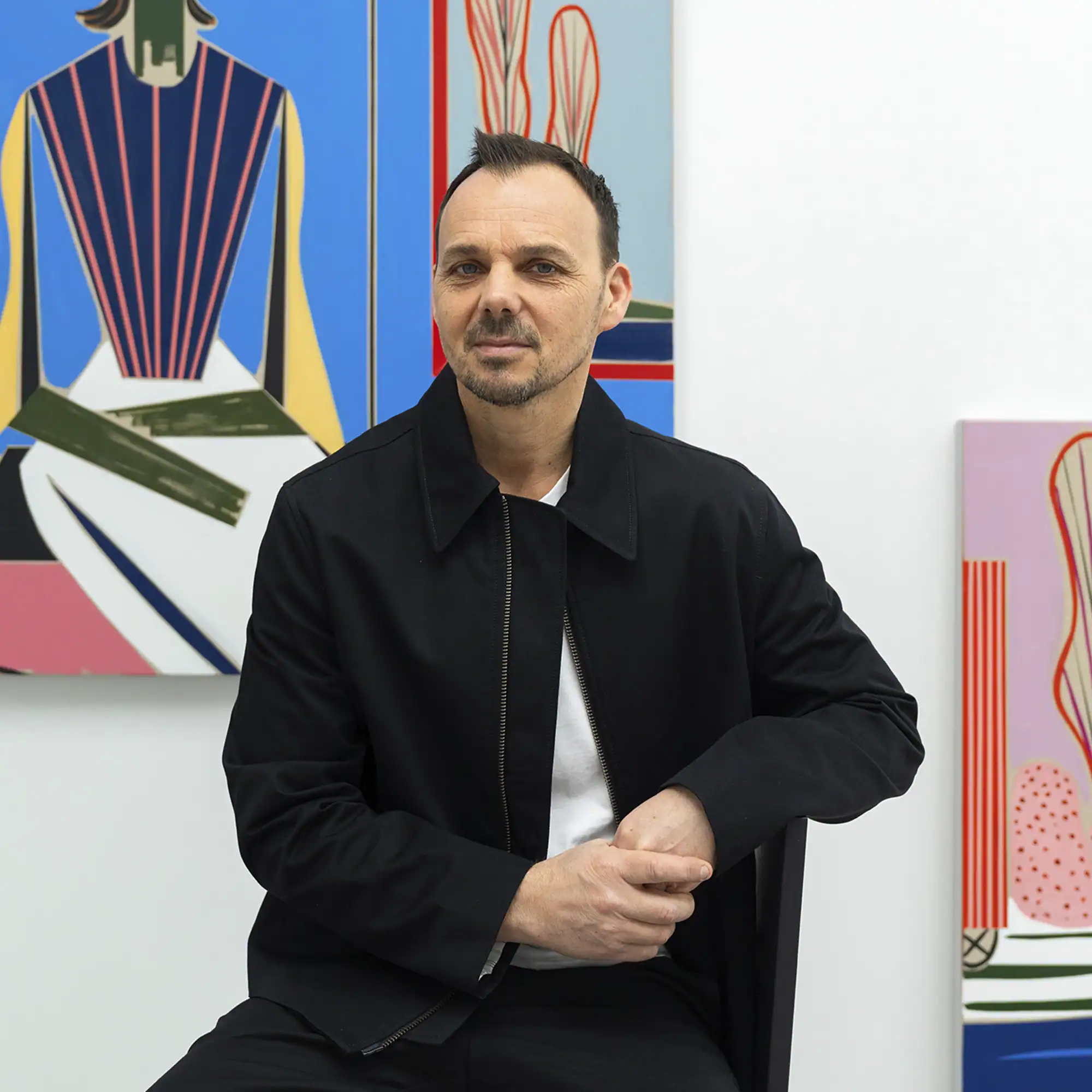
Few contemporary painters draw upon such a distinctive combination of cultural heritage, craftsmanship and art historical reference as Danish artist Henrik Godsk. A seventh-generation traveller whose earliest artistic education came through painting fairground facades, Godsk has developed a visual language that bridges geometric abstraction, portraiture and decorative tradition. His paintings, populated by enigmatic figures suspended between past and present, combine the formal rigour of Cubism and Modernism with influences drawn from medieval murals, Baroque portraiture and the visual culture of travelling fairs.
In this interview, Henrik Godsk discusses the evolution of his distinctive visual language, the influence of his traveller roots, the role of geometry and constraint within his creative process, and how history, place and personal narrative continue to shape his work today.
I have always been interested in the human form. My first canvases, which I did as a young teenager, were imaginary portraits. They were a little more representational at the beginning, but they gradually became very simplified and abstract. The face, and then the entire human body, became a vessel for my exploration of form and colour. Only the essential elements have been retained; everything else has been omitted. No ears, hands, nothing. They have always been very understated. Frozen in time. Emotions are kept under the surface, you might say. But I have found that they have a human presence. They often refer to some of my ancestors, but they generally represent something universal.

My family tree can be traced back seven generations, but it really dates back several centuries. My great-great-great-grandfather, Heinrich Christoffer Hertzberg, arrived in Denmark in the mid-1850s. Accordingly, I call myself a seventh-generation traveller.
I grew up with geometric abstraction as part of my visual vocabulary. From the very beginning, I drew triangles and other geometrical shapes. I often say that this early training taught me to look at the world in geometric shapes. It has become part of my visual DNA. Given that we were decorating panels and facades, which are often seen from a distance and should work both day and night, we used bright colours and contrasts, mixed with a field of neutral greys and soft blues. All of this has affected my visual vocabulary to this day.

My visual language has developed over time. Earlier, I was more conscious about the specific references. Now, it sort of just happens. I never considered myself a playful postmodernist who would invoke art history to raise questions about authenticity; I am aware of the shoulders that I am standing on. The periods that I reference are the ones that I am drawn to.


A short answer would be that it comes natural to me.
I think they were a lot more androgynous a few years back. And yet they still do not seem like particular people. It is important to me that the story is open-ended and universal. I’m trying to create a pictorial universe that I do not fully understand myself, where new narratives flourish. I am attracted to mystery and ambiguity.

Geometry works as a way for me to create order. I rely on very few geometrical elements combined with a few organic flourishes. It is very restrictive in its own way. I find freedom in constraint. I am not allowed to do much, but those limitations give me the freedom to really concentrate on the few decisions that I can make. I like to make order out of things. It calms me down.
Through academia, I became more conscious of my choices and approach as a painter. My field of interest focused on modernism, postmodernism, and post-irony in literature, while I had an eye on art history and philosophy at the same time. I was very inspired by the generation of writers headed by David Foster Wallace, who attempted to come up with a literary solution to the endgame of postmodernism. What are we left with when all grand narratives have been broken down? Is communication possible without transcendent signifiers?
Inspired by this, I sharpened my pen and focused on creating a visual language that had its own logic. I wanted to make order out of things. I wanted to create a pictorial universe that was calming. It was not a naive return to modernism, but rather an attempt to create a pictorial universe that points to its own constructedness while attempting to be honest and calming at the same time.


I was always much more drawn to the aesthetics of antique carousels and rides than the more modern versions. The former was characterised by restraint, patterns and refinement, while the latter is much more overt and spectacular. In addition, before the facades are mounted, many rides and fair installations look like formalist sculptures. Most people never really experience a fair like that. I always preferred it before all the facades had been mounted and the lights were turned on.
From my studio, I can see a big green field with cows on it. Not so far from here, there is a big forest with a lake where we often go for walks. It is very calming. I think it reflects in my work. I go to different places in the world 8–10 times a year for shows. Mostly big cities. Other than that, I live and work away from the noise. It is very healthy for me as a person, and it gives me time to focus on my work.
Interestingly, I am working on a show that focuses on the forest and the lake mentioned above. It is titled “The Lake” and will be shown at Vigo Gallery in May. A century ago, eight of the largest traveller families in Denmark lived side by side around this lakeside in their wagons. For the travellers, the lake served as a temporary sanctuary where they could stay between touring with their funfairs and circuses. The Hertzberg family, to which I belong, had their spot near the top of the lake. Every time I go there, I think of them.
 All images courtesy of Henrik Godsk
All of the above. I am very proud of my family history and the culture it represents. Traveller culture is not really a part of the history books in Denmark. A few publications can be found, but it is almost a hidden story. I hope that I can help put more focus on the culture I come from.
Having said that, my work is about much more than my cultural heritage, and I hope that my paintings can be appreciated as aesthetic explorations of the human condition.



Leave a Reply