
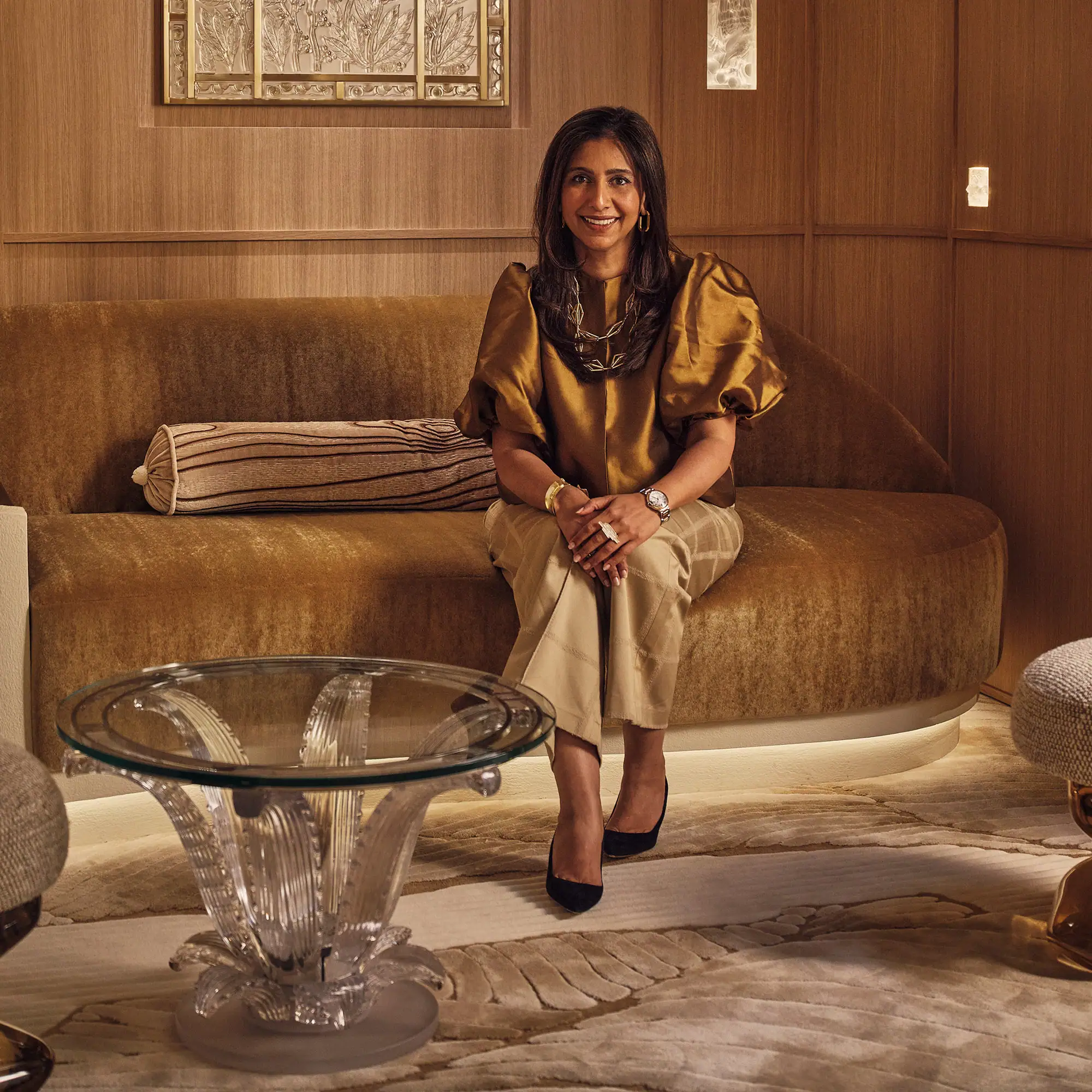
London, UK AUGUST 2026
Charu Gandhi trained as an architect before she ever specified a fabric swatch, qualifying with the RIBA and ARB, working at Allies & Morrison from 2006 and teaching at the Architectural Association, before four years with the Candy & Candy group took her across South Asia and Africa. In 2014 she drew on that grounding to found Elicyon, building a Kensington studio that has grown to around forty people and completed more than ninety projects across fifteen countries, from London townhouses to a four-floor, 16,000-square-foot home in Dubai finished in chamfered edges, pearlescent plaster and mother-of-pearl. This summer she turned her attention to Chelsea Harbour, designing a Lalique-clad bar for WOW!house 2026 that she called “a modern box of delights”, built from crystal, bespoke joinery and backlit niches for a space designed to be experienced in minutes rather than lived in for years.
In this interview, Charu talks about the architectural instincts that still shape how she reads a room, why Elicyon has deliberately avoided a house style, and how craftsmanship is becoming her studio’s answer to an increasingly accelerated world.
 From Elicyon’s family villa in Umm Al Sheif, Dubai. Photography by Sergei Nekrasov.
My background in architecture fundamentally shaped the way I approach interiors. From the beginning, I was fascinated by how people move through spaces and how the built environment influences behaviour, emotion and wellbeing. Rather than seeing interiors as a decorative layer, I have always viewed them as an extension of architecture.
Over time, working across different countries and cultures reinforced the importance of proportion, light and materiality. What interests me most is creating spaces that feel emotionally intuitive. At Elicyon, our work isn’t defined by a house style. We are always driven by how a space feels to inhabit, rather than simply how it appears.
 Elicyon’s Lalique home bar at WOW!house 2026, Design Centre Chelsea Harbour.
Our philosophy centres on creating balance between generosity and intimacy. We often work with large-scale homes, yet our objective is always to ensure they feel welcoming and human.
In a residential project in Dubai, for example, chamfered edges, curved forms and subtle pearlescent finishes recur throughout the home, creating a visual language that quietly connects four floors and over 16,000 square feet.
Light is equally important. We design around the way natural light changes throughout the day, then layer artificial lighting to create depth and atmosphere. Materiality is never applied superficially; it is used to create contrast, texture and sensory richness, allowing spaces to reveal themselves gradually.
 From Elicyon’s Mayfair Garden Escape Home.
If we want a space to feel calm, we might focus on tonal harmony, softened edges, layered textures and a controlled material palette. For example in the Dubai project, we used colours such as pistachio, celadon green and soft ivory to create a sense of tranquillity throughout the principal entertaining spaces.
Warmth often comes from material choices such as timber flooring, handcrafted finishes and tactile fabrics. We carefully edit spaces so that moments of detail and craftsmanship have room to breathe. The most successful interiors rarely rely on a single gesture; they are the result of many considered decisions working together.
 From Elicyon’s family villa in Umm Al Sheif, Dubai. Photography by Sergei Nekrasov.
Materials are one of the most powerful storytelling tools available to designers because they engage multiple senses simultaneously.
Here, in this Dubai project, we used materials to communicate refinement through subtlety rather than extravagance. Mother-of-pearl, hand-finished plaster, figured veneers, woven metals and Japanese washi panels were layered throughout the home, creating depth and texture while maintaining a sense of calm.
I am particularly drawn to combinations that balance natural and crafted elements — stone alongside hand-applied finishes, or highly detailed artisan work paired with restrained architectural forms.
The most successful projects are always collaborative. Clients come to us because they want expertise, but equally our role is to listen and understand what matters most to them.
A brief becomes a dialogue almost immediately. We often uncover opportunities and aspirations that weren’t articulated at the outset. Through discussion, trust develops, allowing both client and designer to challenge assumptions and refine ideas together.
Our goal is never to impose a signature style. Instead, we create a bespoke response that reflects the client’s lifestyle and ambitions while benefiting from our experience and perspective.
 From Elicyon’s Mayfair Garden Escape Home.
Residential projects are deeply personal and often centre around comfort, privacy and emotional connection. Hospitality spaces must create memorable experiences for a broad audience while maintaining operational efficiency. Commercial environments increasingly need to support collaboration, wellbeing and flexibility.
What remains constant is our focus on human experience. Whether someone spends ten minutes in a space or ten years, we consider how they move through it, how they interact with others, and how the environment influences their mood.
 From Elicyon’s family villa in Umm Al Sheif, Dubai. Photography by Sergei Nekrasov.
Designing internationally requires a deep understanding of local lifestyles and cultural nuances. In the UAE, for example, entertaining often plays a much more significant role in family life, and homes need to accommodate both large gatherings and multi-generational living. Our residential project in Dubai shows this through its multiple formal and informal entertaining spaces, extensive guest accommodation and carefully zoned family areas.
Climate also influences material choices, spatial planning and the relationship between indoor and outdoor spaces. However, regardless of location, our objective remains the same: to create environments that feel authentic to the people who live within them rather than importing a design language from elsewhere.
 Elicyon’s Lalique home bar at WOW!house 2026, Design Centre Chelsea Harbour.
The challenge is creating a strong emotional impact within a very short encounter. Every element has to work harder, from the architecture and lighting through to the detailing and material palette. That said, I approach show spaces in much the same way as residential projects. Even within a temporary environment, I want visitors to imagine themselves inhabiting the space.
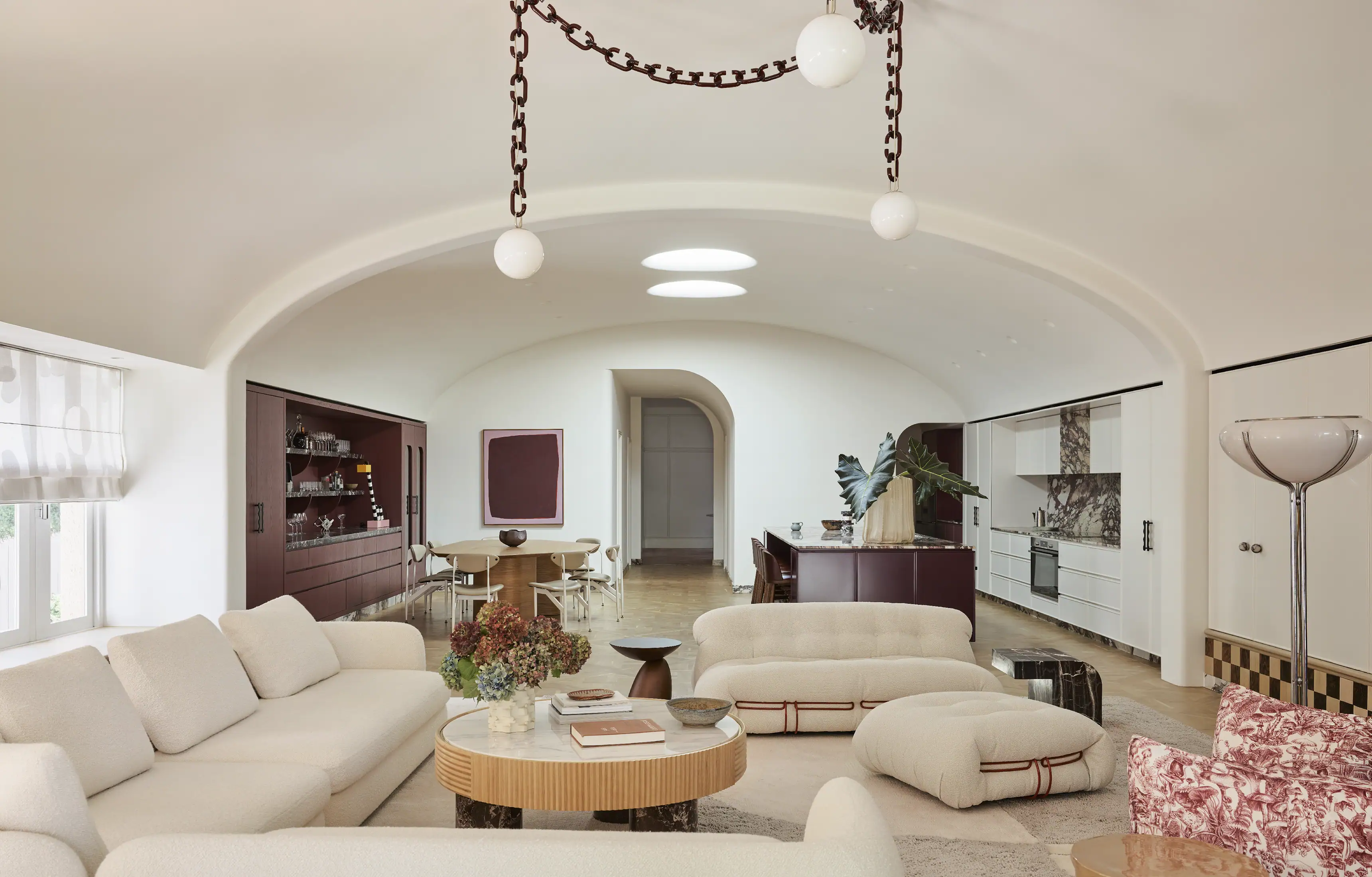
 From Elicyon’s show residence at Chelsea Barracks.
We are increasingly interested in projects where architecture, interiors and experience design intersect. Hospitality continues to be an exciting area for us because it allows us to shape entire journeys rather than individual rooms.
We are also seeing growing demand for wellness-focused environments and homes that support multiple generations under one roof, which presents fascinating spatial challenges.
More broadly, I am interested in exploring how craftsmanship can be integrated into contemporary design in increasingly meaningful ways. As technology accelerates, there is something incredibly valuable about creating spaces that celebrate human skill, material authenticity and a sense of permanence. Those qualities will continue to define the future direction of our practice.
 From Elicyon’s show residence at Chelsea Barracks.
I would like to thank Charu Gandhi for such a considered conversation about the thinking behind Elicyon’s work, from the architectural instincts that inform every brief to the studio’s insistence on craftsmanship over any single house style. Her Lalique bar for this year’s WOW!house condensed that thinking into a few square metres rather than a family home, and offered a rare glimpse of Elicyon’s range beyond the residential work for which the studio is best known.
Further reading: Elicyon’s Dubai Family Villa is organised around two majlises, WOW!house 2026: Inside Design’s Most Immersive Showhouse and Chelsea Barracks: Elicyon Build the Site’s Own History Into a Show Residence.


Leave a Reply